
Catalogue Search | MBRL


Are you sure you want to remove the book from the shelf?

{{itemTitle}}
349
result(s) for
"Autochtones Droits."
Sort by:


Protection of first nations cultural heritage : laws, policy, and reform
No detailed description available for \"Protection of First Nations Cultural Heritage\".
eBook

From where I stand : rebuilding Indigenous Nations for a stronger Canada
\"From Where I Stand is a timely, forthright, and optimistic book for all Canadians. Drawn from speeches made over a ten-year period both at home and abroad, Jody Wilson-Raybould reveals why true reconciliation will occur only when Canada moves beyond denial, recognizes Indigenous Rights, and replaces the Indian Act. We have the solutions. Now is the time to end the legacy of colonialism and replace it with a future built on foundations of trust, cooperation, and Indigenous self-government.\"-- Provided by publisher.
Book
The Neoliberal State, Recognition and Indigenous Rights
The impact of neoliberal governance on indigenous peoples in liberal settler states may be both enabling and constraining. This book is distinctive in drawing comparisons between three such states—Australia, Canada and New Zealand. In a series of empirically grounded, interpretive micro-studies, it draws out a shared policy coherence, but also exposes idiosyncrasies in the operational dynamics of neoliberal governance both within each state and between them. Read together as a collection, these studies broaden the debate about and the analysis of contemporary government policy.The individual studies reveal the forms of actually existing neoliberalism that are variegated by historical, geographical and legal contexts and complex state arrangements. At the same time, they present examples of a more nuanced agential, bottom-up indigenous governmentality. Focusing on intense and complex matters of social policy rather than on resource development and land rights, they demonstrate how indigenous actors engage in trying to govern various fields of activity by acting on the conduct and contexts of everyday neoliberal life, and also on the conduct of state and corporate actors.
eBook

Rooted : the American legacy of land theft and the modern movement for Black land ownership
Why is less than 1% of rural land in the U.S. owned by Black people? An acclaimed writer and activist explores the impact of land theft and violent displacement on racial wealth gaps, arguing that justice stems from the literal roots of the earth. To understand the contemporary racial wealth gap, we must first unpack the historic attacks on Indigenous and Black land ownership. From the moment that colonizers set foot on Virginian soil, a centuries-long war was waged, resulting in an existential dilemma: Who owns what on stolen land? Who owns what with stolen labor? To answer these questions, we must confront one of this nation's first sins: stealing, hoarding, and commodifying the land. Research suggests that between 1910 and 1997, Black Americans lost about 90% of their farmland. Land theft widened the racial wealth gap, privatized natural resources, and created a permanent barrier to access that should be a birthright for Black and Indigenous communities. Rooted traces the experiences of Brea Baker's family history of devastating land loss in Kentucky and North Carolina, identifying such violence as the root of persistent inequality in this country. Ultimately, her grandparents' commitment to Black land ownership resulted in the Bakers Acres--a haven for the family where they are sustained by the land, surrounded by love, and wholly free. A testament to the Black farmers who dreamed of feeding, housing, and tending to their communities, Rooted bears witness to their commitment to freedom and reciprocal care for the land. By returning equity to a dispossessed people, we can heal both the land and our nation's soul.
Book

Shifting boundaries : aboriginal identity, pluralist theory, and the politics of self-government
Using relational pluralism as a theoretical lens, the author takes a fresh look at the complex issue of aboriginal self-government.
eBook

International Law and Indigenous Knowledge
InInternational Law and Indigenous Knowledge, Chidi Oguamanan argues that Indigenous knowledge has posed a crisis of legitimacy for the intellectual property system that calls for a rethinking of the intellectual property jurisprudence in a cross-cultural direction.
eBook
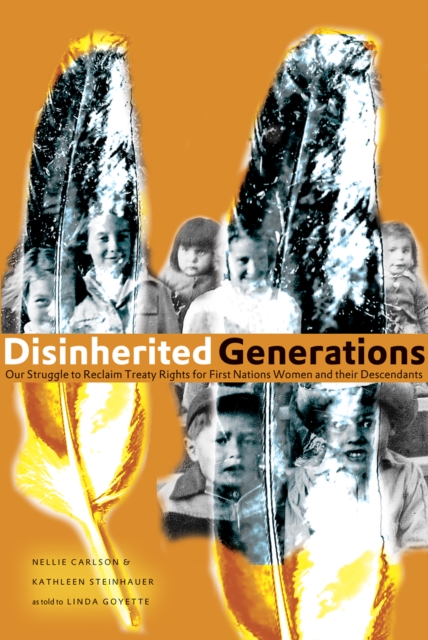
Disinherited Generations
This oral autobiography of two remarkable Cree women tells their life stories against a backdrop of government discrimination, First Nations activism, and the resurgence of First Nations communities. Nellie Carlson and Kathleen Steinhauer, who helped to organize the Indian Rights for Indian Women movement in western Canada in the 1960s, fought the Canadian government's interpretation of treaty and Indigenous Rights, the Indian Act, and the male power structure in their own communities in pursuit of equal rights for Indigenous women and children. After decades of activism and court battles, First Nations women succeeded in changing these oppressive regulations, thus benefitting thousands of their descendants. Those interested in human rights, activism, history, and Indigenous Studies will find that these personal stories, enriched by detailed notes and photographs, form a passionate record of an important, continuing struggle.
eBook

Aboriginal title and indigenous peoples : Canada, Australia, and New Zealand
Offers a perspective on Aboriginal title and land rights that extends beyond national borders and the contemporary context to consider historical developments in common law countries.
eBook

The Origins of Indigenism
\"International indigenism\" may sound like a contradiction in terms, but it is indeed a global phenomenon and a growing form of activism. In his fluent and accessible narrative, Ronald Niezen examines the ways the relatively recent emergence of an internationally recognized identity—\"indigenous peoples\"—intersects with another relatively recent international movement—the development of universal human rights laws and principles. This movement makes use of human rights instruments and the international organizations of states to resist the political, cultural, and economic incursions of individual states. The concept \"indigenous peoples\" gained currency in the social reform efforts of the International Labor Organization in the 1950s, was taken up by indigenous nongovernmental organizations, and is now fully integrated into human rights initiatives and international organizations. Those who today call themselves indigenous peoples share significant similarities in their colonial and postcolonial experiences, such as loss of land and subsistence, abrogation of treaties, and the imposition of psychologically and socially destructive assimilation policies. Niezen shows how, from a new position of legitimacy and influence, they are striving for greater recognition of collective rights, in particular their rights to self-determination in international law. These efforts are influencing local politics in turn and encouraging more ambitious goals of autonomy in indigenous communities worldwide.
eBook