
Catalogue Search | MBRL


Are you sure you want to remove the book from the shelf?

{{itemTitle}}
11
result(s) for
"Autoimmune diseases Fiction."
Sort by:

Bubble
Orphaned eleven-year-old Joe lives in a hospital due to his autoimmune disease, interacting only with his sister, an American boy with the same illness, and medical staff while dreaming of being a superhero.
Book

The Fractured Self: Exploring Selfhood in the Neuronovel The Echo Maker and the Neuromemoir Brain on Fire
This paper will focus on two works: the neuronovel The Echo Maker (2006) by Richard Powers, a fictional account of Mark Schluter who suffers from Capgras Syndrome, that is, a rare neurological condition that results in the patient’s belief that their loved ones have been replaced with exact copies; and the neuromemoir Brain on Fire: My Month of Madness (2012) by Susannah Cahalan, which describes Cahalan’s experiences as she is diagnosed with anti-NMDA receptor encephalitis, a rare auto-immune disease. Both works have protagonists that suffer from a serious brain illness and must rely on their own perceptions, those of family and friends, and neuroscientific research in order to heal and create a more cohesive sense of self again. I argue that The Echo Maker and Brain on Fire complicate the perception of selfhood as the main character in each text can no longer trust their own perceptions and must instead weave together their fragmented personal experience, background from their social groups, and scientific explanations of their conditions to regain a sense of self. The narratives of The Echo Maker and Brain on Fire combine these different perspectives in an effort to regain a sense of selfhood that brain damage has fractured. While the result of the connections of millions of neurons is a smooth and linear perception of the self and the world around us, neuronarratives can complicate this process by revealing the divisions and occasional contradictions that occur in the combination.
Journal Article
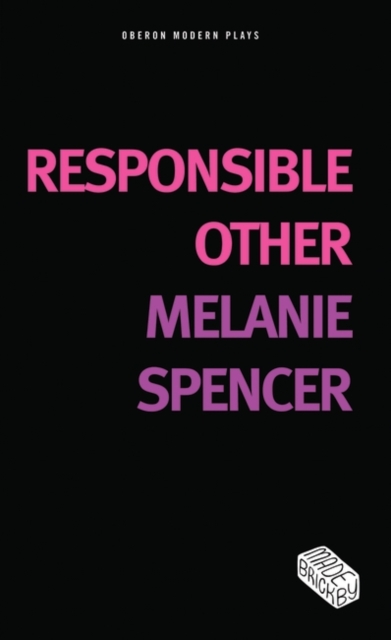
Responsible Other
Daisy is sixteen. She was normal. Now she's just an ill person with a disease no one has heard of. The hospital tells her father Peter that she must travel regularly to London for specialist treatment – but how on earth will he get time off work? There's one person he could ask for help. Problem is, Daisy's not going to like it… Responsible Other is a bittersweet comedy which examines the complexities of family life.
eBook

Autoimmune Illness as a Death-drive: An Autobiography of Defence
This essay returns Derrida's metaphor of autoimmunity to its biomedical origins and explores how various autobiographical narratives of autoimmune disease can provide a novel reading of Derrida's deconstruction of the Freudian death-drive. I argue that Derrida's autoimmunity autoimmunely secures the risks of psychoanalysis, science, science fiction, and deconstruction itself.
Journal Article

Anachronistic Reading
A poem encrypts, though not predictably, the effects it may have when at some future moment, in another context, it happens to be read and inscribed in a new situation, in 'an interpretation that transforms the very thing it interprets', as Jacques Derrida puts it in
Specters of Marx
. In Wallace Stevens's 'The Man on the Dump' (1942), we are told: 'The dump is full/Of images'. The poem's movement is itself a complex temporal to and fro that aims to repudiate and even annihilate these images. This renunciation leaves the man on the dump 'The Latest Freed Man', as the title of another Stevens poem puts it. Like Walter Benjamin's Angel of History, he has his back toward history and has rejected its images in 'disgust' in order to face toward a future that will, he hopes, be purified of ideology. Yet Stevens knows that more such images will come and will need in their turn to be rejected and junked, in an endless task of purification. In a now impossibly outdated way, Stevens nevertheless wanted the poet - that is, himself, the man on the dump - to be the begetter of a new ideology, or a new fiction that would, in a powerful speech act, replace all those outworn images on the dump.
In the context of potentially catastrophic climate change (as the result of something like a global auto-immune disorder), the second part of the essay complements this commentary on the poem with a
free
reading; a performative reading, reading as work or as
oeuvre
that does something with words, for which Jacques Derrida calls. This reading sees Stevens's text as somehow the proleptic foretelling of a present situation. Such future chiming is also, it is argued, a sign to sign relation, an anticipatory allegory or prophecy, or, perhaps, a miniature apocalypse in the etymological sense of an enigmatic unveiling of what has not yet happened.
Journal Article

FLANNERY O’CONNOR
Flannery O’Connor is considered one of America’s greatest fiction writers and one of the strongest apologists for Roman Catholicism in the twentieth century. Born of the marriage of two of Georgia’s oldest Catholic families, O’Connor was a devout believer whose small but impressive body of fiction presents the soul’s struggle with what she called the “stinking mad shadow of Jesus.”
Born in Savannah on March 25, 1925, Mary Flannery O’Connor began her education in the city’s parochial schools. After the family’s move to Milledgeville in 1938, she continued her schooling at the Peabody Laboratory School associated with Georgia State College
Book Chapter
Philadelphia Daily News Tattle column
The Oprah Show Final Season. airs Saturdays and, like other OWN fare, will have frequent repeats. _ Master Class, a series where such boldface names as Diane Sawyer, Simon Cowell, Jay-Z and Condoleezza Rice will show how they're just like the rest of us.
Newsletter