
Catalogue Search | MBRL


Are you sure you want to remove the book from the shelf?

{{itemTitle}}
5,313
result(s) for
"Automatic speech recognition"
Sort by:

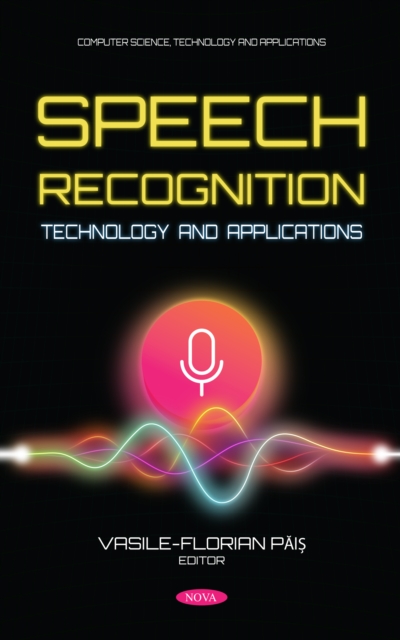
Speech Recognition Technology and Applications
Speech represents the most natural means of communication between humans. By using Automatic Speech Recognition (ASR) and Text-to-Speech (TTS) systems, machines also become able to interact with humans using speech. This is of particular importance for building interactive robots or speech-enabled chatbots. This book starts by exploring state-of-the-art ASR and TTS approaches, making use of artificial neural networks, relevant also to low-resource scenarios. Then, it explores the application of speech technology to specific domains, such as the medical domain, human-robot interaction, and even interlinking of speech and text resources using linguistic linked open data (LLOD) principles. The book also provides punctuation restoration techniques, enabling the production of high-quality text transcripts. Included algorithms have low latency and can be parallelized, thus enabling their use in interactive systems. Chapter authors are professors and scientific researchers with experience in building and using natural language processing algorithms and speech applications.
eBook


Automatic speech recognition for under-resourced languages: A survey
Speech processing for under-resourced languages is an active field of research, which has experienced significant progress during the past decade. We propose, in this paper, a survey that focuses on automatic speech recognition (ASR) for these languages. The definition of under-resourced languages and the challenges associated to them are first defined. The main part of the paper is a literature review of the recent (last 8 years) contributions made in ASR for under-resourced languages. Examples of past projects and future trends when dealing with under-resourced languages are also presented. We believe that this paper will be a good starting point for anyone interested to initiate research in (or operational development of) ASR for one or several under-resourced languages. It should be clear, however, that many of the issues and approaches presented here, apply to speech technology in general (text-to-speech synthesis for instance).
Journal Article

Dragon NaturallySpeaking for dummies
Command your computer, surf the web, create reports, and more-- with your voice! Dragon NaturallySpeaking is a speech recognition program that lets users dictate into any Windows application, allowing you to access documents, write e-mails, and even update Facebook using only your voice.
Book

Real-Time Automatic Continuous Speech Recognition System for Kannada Language/Dialects
In this work, we present recent advancements in our earlier automatic continuous Kannada speech recognition (ACKSR) system under real-time conditions. In our previous research, we collected task-specific Kannada speech data from 2400 speakers in field conditions, proposing a robust noise elimination technique to enhance degraded speech data. The automatic speech recognition models were developed using Kaldi, and experimental results revealed slightly higher word error rates, attributed to the substantial speech data required for training deep neural networks. Building upon these findings, our current work addresses this limitation by expanding the database. We collected continuous Kannada speech data from an additional 300 speakers under real-time conditions. The updated degraded speech database underwent enhancement using the proposed noise elimination technique. The results demonstrate a significant improvement in the performance of the ACKSR system, particularly in terms of speech recognition accuracy compared to our earlier work.
Journal Article

How does voice recognition work?
Introduces readers to the software that allows jet pilots to speak to their planes, smartphone users to make a hands-free call, and automated phone systems to give bank account information.
Book

Challenges and Limitations in Speech Recognition Technology: A Critical Review of Speech Signal Processing Algorithms, Tools and Systems
Speech recognition systems have become a unique human-computer interaction (HCI) family. Speech is one of the most naturally developed human abilities; speech signal processing opens up a transparent and hand-free computation experience. This paper aims to present a retrospective yet modern approach to the world of speech recognition systems. The development journey of ASR (Automatic Speech Recognition) has seen quite a few milestones and breakthrough technologies that have been highlighted in this paper. A step-by-step rundown of the fundamental stages in developing speech recognition systems has been presented, along with a brief discussion of various modern-day developments and applications in this domain. This review paper aims to summarize and provide a beginning point for those starting in the vast field of speech signal processing. Since speech recognition has a vast potential in various industries like telecommunication, emotion recognition, healthcare, etc., this review would be helpful to researchers who aim at exploring more applications that society can quickly adopt in future years of evolution.
Journal Article
Efficient Speech Enhancement Using Recurrent Convolution Encoder and Decoder
The accuracy of voice or speech recognition is affected due to the presence of various background noises present in the surroundings. Automatic Speech Recognition communication systems are utilized for enhancing the speech by either reducing or eliminating the surrounding noises. The corrupted speech signals are enhanced by using different techniques. In this paper, Recurrent Convolutional Encoder-Decoder (R-CED) network is proposed for enhancing the speech by the elimination of noise signals. The efficiency of the proposed work is determined by comparing the performance metrics like PESQ, STOI and CER with various existing techniques. From the results obtained, it can be confirmed that the efficiency of proposed R-CED is higher and optimal when compared to the existing techniques.
Journal Article