
Catalogue Search | MBRL


Are you sure you want to remove the book from the shelf?

{{itemTitle}}
3
result(s) for
"Automedon"
Sort by:

Two Unnarrated Stories in Horace's Roman Odes (Carm. 3.2.1–12 and 3.6.21–32): Echoes of Vergil's Unfinished Aeneid and a Lowlife Epigram
Within the rhetorical frameworks of exhortation and illustrative exemplum, Horace's second and sixth Roman Odes offer compressed, contrasting images of a young person's education and transformation, presenting these as stories about a puer and a virgo, respectively, in a lyric mode that does not narrate. In the first of these stories (Carm. 3.2.1–12), Horace slyly usurps characters from Vergil's unfinished Aeneid, alluding to some of its distinctive narrative techniques, but also draws on the similes and plot structure of its Iliadic model. The second of Horace's stories (Carm. 3.6.21–32) plays off his first, as he converts the adulta virgo who figures in Carm. 3.2 into her antitype. This story has as its intertext an obscene Hellenistic epigram by Automedon. Horace makes both intertextual and metatextual use of his models, while his indirect references, through Homer, to Vergil's intended design for his emerging Aeneid may be considered under the new heading of extratextual.
Journal Article
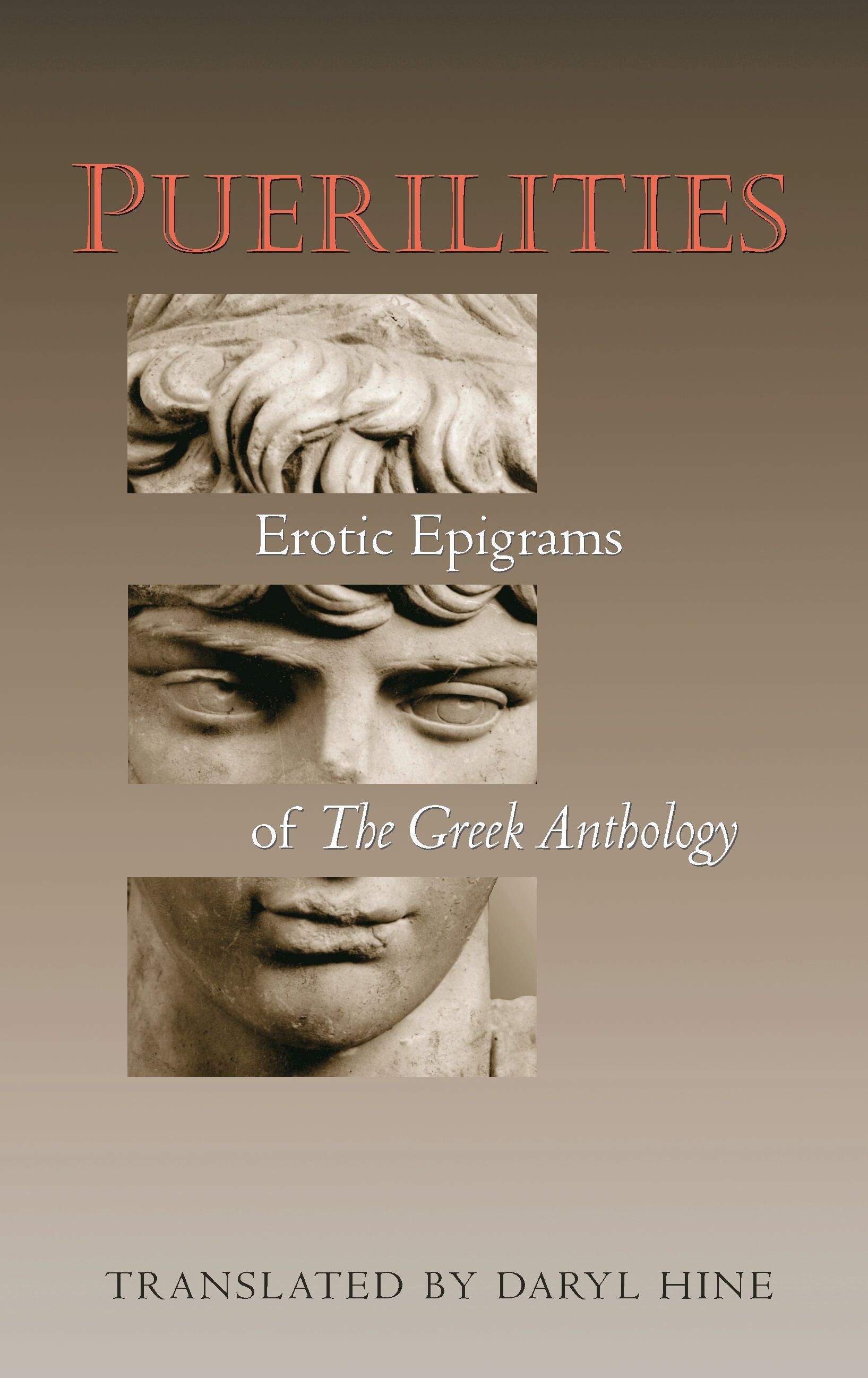
Puerilities
Elegiac lyrics celebrating the love of boys, which the translator termsPuerilities, comprise most of the twelfth book ofThe Greek Anthology. That book, the so-calledMusa Puerilis, is brilliantly translated in this, the first complete verse version in English. It is a delightful eroticopia of short poems by great and lesser-known Greek poets, spanning hundreds of years, from ancient times to the late Christian era.
The epigrams--wry, wistful, lighthearted, libidinous, and sometimes bawdy--revel in the beauty and fickle affection of boys and young men and in the fleeting joys of older men in loving them. Some, doubtless bandied about in the lax and refined setting of banquets, are translated as limericks. Also included are a few fine and often funny poems about girls and women.
Fashion changes in morality as well as in poetry. The sort of attachment that inspired these verses was considered perfectly normal and respectable for over a thousand years. Some of the very best Greek poets--including Strato of Sardis, Theocritus, and Meleager of Gadara--are to be found in these pages. The more than two hundred fifty poems range from the lovely to the playful to the ribald, but all are, as an epigram should be, polished and elegant. The Greek originals face the translations, enhancing the volume's charm.
A friend of Youth, I have no youth in mind, For each has beauties, of a different kind. --Strato I've had enough to drink; my heart and soul As well as tongue are losing self-control. The lamp flame bifurcates; I multiply The dinner guests by two each time I try. Not only shaken up by the wine-waiter, I ogle too the boy who pours the water. --Strato Venus, denying Cupid is her son, Finds in Antiochus a better one. This is the boy to be enamored of, Boys, a new love superior to Love. --Meleager
eBook

The Nautical Imagery in Anthologia Graeca 10.23
In this poem, ascribed to Automedon, Nicetes' way of orating is compared first to a light breeze that strikes upon the rigging of a sailing vessel and then, when the breeze has increased to a wind, to the vessel itself as it runs over open water under full sail.
Journal Article