
Catalogue Search | MBRL


Are you sure you want to remove the book from the shelf?

{{itemTitle}}
1,215
result(s) for
"Automobile industry and trade -- Mexico"
Sort by:

Reshaping the North American Automobile Industry
This work examines the responses of unions and workers to regional integration and restructuring in the automobile industry in North and Central America. The focus is on the automobile industry in Mexico, which, because of its size and importance, is viewed as a strategic sector of the Mexican economy and was the focal point of talks between the US, Canada and Mexico during negotiations on NAFTA. Focusing on the period from 1980, John P. Tuman examines the changes implemented by firms to promote export production, he explores reasons for the variation in labour responses to restructuring, and he discusses the prospects for cross-border organizing and co-operation among automobile workers in Canada, the US and Mexico.
eBook

The Rapid Response Labor Mechanism of the US–Mexico–Canada Agreement
The US–Mexico–Canada Agreement (USMCA) introduced a new compliance institution for labor rights in trade agreements: the facility-specific Rapid Response Labor Mechanism (RRM). The RRM was developed to tackle one particular thorn in the side of North American integration – labor rights for Mexican workers – as it had had detrimental, long-term political–economic consequences for the US–Mexico trade relationship. This article reviews the unique political–economic moment in the United States and Mexico that prompted the creation of this tool. It describes how the RRM works and the considerable financial and human resources the US and Mexican governments deployed to operationalize it. The article then reports a number of stylized facts on how governments used the RRM during its first three years, largely in the auto sector. It proposes paths of potentially fruitful political–economic research to aid understanding of the full implications of the RRM and concludes with preliminary lessons as well as a discussion on the potential for policymakers to assess facility-specific mechanisms for labor or other issues, such as the environment, in future economic agreements.
Journal Article
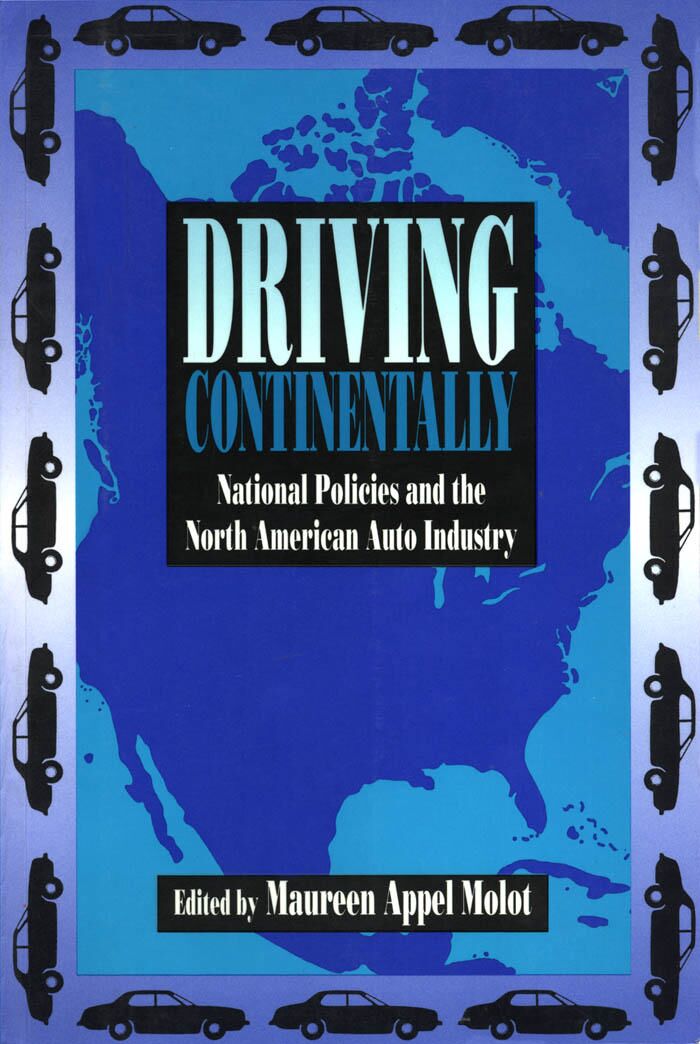
Driving Continentally
The papers in this collection provide important new material on this industry in crisis which is critical to the economies of the U.S., Canada and Mexico. The authors examine major changes in the industry, and how government policies in the three countries have promoted, protected and shaped it.
eBook

An Analysis of the Structural Traits and Drivers of Virtual Land Trade Networks Within the G20 Countries
With the deepening of international trade and the increasing shortage of land resources, the importance of virtual soil trade in grain has become increasingly prominent. Based on FAO data, this study constructs the virtual soil trade network of wheat, rice, corn and soybean in the major G20 grain trading countries in 2013 and 2023, measures its network characteristics, and uses the exponential random graph model to explore its influencing factors from three dimensions of economic scale, geographical characteristics and resource endowment. The results show that: (1) virtual land trade is essentially a redistribution mechanism of land use pressure, rather than a simple grain flow; (2) the formation of network is driven by exogenous economic factors and endogenous relations; and (3) the role of each country in the network varies with the grain and food category and the development stage, showing a systematic differentiation. It is suggested that the allocation of land resources should be optimized according to the differences in virtual land flows in different countries and food categories. Since the export of virtual land is accompanied by ecological costs (such as deforestation, soil degradation, and water consumption), sustainability must be integrated into trade policies. Rations involve national security strategy, and it is necessary to strengthen domestic productivity and strategic reserves. Feed grain can use the market mechanism to promote trade liberalization and diversification, and reduce the risk of supply chain concentration while giving full play to the global comparative advantage.
Journal Article

Mexico's transition to a knowledge-based economy : challenges and opportunities
Unlock Mexico's Economic Potential in the Knowledge Era. This insightful study examines Mexico's journey toward a knowledge-based economy, revealing both challenges and opportunities for sustainable growth. Authored by experts Yevgeny Kuznetsov and Carl Dahlman, this volume provides strategies for enhancing Mexico's competitiveness through innovation, education reform, and strategic investment in ICT infrastructure. Discover how Mexico can leverage its regional diversity and existing strengths to transform its economy and improve the lives of its citizens. * Understand the key sources of growth in the global knowledge economy * Identify challenges and opportunities for Mexico's economic transformation * Explore strategies for enhancing competitiveness through innovation and education * Learn how to promote regional development and overcome institutional rigidities For policymakers, economists, business leaders, and academics interested in Mexico's economic future.
eBook

Agriculture Under Pressure: The Economic, Environmental, and Development Drivers Transforming Florida Agriculture
Florida (FL)’s agriculture sector is undergoing rapid transformation due to biological shocks, environmental stressors, import competition, and accelerating urbanization. Citrus greening, laurel wilt, and hurricane-related damage have sharply reduced yields and acreage, while rising imports from Mexico and Brazil erode market share and depress prices. Urban development and recreational land-use expansion are accelerating land-value increases, which in turn drives farmland loss and abandonment. This policy-oriented review synthesizes these pressures and evaluates state policy responses. Our findings highlight the need for integrated strategies that improve resilience, strengthen land conservation, and enhance the long-term competitiveness of FL’s agricultural sector.
Journal Article

Planes, Trains and Barges: Port Authority Turns 60
Transportation The head of Union Pacific Railroad said he had cautionary words for President Donald Trump several weeks ago about the country's trade war with China. Fritz was joined by Arkansas Gov. Asa Hutchinson on the panel, which was moderated by auto dealer and former White House Chief of Staff Mack McLarty. During his meeting with Trump, Fritz said the president understood the risk to the economy the trade war was presenting and the concerns of business leaders.
Journal Article

The Auto Parts-Automotive Chain in Mexico and China: Co-operation Potential?
Mexico's economic relationship with China has intensified substantially in the last decade. Based on an increasing literature on the overall and aggregate relationship, this analysis proposes a detailed examination of the auto parts-automobile chain, which is of utmost importance for both countries and will be significant for understanding the future trade relationship between them. In order to understand the industrial organization of Mexico and China, the article first gives an overview of the international trade and industrial organization patterns. After establishing the characteristics of Mexico's and China's legal framework, production, employment and trade, the analysis concludes with a group of proposals to improve binational co-operation. Both countries – China interested in increasing its export platform based on Chinese parts brands and Mexico supplying parts and components and providing decades of experiences in international networks – can benefit from these suggestions and overcome current tensions.
Journal Article

Neither synthesis nor rivalry: Complementary policy models and technological learning in the Mexican and Brazilian petroleum and automotive industries
Although technological learning is indispensable for economic transformation in developing countries, recent research on industrial policy both lacks consensus regarding policy models and engages in little long-term analysis of policy impacts. This study contributes to this literature through a controlled case comparison of the varied addition of new and unique functional capacities in the Mexican and Brazilian automotive and petroleum industries from 1975 to 2000. It offers a dynamic industrial policy perspective that underscores the explanatory role of alternating state- and market-led industrial policy approaches and their associated cumulative processes of “exploration” and “exploitation” (March (1991)). It also suggests that two background conditions—prior investments in learning and exogenous shocks that undermine the status quo—intervene decisively in the successful sequencing of policy approaches. The study concludes by proposing a framework that recognizes three main learning pathways formed through different configurations of the main independent variable and background conditions. This framework can be deployed as a rough predictive tool to assess how other industries might most effectively increase their technological sophistication.
Journal Article
The Auto Parts-Automotive Chain in Mexico and China: Co-operation Potential?
Mexico's economic relationship with China has intensified substantially in the last decade. Based on an increasing literature on the overall and aggregate relationship, this analysis proposes a detailed examination of the auto parts-automobile chain, which is of utmost importance for both countries and will be significant for understanding the future trade relationship between them. In order to understand the industrial organization of Mexico and China, the article first gives an overview of the international trade and industrial organization patterns. After establishing the characteristics of Mexico's and China's legal framework, production, employment and trade, the analysis concludes with a group of proposals to improve binational co-operation. Both countries -- China interested in increasing its export platform based on Chinese parts brands and Mexico supplying parts and components and providing decades of experiences in international networks -- can benefit from these suggestions and overcome current ensions. Adapted from the source document.
Journal Article