
Catalogue Search | MBRL


Are you sure you want to remove the book from the shelf?

{{itemTitle}}
155
result(s) for
"Avalanches History."
Sort by:

The world's worst avalanches
\"An earthquake shakes a snow-covered mountain. The fresh snow slides down. It's an avalanche!\"-- Provided by publisher.
Book

Encounters in Avalanche Country
Every winter settlers of the U.S. and Canadian Mountain West could expect to lose dozens of lives to deadly avalanches. This constant threat to trappers, miners, railway workers-and their families-forced individuals and communities to develop knowledge, share strategies, and band together as they tried to survive the extreme conditions of \"avalanche country.\" The result of this convergence, author Diana Di Stefano argues, was a complex network of formal and informal cooperation that used disaster preparedness to engage legal action and instill a sense of regional identity among the many lives affected by these natural disasters.
Encounters in Avalanche Country tells the story of mountain communities' responses to disaster over a century of social change and rapid industrialization. As mining and railway companies triggered new kinds of disasters, ideas about environmental risk and responsibility were increasingly negotiated by mountain laborers, at the elite levels among corporations, and in socially charged civil suits. Disasters became a dangerous crossroads where social spaces and ecological realities collided, illustrating how individuals, groups, communities, and corporate entities were all tangled in this web of connections between people and their environment.
Written in a lively and engaging narrative style, Encounters in Avalanche Country uncovers authentic stories of survival struggles, frightening avalanches, and how local knowledge challenged legal traditions that defined avalanches as acts of god. Combining disaster, mining, railroad, and ski histories with the theme of severe winter weather, it provides a new and fascinating perspective on the settlement of the Mountain West.
eBook

Whiter than snow
In a small mining town near Colorado's majestic Tenmile Range, as nine children walk home from school, a spring avalanche thunders down from Jubilee Mountain burying everything in its path. This novel of survival, redemption, and faith reveals the backstory of each family affected by this tragedy.
Book
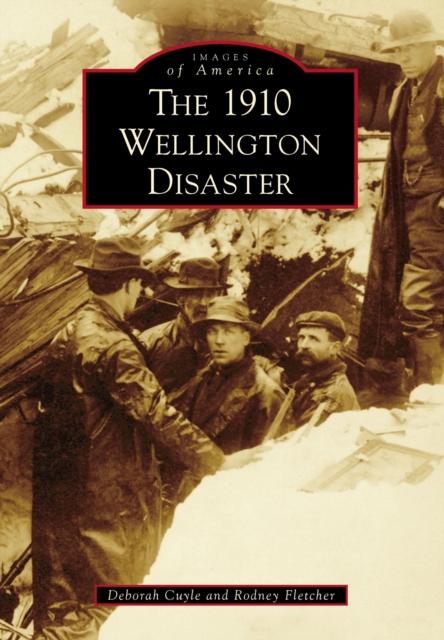
The 1910 Wellington Disaster
The town of Wellington was located by the Stevens Pass summit in the Cascade Mountains. During the last days of February in 1910, the snow was relentless in the Cascades, falling as much as one foot per hour and rising up to 20 feet deep in areas. Rotary plows could not keep the lines open as snow covered the railroad tracks almost immediately after being cleared. The Seattle Express, coming from Spokane, and a fast mail train were stranded just beyond the \"safety\" of the Cascade Tunnel, where they remained unmovable for almost a week under the snowpacked mountains. On March 1, an avalanche swept away the tracks and passengers aboard the two trains as well as several of Wellington's buildings and homes. Almost 100 individuals were killed in just a few seconds, creating America's deadliest avalanche and train disaster in history. Today, the site is part of the Iron Goat Trail off Highway 2, east of Skykomish. The snowshed, the abandoned original Cascade Tunnel, and various scraps of the trains left in the ravine are the only evidence that remain of Wellington, its long-forgotten inhabitants, or the disaster.
eBook

Barry
Barry der Menschenretter, a Saint Bernard dog, reflects back on his life in the early 1800s at the Hospice of the Great Saint Bernard in the Swiss Alps, where he rescued some forty people from avalanches. Includes facts about the breed and the hospice.
Book

50+ years of eukaryotic transcription: an expanding universe of factors and mechanisms
The landmark 1969 discovery of nuclear RNA polymerases I, II and III in diverse eukaryotes represented a major turning point in the field that, with subsequent elucidation of the distinct structures and functions of these enzymes, catalyzed an avalanche of further studies. In this Review, written from a personal and historical perspective, I highlight foundational biochemical studies that led to the discovery of an expanding universe of the components of the transcriptional and regulatory machineries, and a parallel complexity in gene-specific mechanisms that continue to be explored to the present day.
Journal Article

Constitution of a multicentennial multirisk database in a mountainous environment from composite sources: the example of the Vallouise-Pelvoux municipality
To develop efficient mountain risk management strategies, an obvious, yet tremendously difficult prerequisite is the constitution of comprehensive databases of past events and their impacts over long-time frames. However, existing records are often too short and siloed between different data providers and/or as function of hazards. To fill this gap, a methodology based on the combination of scattered pre-existing records with further archival research is proposed and used to populate a well-structured multirisk database covering the period 1600-2020 AD in a municipality of the French Alps - Vallouise-Pelvoux. Results include 2131 events related to rockfall, landslides, snow avalanches, floods (including debris flows) and glacial hazards, with documentation of possible interactions between hazards, their characteristics and detailed impacts. The combined use of different sources - and in particular archival searches - and their cross-referencing therefore provides a detailed record of past events that goes far beyond any inventory existing at the local scale. The analysis suggests that the distribution of events results from the combined effect of hazards, sources and human activities putting assets at risk, with a primary effect of sources. The methodology opens perspective for multirisk assessment in mountain territories and can be usefully transferred to other case studies.
Journal Article

Probabilistic prediction of rock avalanche runout using a numerical model
Rock avalanches can be a significant hazard to communities located in mountainous areas. Probabilistic predictions of the 3D impact area of these events are crucial for assessing rock avalanche risk. Semi-empirical, calibration-based numerical runout models are one tool that can be used to make these predictions. When doing so, uncertainties resulting from both noisy calibration data and uncertain governing movement mechanism(s) must be accounted for. In this paper, a back-analysis of a database of 31 rock avalanche case histories is used to assess both of these sources of uncertainty. It is found that forecasting results are dominated by uncertainties associated with the bulk basal resistance of the path material. A method to account for both calibration and mechanistic uncertainty is provided, and this method is evaluated using pseudo-forecasts of two case histories. These pseudo-forecasts show that inclusion of expert judgement when assessing the bulk basal resistance along the path can reduce mechanistic uncertainty and result in more precise predictions of rock avalanche runout.
Journal Article

Using historical data for developing a hazard and disaster profile of the Kashmir valley for the period 1900–2020
Disasters cause high mortality and suffering and also thwart development and damage local economies. Kashmir valley in the NW Himalaya is subject to a multitude of hazards and has been an area of many disasters ranging from landslides to catastrophic earthquakes, with heavy loss of life and property. However, information on most of these events is poorly reported or exaggerated and in some cases not recorded at all. The availability of an organized and reliable database of past hazards and disasters is essential for understanding risk and mitigating future disasters in the valley. The present study addresses the lack of data availability by developing a hazard and disaster catalogue for Kashmir valley based on an investigation of secondary data sources. The database comprises 1858 events including 1693 earthquakes, 39 floods, 69 landslides, and 57 snow avalanches for the period of 1900–2020. Information on triggers and impacts, and insights into spatial and temporal trends are also included. There is a general increase in the incidence of the extreme events over this period of the study, except for floods, which show little change in frequency. The results further reveal that the valley has experienced numerous small to major earthquakes that appear to be randomly distributed in space. In contrast, floods recur at regular intervals and are restricted to floodplains, and landslides and snow avalanches have occurred only on slopes adjacent to the valley. The historical disaster database is an aid in regional planning and policy development to facilitate the disaster risk reduction process.
Journal Article

Low surface strength of the asteroid Bennu inferred from impact ejecta deposit
The surface strength of small rubble-pile asteroids, which are aggregates of unconsolidated material under microgravity, is poorly constrained but critical to understanding surface evolution and geologic history of the asteroid. Here we use images of an impact ejecta deposit and downslope avalanche adjacent to a 70-m-diameter impact crater on the rubble-pile asteroid (101955) Bennu to constrain the asteroid’s surface properties. We infer that the ejecta deposited near the crater must have been mobilized with velocities less than Bennu’s escape velocity (20 cm s
–1
); such low velocities can be explained only if the effective strength of the local surface is exceedingly low, nominally ≤2 Pa. This value is four orders of magnitude below strength values commonly used for asteroid surfaces, but it is consistent with recent estimates of internal strength of rubble-pile asteroids and with the surface strength of another rubble-pile asteroid, Ryugu. We find a downslope avalanche indicating a surface composed of material readily mobilized by impacts and that has probably been renewed multiple times since Bennu’s initial assembly. Compared with stronger surfaces, very weak surfaces imply (1) more retention of material because of the low ejecta velocities and (2) lower crater-based age estimates—although the heterogeneous structure of rubble piles complicates interpretation.
Observations of deposits associated with a crater on the rubble-pile asteroid Bennu indicate a surface with low strength that is readily reworked by impact processes.
Journal Article