
Catalogue Search | MBRL


Are you sure you want to remove the book from the shelf?

{{itemTitle}}
5
result(s) for
"Avant-garde (Aesthetics) Russia (Federation) History 20th century."
Sort by:

Chagall to Malevich : the Russian avant-gardes
140 masterpieces of painting demonstrate the parallel development of widely different styles, design principles and aesthetic ideas. The avant-garde artists influenced each other and were sometimes in conflict with each other. At the same time you could find advocates of representational Expressionism and supporters of pure abstraction; styles like Primitivism, Cubo-Futurism and Suprematism followed each other in succession. Surprising contrasts of works visualize the differences, so that the successive conflicting -isms are clearly demonstrated. Through this visual confrontation the picture of all the many different forms of Russian avant-garde come alive. With works by Altman,Chagall, Exter, Gontscharowa, Griogorijew, Kandinsky, Larionow, Lissitzky, Malewitsch, Petrow-Wodkin, Popowa, Rodtschenko and many ohters.
Book

Voiceless Vanguard
Winner, 2015 International Research Society in Children's Literature (IRSCL) Book AwardVoiceless Vanguard: The Infantilist Aesthetic of the Russian Avant-Gardeoffers a new approach to the Russian avant-garde. It argues that central writers, artists, and theorists of the avant-garde self-consciously used an infantile aesthetic, as inspired by children's art, language, perspective, and logic, to accomplish the artistic renewal they were seeking in literature, theory, and art. It treats the influence of children's drawings on the Neo-Primitivist art of Mikhail Larionov, the role of children's language in the Cubo-Futurist poetics of Aleksei Kruchenykh, the role of the naive perspective in the Formalist theory of Viktor Shklovsky, and the place of children's logic and lore in Daniil Kharms's absurdist writings for children and adults. This interdisciplinary and cultural study not only illuminates a rich period in Russian culture but also offers implications for modernism in a wider Western context, where similar principles apply.
eBook


The Mitki and the Art of Postmodern Protest in Russia
During the late Soviet period, the art collective known as the Mitki emerged in Leningrad. Producing satirical poetry and prose, pop music, cinema, and conceptual performance art, this group fashioned a playful, emphatically countercultural identity with affinities to European avant-garde and American hippie movements. More broadly, Alexandar Mihailovic shows, the Mitki pioneered a form of political protest art that has since become a centerpiece of activism in post-Soviet Russia, most visibly today in groups such as Pussy Riot. He draws on extensive interviews with members of the collective and illuminates their critique of the authoritarian state, militarism, and social strictures from the Brezhnev years to the present.
eBook
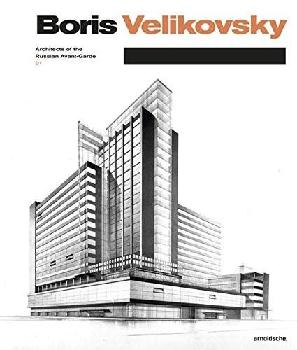
Boris Velikovsky, 1878-1937
With his residential buildings, office blocks, schools and factories, Boris Velikovsky (1878-1937) made a definitive contribution to Russian avant-garde architecture. His early constructions, such as Gribov House in Moscow, are still very much bound to Russian Neoclassism, yet since the Revolution of 1917, he increasingly designed Constructivist architecture. One example is his Gostorg Management Building, distinguished by glass facades, the functional division of space and use of state-of-the-art materials. Furthermore in the garden city of Druzhba for instance, Velikovsky intensively engaged with new ideas in town planning. With mostly hitherto unpublished technical plans, as well as numerous historical and new colour photographs of his most famous projects, Boris Velikowsky's contribution to Russian avant-garde architecture is appreciated for the first time in book form.
Book