
Catalogue Search | MBRL


Are you sure you want to remove the book from the shelf?

{{itemTitle}}
297
result(s) for
"Avarice."
Sort by:

Alcune note sociologiche (ma non solo) sulla mentalità dei genovesi
Mentality, an ambivalent analytical category, is in fact a relevant resource from a cultural point of view due to its reflections on the concrete behaviors of both the individual and a community. The essay attempts to reflect sociologically on the mentality with reference to a specific case study: the Genoese people. Here focus only on three interdependent aspects, that traditionally contribute to the configuration of the Genoese mentality: avarice, grumbling and the fear of the new expressed in the lexicon of the maniman. Some banal stereotypes are thus dismantled. This preliminary exploration adopts an interdisciplinary methodology based on a plurality of sources and data in the hope of further insights.
Journal Article


The impact of bitcoin fear and greed on good and bad network connectedness: the case of the US sectoral high frequency returns
This article is the first one to examine the moderating role of bitcoin sentiment indices on the short term and long-term time–frequency-based good and bad network connectedness of all US sectors. In more detail, the paper quantifies the above relationship between the 11 US sectoral high frequency returns and then identifies the moderating impact of bitcoin investors’ fear and greed sentiment on good and bad network connectedness during pre-Covid-19 and Covid-19. For the said purpose, we decompose the returns into good and bad volatility, and rely on time and frequency dependent spillover measures and quantify a spillover symmetrical and asymmetrical measure for network connectedness for different investment horizons. Furthermore, we also quantify the NET good–bad volatility transmission and reception capability of all our sectors within the frequency dependent network. The extracted good and bad network connectedness indices are then regressed on multiple thresholds of bitcoin sentiment indices. Quantile regression results revealed that fear, extreme fear, greed and extreme greed moderate the short term and long term good and bad volatility spillovers within the network connectedness. Finally, we also utilize hedge ratios and optimal portfolio weight selection strategies to explain whether short positioning in the US sectoral returns can be used to hedge against bitcoin sentiment risk.
Journal Article

The fate of Fausto : a painted fable
A selfish man sets out to prove that he is the boss of everything he surveys.
Book
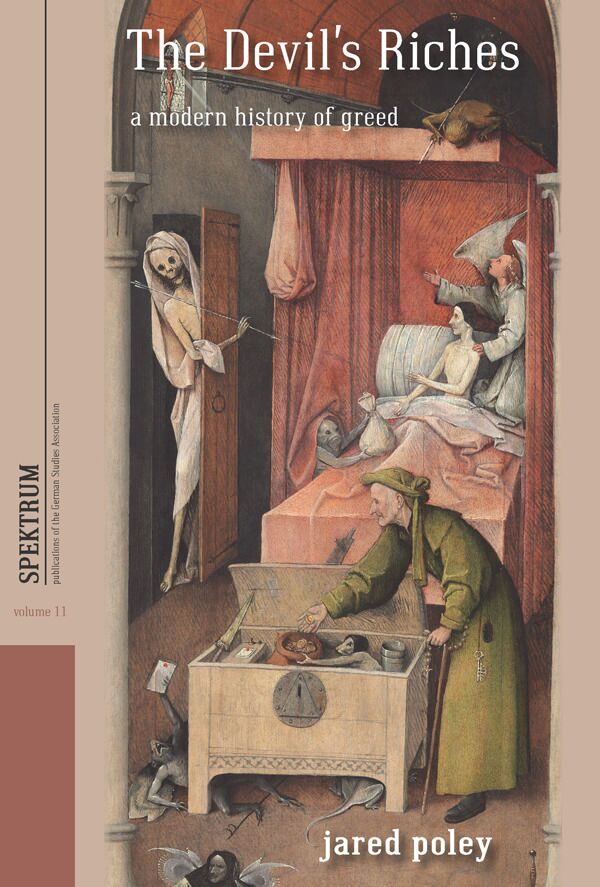
The Devil's Riches
A seeming constant in the history of capitalism, greed has nonetheless undergone considerable transformations over the last five hundred years. This multilayered account offers a fresh take on an old topic, arguing that greed was experienced as a moral phenomenon and deployed to make sense of an unjust world. Focusing specifically on the interrelated themes of religion, economics, and health—each of which sought to study and channel the power of financial desire—Jared Poley shows how evolving ideas about greed became formative elements of the modern experience.
eBook


Are greedy individuals more corrupt?
It is a widespread belief that greed keeps corruption alive. We tried to testify this belief and further proposed that this pattern would fade under conditions of low descriptive corruption norms. Therefore, two studies were conducted to examine the effect of greed on corruption and the buffering role of descriptive corruption norms. In Study 1, we strengthened support for the causal effect of greed on corruption. In Study 2, we further illustrated that greed positively predicted corrupt intent when descriptive corruption norms were high; by contrast, the relationship disappeared when descriptive corruption norms were low. The present research refines the belief that greed leads to corruption absolutely, and suggests feasible ways to reduce the negative influence of greed on corruption.
Journal Article

Guilty not guilty
Bill Russell is acting as a volunteer steward at Warwick races when he confronts his worst nightmare---the violent death of his much-loved wife. But, the aftermath proves much worse when he is accused of killing her and then hounded mercilessly by the media. Losing his job and in danger of losing his home too, Bill's life begins to unravel completely. Even his best friends turn against him, thinking him guilty of the heinous crime, despite the lack of any compelling evidence. As Bill sets out to clear his name, he finds that proving one's innocence isn't easy. He believes he can track down the true culprit, but can he prove it before he becomes the murderer's next victim? Guilty Not Guilty is a journey of greed and jealousy set against the grief of personal tragedy, with many a twist and turn along the way.-- Publisher's description.
Book
