
Catalogue Search | MBRL


Are you sure you want to remove the book from the shelf?

{{itemTitle}}
26
result(s) for
"Aztec cosmology"
Sort by:


Descendants of Aztec Pictography
In the aftermath of the sixteenth-century Spanish conquest of
Mexico, Spanish friars and authorities partnered with indigenous
rulers and savants to gather detailed information on Aztec history,
religious beliefs, and culture. The pictorial books they created
served the Spanish as aids to evangelization and governance, but
their content came from the native intellectuals, painters, and
writers who helped to create them. Examining the nine major
surviving texts, preeminent Latin American art historian Elizabeth
Hill Boone explores how indigenous artists and writers documented
their ancestral culture.
Analyzing the texts as one distinct corpus, Boone shows how they
combined European and indigenous traditions of documentation and
considers questions of motive, authorship, and audience. For
Spanish authorities, she shows, the books revealed Aztec ideology
and practice, while for the indigenous community, they preserved
venerated ways of pictorial expression as well as rhetorical and
linguistic features of ancient discourses. The first comparative
analysis of these encyclopedias, Descendants of Aztec
Pictography analyzes how the painted compilations embraced
artistic traditions from both sides of the Atlantic.
eBook

Aztec religion and art of writing : investigating embodied meaning, indigenous semiotics, and the Nahua sense of reality
Laack's study presents an innovative interpretation of Aztec religion and art of writing. She explores the Nahua sense of reality from the perspective of the aesthetics of religion and analyzes Indigenous semiotics and embodied meaning in Mesoamerican pictorial writing.
eBook

Aztec Philosophy
InAztec Philosophy, James Maffie reveals a highly sophisticated and systematic Aztec philosophy worthy of consideration alongside European philosophies of their time. Bringing together the fields of comparative world philosophy and Mesoamerican studies, Maffie excavates the distinctly philosophical aspects of Aztec thought.Aztec Philosophyfocuses on the ways Aztec metaphysics-the Aztecs' understanding of the nature, structure and constitution of reality-underpinned Aztec thinking about wisdom, ethics, politics,\\ and aesthetics, and served as a backdrop for Aztec religious practices as well as everyday activities such as weaving, farming, and warfare. Aztec metaphysicians conceived reality and cosmos as a grand, ongoing process of weaving-theirs was a world in motion. Drawing upon linguistic, ethnohistorical, archaeological, historical, and contemporary ethnographic evidence, Maffie argues that Aztec metaphysics maintained a processive, transformational, and non-hierarchical view of reality, time, and existence along with a pantheistic theology.Aztec Philosophywill be of great interest to Mesoamericanists, philosophers, religionists, folklorists, and Latin Americanists as well as students of indigenous philosophy, religion, and art of the Americas.
eBook

Time, history, and belief in Aztec and Colonial Mexico
Based on their enormously complex calendars that recorded cycles of many kinds, the Aztecs and other ancient Mesoamerican civilizations are generally believed to have had a cyclical, rather than linear, conception of time and history. This boldly revisionist book challenges that understanding. Ross Hassig offers convincing evidence that for the Aztecs time was predominantly linear, that it was manipulated by the state as a means of controlling a dispersed tribute empire, and that the Conquest cut off state control and severed the unity of the calendar, leaving only the lesser cycles. From these, he asserts, we have inadequately reconstructed the pre-Columbian calendar and so misunderstood the Aztec conception of time and history. Hassig first presents the traditional explanation of the Aztec calendrical system and its ideological functions and then marshals contrary evidence to argue that the Aztec elite deliberately used calendars and timekeeping to achieve practical political ends. He further traces how the Conquest played out in the temporal realm as Spanish conceptions of time partially displaced the Aztec ones. His findings promise to revolutionize our understanding of how the Aztecs and other Mesoamerican societies conceived of time and history.
eBook
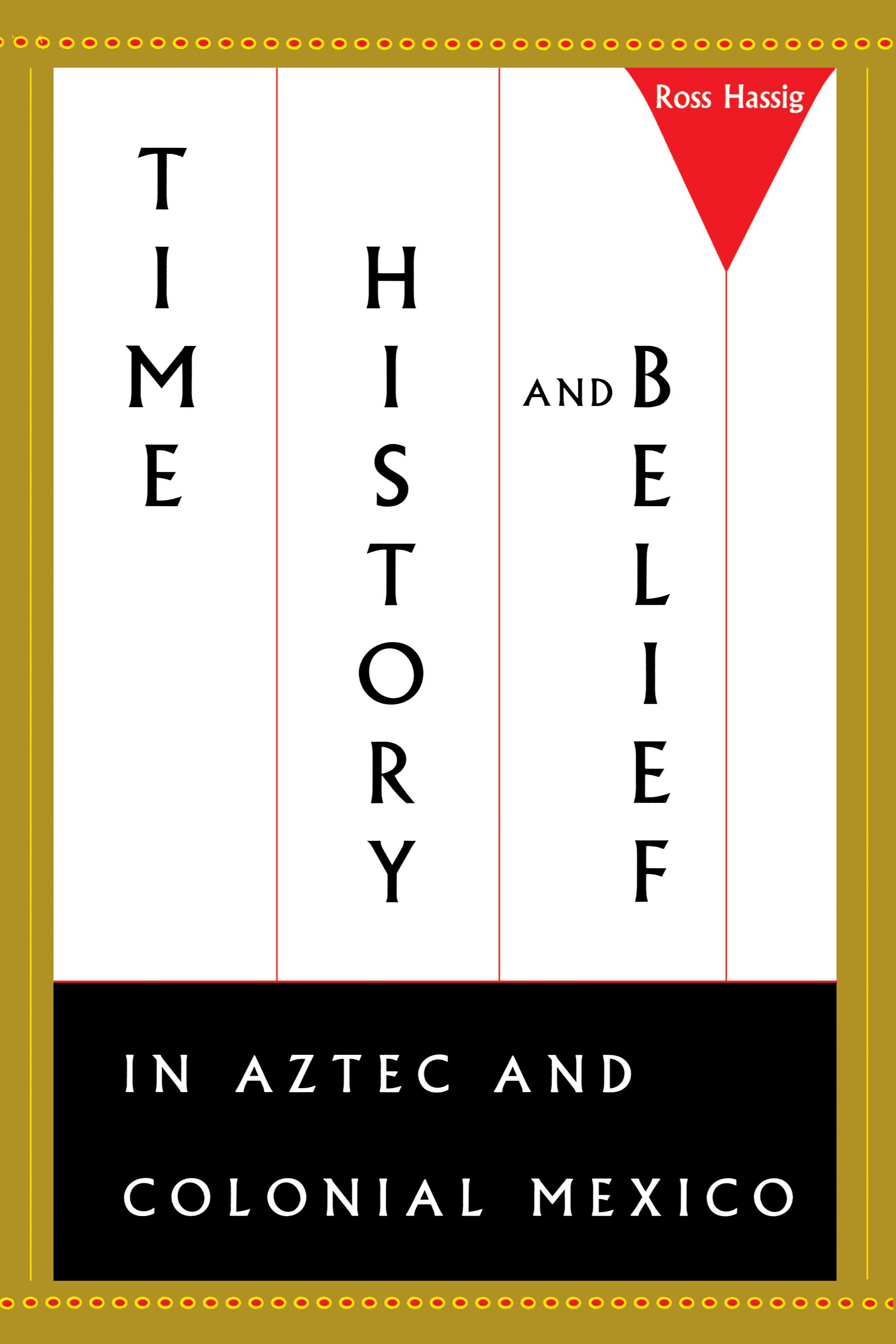
Time, History, and Belief in Aztec and Colonial Mexico
Based on their enormously complex calendars that recorded cycles
of many kinds, the Aztecs and other ancient Mesoamerican
civilizations are generally believed to have had a cyclical, rather
than linear, conception of time and history. This boldly
revisionist book challenges that understanding. Ross Hassig offers
convincing evidence that for the Aztecs time was predominantly
linear, that it was manipulated by the state as a means of
controlling a dispersed tribute empire, and that the Conquest cut
off state control and severed the unity of the calendar, leaving
only the lesser cycles. From these, he asserts, we have
inadequately reconstructed the pre-Columbian calendar and so
misunderstood the Aztec conception of time and history.
Hassig first presents the traditional explanation of the Aztec
calendrical system and its ideological functions and then marshals
contrary evidence to argue that the Aztec elite deliberately used
calendars and timekeeping to achieve practical political ends. He
further traces how the Conquest played out in the temporal realm as
Spanish conceptions of time partially displaced the Aztec ones. His
findings promise to revolutionize our understanding of how the
Aztecs and other Mesoamerican societies conceived of time and
history.
eBook


THE BUTTERFLY BIRD GOD AND HIS MYTH AT TEOTIHUACAN
We know little about the gods of the Teotihuacan pantheon and practically nothing of their mythology. Starting from the analysis of a group of murals in Atetelco (Teotihuacan), a partial reconstruction is proposed for a Teotihuacan myth, the principal figure of which has the character of a sun god linked to vegetation. In this proposal, this god descends to the Underworld and is reborn, thus rising out of the depths of the earth. The myth appears to include, moreover, a ballgame in the Underworld and probably a supernatural macaw, linked in some way to the god in question. In my opinion, this is probably a creation myth, with a basic structure bearing a resemblance to that of the Popol Vuh.
Journal Article

The Myth Project: Essential Bodies
The most recent iteration of this series, entitled The Myth Project: Essential Bodies, is an original full-evening, site-specific work, honoring the ancient Mexican ritual of Dia de los Muertos, (in 2008, the tradition of Dia de los Muertos was officially inscribed in the Representative List of the Intangible Cultural Heritage of Humanity by UNESCO with the aim of safeguarding and better protecting important cultural heritages worldwide, as well as supporting the significance of each culture and their sacred traditions). The text used to transport this dance-theatre work from the human world to the underworld also included these excerpts from the writing of The Mictlán: Until I get Before the Lord and Lady of the death To them I give them my offerings To be accepted in the place Where my soul, my tonali Will be released Gone are my attachments The physical body, the earthly, Now I vanish in nothing. To Reach the Mictlán is no easy task So we ask our alive [ones] That during four years make us altars. [...]help us to get there...
Journal Article

A dark light: Reflections on obsidian in Mesoamerica
Throughout Mesoamerica, from c. 1500 BC to the Spanish conquest and beyond, obsidian was centrally located in the physical and symbolic worlds of indigenous societies. The aesthetic engagement with obsidian, based on its unique physical properties in a world without metal tools, bestowed distinctive kinds of agency on artefacts made from this dark volcanic glass-especially as blades used for bloodletting and human sacrifice. Linked to landscape, cosmology and myth, obsidian attained its apotheosis as the Aztec deity Tezcatlipoca, 'Lord of the Smoking (Obsidian) Mirror'. After the conquest, its symbolic role was re-aligned. Used to decorate early Christian atrial crosses, it was viewed as adornment by Catholic priests, but as a syncretic continuation of pre-Columbian belief by native peoples.
Journal Article