
Catalogue Search | MBRL


Are you sure you want to remove the book from the shelf?

{{itemTitle}}
615
result(s) for
"Büchner"
Sort by:

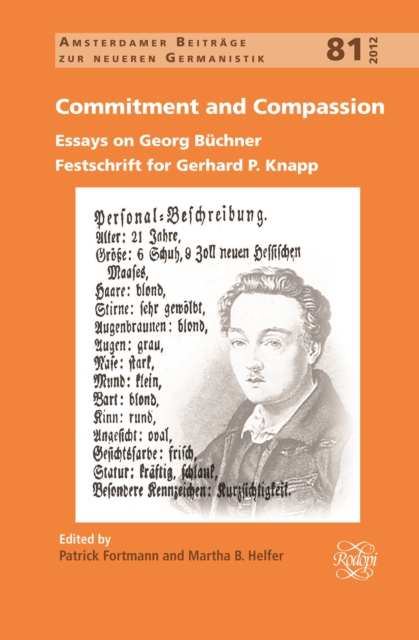
Commitment and Compassion
The writer, scientist, philosopher, and radical democrat Georg Büchner (1813-1837) occupies a unique place in the cultural legacy of the German-speaking countries. Born into an epoch of inevitable, yet arrested historical transition, Büchner produced a small but exceptionally rich body of work. This collection of essays in English and in German considers the full spectrum of his writings, the political pamphlet Der Hessische Landbote, the dramas Danton's Tod, Leonce und Lena, Woyzeck, and the fragmentary narrative Lenz, as well as the letters, the philosophical lectures on Descartes and Spinoza, and the scientific texts. The essays examine connections between these works, study texts in detail, debate ways of editing them, and trace their reception in contemporary literature and film. The novel readings presented here not only celebrate Büchner on the eve of his bicentenary birthday but also insert this untimely figure into discussions of the revolution-restoration dynamic and realism in poetics and politics.
eBook
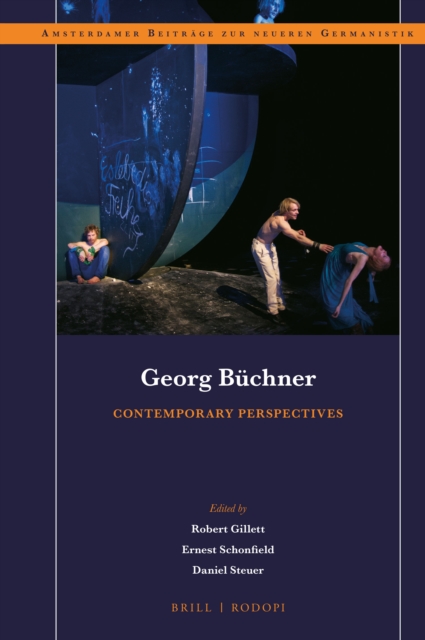
Georg Büchner
This book examines the continuing relevance of Büchner in the early twenty-first century, in terms of politics, science, philosophy, aesthetics, performance and cultural studies, uniquely combining close readings with wide-ranging cultural, theatrical, philosophical and theoretical contextualizations. Der Band beschäftigt sich mit Büchners anhaltender Aktualität in den verschiedensten Bereichen. Er zeichnet sich durch detailliert textbezogene Interpretationen aus, die gleichzeitig zahlreiche aktuelle kultur- und theaterwissenschaftliche, philosophische, naturwissenschaftliche, ästhetische und theoretische Themen ansprechen.
eBook

Applause from the Jury
In Dantons Tod (1835), Büchner’s stage direction of Beifall, or “applause,” in scenes before the Revolutionary Tribunal is a citation of the historical anxiety stretching from ancient times up to Büchner’s contemporaries surrounding reformed trial procedure that opens the theatricality of justice to public participation. This paper argues that the applause stage direction is Büchner’s contribution to the interpretation of a specific historical judicial problem: that of negotiating the requirements of radical legal reform in a new Republic–reform, such as public, oral trial by jury, that manifested outwardly in the French Revolution as tools of tyranny during the Terror and remained at the heart of legal reform debates in the German states at the time of the play’s publication. At stake is the desire to open institutions of justice to public participation, yet there remains a distinct fear that justice will lose its legitimacy as a mere theatrical spectacle. Through the trial scenes in Dantons Tod, however, Büchner emphasizes an understanding that justice is indeed theatrical and performance-based. The question is no longer whether justice is theater but rather: who controls the theater of the courtroom, who is allowed to participate, and to what extent?
Journal Article
Georg Büchner – anatom
This article is a discussion of the book Atlas anatomiczny Georga Büchnera (George Büchner’s Anatomical Atlas) by Anna R. Burzyńska. The author tries to show that Burzyńska interprets the literary and scientific texts of the German writer through the theories of Michel Foucault, but extends them to include a broad context related to the history of ideas and science. Special attention is devoted to the interference of the medical and literary discourse. The basic theme of the book is the materiality of culture, manifested at various levels: as the materiality of the manuscript (the vast majority of Büchner texts were not published during his lifetime and the manu- scripts contain a number of versions of the same scenes, they are also difficult to read and half-destroyed), the philosophical materialism related to social criticism (in The Hessian Courier, Büchner uses statistics and economic data to show the material aspects of social inequalities) and finally corporeal descriptions (Büchner is fascinated by the human body, disease, the physicality of our existence; also as a scientist he undertakes a material analysis of the bodies of vertebrates). The article shows how the writer’s work opens up to a variety of contemporary literary and cultural theories, from poststructuralism through post-secularism to somatopoetics.
Journal Article

Georg Büchner – anatom
Artykuł jest omówieniem monografii Anny R. Burzyńskiej Atlas anatomiczny Georga Büchnera. Pokazuje, że autorka interpretuje teksty literackie i naukowe niemieckiego pisarza poprzez teorie Michela Foucaulta, ale rozbudowuje je o szeroki kontekst związany z historią idei i nauki, szczególną uwagę poświęcając interferencjom dyskursu medycznego i literackiego. Podstawowym tematem książki jest materialność kultury, objawiająca się w różnych jej aspektach: jako materialność manuskryptu (znakomita większość tekstów Büchnera nie była wydana za jego życia, a rękopisy zawierają szereg wersji tych samych scen, są ponadto trudno czytelne i zniszczone), jako filozoficzno-materialistyczna interpretacja rzeczywistości politycznej (w Gońcu Heskim Büchner posługuje się statystykami i danymi gospodarczymi w celu ukazania materialnych aspektów nierówności społecznych), a wreszcie na poziomie opisów cielesności (Büchner jest zafascynowany ciałem ludzkim, chorobą, fizycznością istnienia, a zarazem jako naukowiec podejmuje się analizy budowy ciała kręgowców). Artykuł ukazuje, jak twórczość pisarza otwiera się na współczesne teorie literaturoznawcze i kulturowe, od poststrukturalizmu, przez postsekularyzm, aż po somatopoetykę.
Journal Article

Revolt and Revolution: On the Political Mobilization of the Peasant in Georg Büchner’s “The Hessian Messenger” (1834)
This article takes Georg Büchner’s pamphlet “The Hessian Messenger,” written in 1834 in collaboration with the theologian and revolutionist Friedrich Weidig, as a starting point to explore the literary forms of peasant agitation and mobilization in the context of the German Vormärz (c. 1830–1848). Against the background of the conceptualization of the peasant as a genuinely conservative and anti-revolutionary force in the theory of the mid-19th century, elaborated by such different thinkers like Karl Marx and Wilhelm Heinrich Riehl, this article focuses on the possibilities that writers of the radical and progressive opposition like Büchner opened for the integration of peasants into the (liberal) revolutionary project. What is the function of literature in negotiating the political agency of the peasant and what literary forms, aesthetics, and strategies does it generate to portray and influence the peasant’s perspective on the political conflicts of its time? In a close textual analysis, I explore, how, by implementing specific rhetorical means (statistics, agrarian references, biblical narratives), the text first places the peasant world and the interests and problems of the rural population at the center of its argumentation. Second , I show how the pamphlet connects the disclosure of the peasants’ social and economic grievances inevitably with a discussion of the constitution and the institution of the state. The abstract liberal question of human rights is thus derived directly from power relations and economic exploitation in the countryside. By referring to those seemingly traditional ‘characteristics’ of the peasant, which until then and later influenced the dominant image of the peasant as conservative, that Büchner and Weidig were able to constitute the peasant as a political, powerful collective and revolutionary disruptive force.
Journal Article

A Weak Messianic Power: Figures of a Time to Come in Benjamin, Derrida, and Celan
In his famous theses on the philosophy of history, Benjamin writes: \"We have been endowed with a weak messianic power to which the past has a claim.\" This claim addresses us not just from the past but from what will have belonged to it only as a missed possibility and unrealized potential. For Benajmin, as for Celan and Derrida, what has never been actualized remains with us, not as a lingering echo but as a secretly insistent appeal. Because such appeals do not pass through normal channels of communication, they require a special attunement, perhaps even a mode of unconscious receptivity. Levine examines the ways in which this attunement is cultivated in Benjamin's philosophical, autobiographical, and photohistorical writings; Celan's poetry and poetological addresses; and Derrida's writings on Celan.
eBook

Transfusions of Sovereignty: Büchner's \Danton's Tod\, Political Theology, and the Afterlife of Language
This paper focuses on the nexus between language, history, and the body in Büchner's Danton's Tod. Büchner's play marks a transitional, and internally fractured, stage in the history of political theology in which the language, rites, and ideology of the past continue to haunt the present. The paper is organized around the idea of transfusion, a model that indicates the dependency of the present on the past while also marking the site of this relation as a physical one. Transfusions taint the present with a politico-theological remnant that marks the bodies of the revolutionary leaders. The resolution to the circularity of transfusion takes place linguistically, through quotation. Quotation transforms language into a repository for historical memory while imbuing it with a power for action. The circulation of language via quotation is the literary analogue to the model of transfusion above, but whereas transfusion is marked by an inescapable dependency on the past, quotation introduces a possibility of change and action even as it takes this power out of human intentionality.
Journal Article
