
Catalogue Search | MBRL


Are you sure you want to remove the book from the shelf?

{{itemTitle}}
97
result(s) for
"BBC Radio"
Sort by:
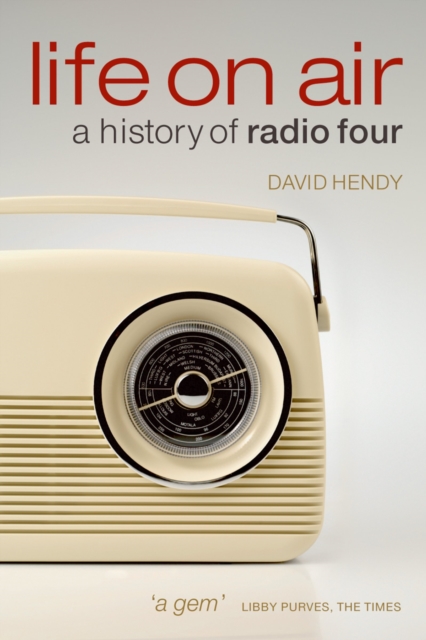
Life on air : a history of Radio Four
Radio Four has been described as 'the greatest broadcasting channel in the world', the 'heartbeat of the BBC', a cultural icon of Britishness, and the voice of Middle England. Defined by its rich mix, encompassing everything from journalism and drama to comedy, quizzes, and short-stories, its programmes - such as Today,The Archers, Woman's Hour, The Hitchhiker's Guide To the Galaxy, Gardeners' Question Time, and The Shipping Forecast - have been part of British life for decades. Others, less successful, have caused offence and prompted derision. Born as it was in the Swinging Sixties, Radio Four's central challenge has been to change with the times, while trying not to lose faith with those who see it as a standard-bearer for quality, authoritativeness, or simply 'old-fashioned' BBC values. In this first major behind-the-scenes account of the station's history, David Hendy - a former producer for Radio Four - draws on privileged access to the BBC's own archives and new interviews with key personnel to illuminate the arguments and controversies behind the creation of some of its most popular programmes. He reveals the station's struggle to justify itself in a television age, favouring clear branding and tightly-targeted audiences, with bitter disputes between the BBC and its fiercely loyal listeners. The story of these struggles is about more than the survival of one radio network: Radio Four has been a lightning rod for all sorts of wider social anxieties over the past forty years. A kaleidoscopic view of the changing nature of the BBC, the book provides a gripping insight into the very nature of British life and culture in the last decades of the twentieth century.
eBook

The Blame Game
The blame game, with its finger-pointing and mutual buck-passing, is a familiar feature of politics and organizational life, and blame avoidance pervades government and public organizations at every level. Political and bureaucratic blame games and blame avoidance are more often condemned than analyzed. InThe Blame Game, Christopher Hood takes a different approach by showing how blame avoidance shapes the workings of government and public services. Arguing that the blaming phenomenon is not all bad, Hood demonstrates that it can actually help to pin down responsibility, and he examines different kinds of blame avoidance, both positive and negative.
Hood traces how the main forms of blame avoidance manifest themselves in presentational and \"spin\" activity, the architecture of organizations, and the shaping of standard operating routines. He analyzes the scope and limits of blame avoidance, and he considers how it plays out in old and new areas, such as those offered by the digital age of websites and e-mail. Hood assesses the effects of this behavior, from high-level problems of democratic accountability trails going cold to the frustrations of dealing with organizations whose procedures seem to ensure that no one is responsible for anything.
Delving into the inner workings of complex institutions,The Blame Gameproves how a better understanding of blame avoidance can improve the quality of modern governance, management, and organizational design.
eBook


Industrial Balladry, Mass Culture, and the Politics of Realism in Cold War Britain
Focusing on a series of pioneering radio ballads produced for the BBC between 1958 and 1961 by Ewan MacColl, Charles Parker, and Peggy Seeger, this article explores representations of industrial working-class culture in folksongs of the radical Left. Situating such work in relation to A. L. Lloyd, mass culture, the nascent New Left, gender, and the aesthetics of social realism (distinct from the project of Soviet socialist realism), I argue that early radio ballads were nostalgic panegyrics for the integrity of working-class identity in the face of unprecedented socioeconomic change. At the very moment when distinctively masculine working-class traditions seemed to be at risk of disappearing under the rising tide of affluence, Conservative Party rhetoric, female emancipation, and the emergence of a classless commodity utopia, these programs generated a portrait of an unwavering British subculture damaged and defined by capitalist exploitation yet resistant to the unwelcome advance of globalized modernity. Ultimately, such work revealed far more about MacColl’s own political convictions than about the intricacies of workingclass life in Britain.
Journal Article


The accent of BBC radio presenters
Artykuł opisuje badanie audytoryjne oraz akustyczne przeprowadzone na nagraniach prezenterów czterech stacji radiowych BBC: BBC Radio 1, BBC Radio 4, BBC Radio 5 Live i BBC World Service w trzech typach audycji: wiadomościach, wiadomościach sportowych oraz programach rozrywkowych. Badanie miało na celu znalezienie odpowiedzi na pytanie, czy występują różnice w akcencie brytyjskich prezenterów reprezentujących różne stacje radiowe BBC oraz prowadzących różne typy audycji, a także — jeśli w istocie tak jest — w jakich kontekstach używany jest formalny, standardowy brytyjski akcent RP oraz jaką pełni funkcję. Szczegółowym analizom poddano dwa zjawiska fonetyczne: h-dropping, czyli elizję dźwięku /h/ w pierwszej akcentowanej sylabie w słowie, oraz /t/ glottalling, czyli zastąpienie głoski /t/ przez zwarcie krtaniowe. Badanie potwierdziło występowanie różnic w akcencie prezenterów. W wiadomościach względnie często zauważono występowanie standardowego akcentu RP, natomiast w programach rozrywkowych oraz wiadomościach i reportażach sportowych znacznie rzadziej. Badanie pokazało także, że różnice w wymowie prezenterów odzwierciedlają różnice poszczególnych stacji radiowych: stacje ukierunkowane na młodych odbiorców mają większy zasób regionalnych, niestandardowych akcentów aniżeli stacje ukierunkowane na dorosłych odbiorców, skupiające się na przekazie informacji.
Journal Article

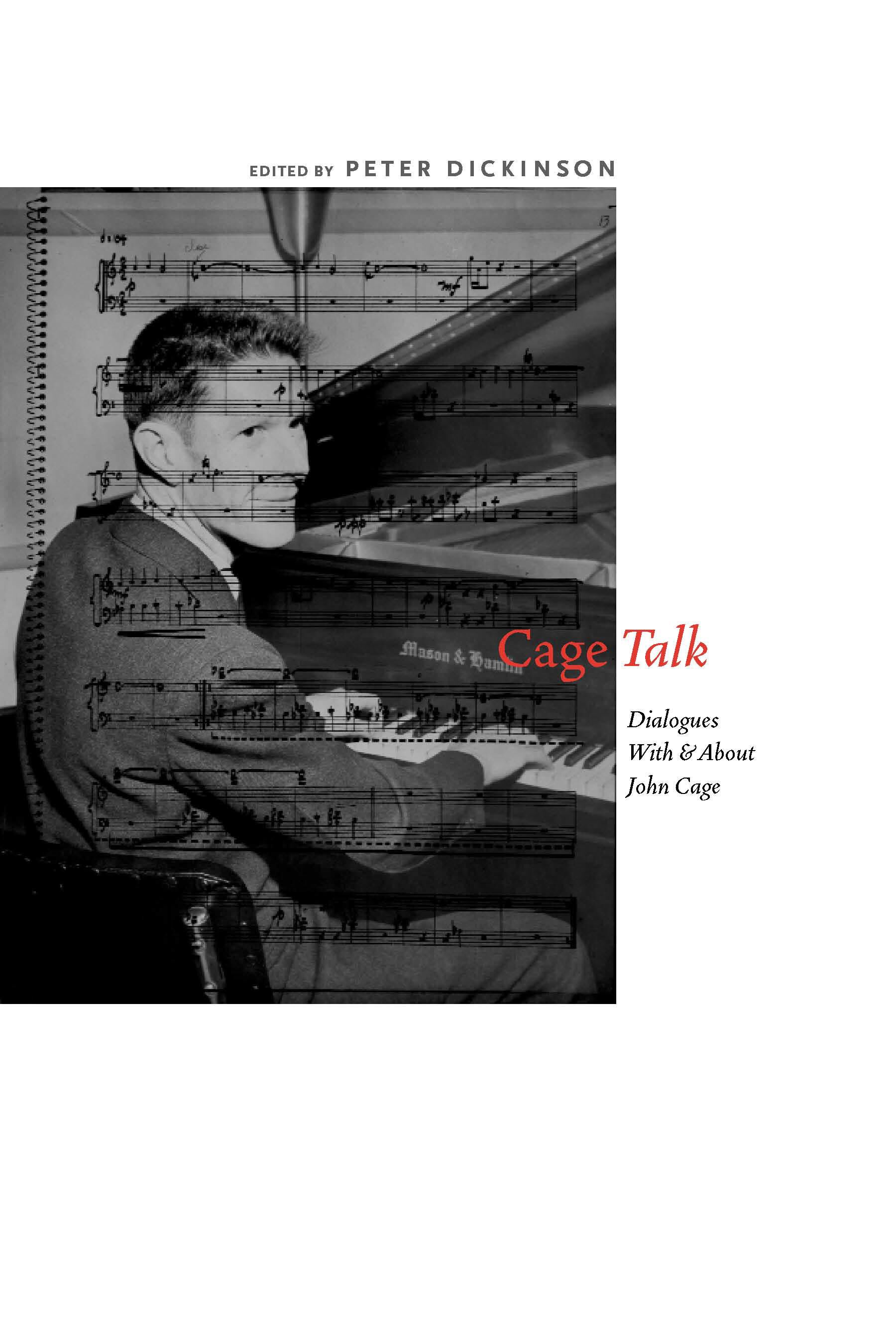
CageTalk
Revealing unpublished interviews with John Cage and some of his closest colleagues, including Virgil Thomson, Karlheinz Stockhausen, Pauline Oliveros, Merce Cunningham, and David Tudor.John Cage, one of America's most renowned composers from the 1940s until his death in 1992, was also a much-admired writer and artist, and a uniquely attractive personality able to present his ideas engagingly wherever he went. In CageTalk: Dialogues with and about John Cage, Peter Dickinson showcases a collection of vividly revealing and unpublished interviews given by Cage in the late 1980s for a BBC Radio 3 documentary. For this paperback edition, Dickinson presents a new preface noting developments in Cage criticism since the book's publication in 2006, updated comments from several of the original interviewees, and a new interview with Christian Wolff. CageTalk also features earlier BBC interviews with Cage, including ones by renowned literary critic Frank Kermode and art critic David Sylvester. In addition, there are discussions of Cage with Bonnie Bird, Earle Brown, Merce Cunningham,Minna Lederman, Otto Luening, Jackson Mac Low, Peadar Mercier, Pauline Oliveros, John Rockwell, Kurt Schwertsik, Karlheinz Stockhausen, Virgil Thomson, David Tudor, LaMonte Young, and Paul Zukovsky. Most of these interviews weregiven to Peter Dickinson but there are others in which with Rebecca Boyle, Anthony Cheevers, Michael Oliver, and Roger Smalley were the interviewers. Peter Dickinson, British composer and pianist, is Emeritus Professor,University of Keele and University of London, and has written or edited several books about twentieth-century music, including Copland Connotations [Boydell Press, 2002] and The Music of Lennox Berkeley [Boydell Press, 2003].
eBook