
Catalogue Search | MBRL


Are you sure you want to remove the book from the shelf?

{{itemTitle}}
112
result(s) for
"BIOGRAPHY/BIOGRAPHICAL."
Sort by:

Open and Closed Biographical Politicization
The article deals with political socialization with particular consideration of open and closed processes of biographical politicization, i.e. biographical alienation. Based on narrative-biographical and theme-oriented interviews with two survivors of the Holocaust, processes of consciousness are analyzed. Henri LEFEBVRE refers in the chapter \"the lived and the living\" in his third volume of the \"Critique of Everyday Live\" (1975) to the complexity of processes of consciousness. According to LEFEBVRE there is a dialectic between the \"lived\" and the \"living\", thus the \"lived\" cannot be characterized only as past actions but as past experiences, constituting dialectically the present--the \"living.\" For LEFEBVRE there is an inescapable conflict between past experiences and present life, i.e. the past could be seen as a constituting part of the conditions of individual (and societal) present consciousness. Following this line of thought, one could state that to analyze former biographical (extraordinary) experiences, i.e. \"the lived,\" is crucial to better understanding of the constitutional conditions of processes of political socialization. Thus former extraordinary biographical experiences might have an essential impact on political socialization and, therefore, on political attitudes. [PUBLICATION ABSTRACT]
Journal Article


Geographies of philological knowledge
Geographies of Philological Knowledge examines the relationship between medievalism and colonialism in the nineteenth-century Hispanic American context through the striking case of the Creole Andrés Bello (1781–1865), a Venezuelan grammarian, editor, legal scholar, and politician, and his lifelong philological work on the medieval heroic narrative that would later become Spain's national epic, the Poem of the Cid. Nadia R. Altschul combs Bello's study of the poem and finds throughout it evidence of a \"coloniality of knowledge.\"
Altschul reveals how, during the nineteenth century, the framework for philological scholarship established in and for core European nations—France, England, and especially Germany—was exported to Spain and Hispanic America as the proper way of doing medieval studies. She argues that the global designs of European philological scholarship are conspicuous in the domain of disciplinary historiography, especially when examining the local history of a Creole Hispanic American like Bello, who is neither fully European nor fully alien to European culture. Altschul likewise highlights Hispanic America's intellectual internalization of coloniality and its understanding of itself as an extension of Europe.
A timely example of interdisciplinary history, interconnected history, and transnational study, Geographies of Philological Knowledge breaks with previous nationalist and colonialist histories and thus forges a new path for the future of medieval studies.
eBook

Eugene O'Neill's America : desire under democracy
In the face of seemingly relentless American optimism, Eugene O'Neill's plays reveal an America many would like to ignore, a place of seething resentments, aching desires, and family tragedy, where failure and disappointment are the norm and the American dream a chimera. Though derided by critics during his lifetime, his works resonated with audiences, won him the Nobel Prize and four Pulitzer, and continue to grip theatergoers today. Now noted historian John Patrick Diggins offers a masterly biography that both traces O'Neill's tumultuous life and explains the forceful ideas that form the heart of his unflinching works.
Diggins paints a richly detailed portrait of the playwright's life, from his Irish roots and his early years at sea to his relationships with his troubled mother and brother. Here we see O'Neill as a young Greenwich Village radical, a ravenous autodidact who attempted to understand the disjunction between the sunny public face of American life and the rage that he knew was simmering beneath. According to Diggins, O'Neill mined this disjunction like no other American writer. His characters burn with longing for an idealized future composed of equal parts material success and individual freedom, but repeatedly they fall back to earth, pulled by the tendrils of family and the insatiability of desire. Drawing on thinkers from Emerson to Nietzsche, O'Neill viewed this endlessly frustrated desire as the problematic core of American democracy, simultaneously driving and undermining American ideals of progress, success, and individual freedom.
Melding a penetrating assessment of O'Neill's works and thought with a sensitive re-creation of his life, Eugene O'Neill's America offers a striking new view of America's greatest playwright—and a new picture of American democracy itself.
eBook

The Art of Biography in Antiquity
Greek and Roman biography embraces much more than Plutarch, Suetonius and their lost Hellenistic antecedents. In this book Professor Hägg explores the whole range and diversity of ancient biography, from its Socratic beginnings to the Christian acquisition of the form in late antiquity. He shows how creative writers developed the lives of popular heroes like Homer, Aesop and Alexander and how the Christian gospels grew from bare sayings to full lives. In imperial Rome biography flourished in the works of Greek writers: Lucian's satire, Philostratus' full sophistic orchestration, Porphyry's intellectual portrait of Plotinus. Perhaps surprisingly, it is not political biography or the lives of poets that provide the main artery of ancient biography, but various kinds of philosophical, spiritual and ethical lives. Applying a consistent biographical reading to a representative set of surviving texts, this book opens up the manifold but often neglected art of biography in classical antiquity.
eBook

In the shadow of the magic mountain
A biography of Thomas Mann's two eldest children that provides intriguing insight into both their lives and the political and cultural shifts at the same time.
Thomas Mann's two eldest children, Erika and Klaus, were unconventional, rebellious, and fiercely devoted to each other. Empowered by their close bond, they espoused vehemently anti-Nazi views in a Europe swept up in fascism and were openly, even defiantly, gay in an age of secrecy and repression. Although their father's fame has unfairly overshadowed their legacy, Erika and Klaus were serious authors, performance artists before the medium existed, and political visionaries whose searing essays and lectures are still relevant today. And, as Andrea Weiss reveals in this dual biography, their story offers a fascinating view of the literary and intellectual life, political turmoil, and shifting sexual mores of their times.
In the Shadow of the Magic Mountain begins with an account of the make-believe world the Manns created together as children—an early sign of their talents as well as the intensity of their relationship. Weiss documents the lifelong artistic collaboration that followed, showing how, as the Nazis took power, Erika and Klaus infused their work with a shared sense of political commitment. Their views earned them exile, and after escaping Germany they eventually moved to the United States, where both served as members of the U.S. armed forces. Abroad, they enjoyed a wide circle of famous friends, including Andre Gide, Christopher Isherwood, Jean Cocteau, and W. H. Auden, whom Erika married in 1935. But the demands of life in exile, Klaus's heroin addiction, and Erika's new allegiance to their father strained their mutual devotion, and in 1949 Klaus committed suicide.
Beautiful never-before-seen photographs illustrate Weiss's riveting tale of two brave nonconformists whose dramatic lives open up new perspectives on the history of the twentieth century.
eBook
Of farming & classics
A fiercely independent thinker, colorful storyteller, and spirited teacher, David Grene devoted his life to two things: farming, which he began as a boy in Ireland and continued into old age; and classics, which he taught for several decades that culminated in his translating and editing, with Richmond Lattimore, of The Complete Greek Tragedies. In this charming memoir, which he wrote during the years leading up to his death in 2002 at the age of eighty-nine, Grene weaves together these interests to tell a quirky and absorbing story of the sometimes turbulent and always interesting life he split between the University of Chicago—where he helped found the Committee on Social Thought—and the farm he kept back in Ireland. Charting the path that took him from Europe to Chicago in 1937, and encompassing his sixty-five-year career at the university, Grene’s book draws readers into the heady and invigorating climate of his time there. And it is elegantly balanced with reflections stemming from his work on the farm where he hunted, plowed and regularly traveled on horseback to bring his cows home for milking. Grene’s form and humor are quite his own, and his brilliant storytelling will enthrall anyone interested in the classics, rural Ireland, or twentieth-century intellectual history, especially as it pertains to the University of Chicago.
eBook
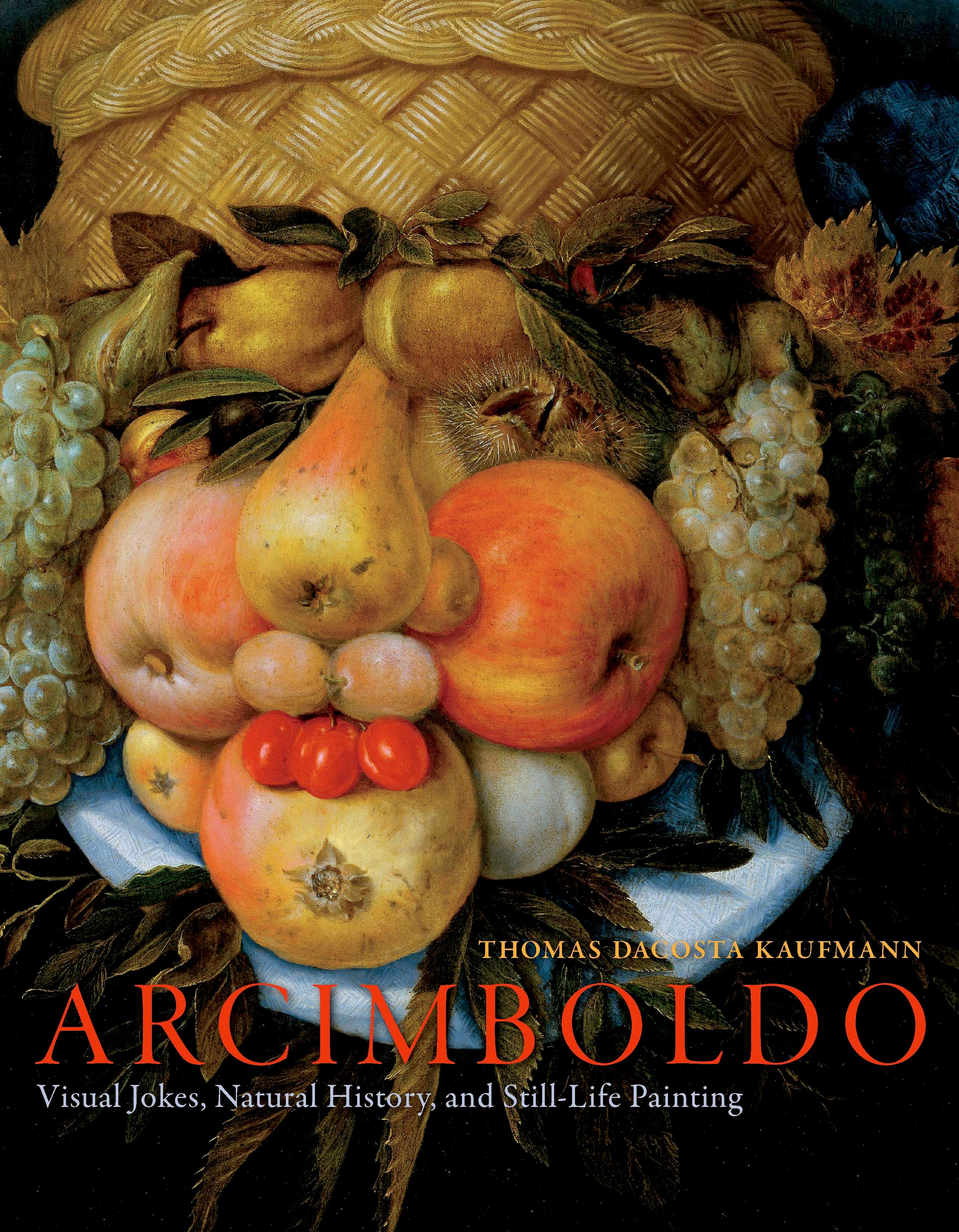
Arcimboldo : visual jokes, natural history, and still-life painting
In Giuseppe Arcimboldo's most famous paintings, grapes, fish, and even the beaks of birds form human hair. A pear stands in for a man's chin. Citrus fruits sprout from a tree trunk that doubles as a neck. All sorts of natural phenomena come together on canvas and panel to assemble the strange heads and faces that constitute one of Renaissance art's most striking oeuvres. The first major study in a generation of the artist behind these remarkable paintings, Arcimboldo tells the singular story of their creation.
Drawing on his thirty-five-year engagement with the artist, Thomas DaCosta Kaufmann begins with an overview of Arcimboldo's life and work, exploring the artist's early years in sixteenth-century Lombardy, his grounding in Leonardesque traditions, and his tenure as a Habsburg court portraitist in Vienna and Prague. Arcimboldo then trains its focus on the celebrated composite heads, approaching them as visual jokes with serious underpinnings—images that poetically display pictorial wit while conveying an allegorical message. In addition to probing the humanistic, literary, and philosophical dimensions of these pieces, Kaufmann explains that they embody their creator's continuous engagement with nature painting and natural history. He reveals, in fact, that Arcimboldo painted many more nature studies than scholars have realized—a finding that significantly deepens current interpretations of the composite heads.
Demonstrating the previously overlooked importance of these works to natural history and still-life painting, Arcimboldo finally restores the artist's fantastic visual jokes to their rightful place in the history of both science and art.
eBook

Sensory Biographies
Robert Desjarlais's graceful ethnography explores the life histories of two Yolmo elders, focusing on how particular sensory orientations and modalities have contributed to the making and the telling of their lives. These two are a woman in her late eighties known as Kisang Omu and a Buddhist priest in his mid-eighties known as Ghang Lama, members of an ethnically Tibetan Buddhist people whose ancestors have lived for three centuries or so along the upper ridges of the Yolmo Valley in north central Nepal. It was clear through their many conversations that both individuals perceived themselves as nearing death, and both were quite willing to share their thoughts about death and dying. The difference between the two was remarkable, however, in that Ghang Lama's life had been dominated by motifs of vision, whereas Kisang Omu's accounts of her life largely involved a \"theatre of voices.\" Desjarlais offers a fresh and readable inquiry into how people's ways of sensing the world contribute to how they live and how they recollect their lives.
eBook