
Catalogue Search | MBRL


Are you sure you want to remove the book from the shelf?

{{itemTitle}}
192,568
result(s) for
"BUDGET FOR EDUCATION"
Sort by:

Developing post-primary education in Sub-Saharan Africa : assessing the financial sustainability of alternative pathways
All countries in Sub-Saharan Africa (SSA) face the prospect of a substantial increase in the number of primary school completers in the coming years. Although initial conditions vary widely from country to country, this increase will inevitably intensify pressure on the education system, particularly at the secondary and tertiary levels. African countries may thus find it timely to align their education policies and strategies to the emerging challenges. A key goal is to ensure that the education system continues to develop in an efficient, equitable, and fiscally sustainable manner even as it expands to accommodate the rising numbers seeking a place in secondary and tertiary education. The rest of this report is organized as follows. Chapter two elaborates the policy context for education development in SSA. Chapter three explains the methodology and data sources. Chapter four examines the challenges and constraints posed by the sheer volume of increases in enrollments in post-primary education with which most education systems in SSA must grapple in the coming years. Taking these constraints into account, the report evaluates the scope for policy development from three perspectives in the subsequent chapters: the coverage of education systems (chapter five), the quality and cost of service delivery (chapter six), and the division of financing by public and private sources (chapter seven). The fiscal implications of plausible policy packages that SSA countries might consider are assessed in chapter eight. Chapter nine seems up the general conclusions of the report.
eBook


The role and impact of public-private partnerships in education
Enhancing the role of private sector partners in education can lead to significant improvements in education service delivery. However, the realization of such benefits depends in great part on the design of the partnership between the public and private sectors, on the overall regulatory framework of the country, and on the governmental capacity to oversee and enforce its contracts with the private sector. Under the right terms, private sector participation in education can increase efficiency, choice, and access to education services, particularly for students who tend to fail in traditional education settings. Private-for-profit schools across the world are already serving a vast range of usersâ€\"from elite families to children in poor communities. Through balanced public-private partnerships (PPPs) in education, governments can leverage the specialized skills offered by private organizations as well as overcome operating restrictions such as salary scales and work rules that limit public sector responses. 'The Role and Impact of Public-Private Partnerships in Education' presents a conceptualization of the issues related to PPPs in education, a detailed review of rigorous evaluations, and guidleines on how to create successful PPPs. The book shows how this approach can facilitate service delivery, lead to additional financing, expand equitable access, and improve learning outcomes. The book also discusses the best way to set up these arrangements in practice. This information will be of particular interest to policymakers, teachers, researchers, and development practitioners.
eBook
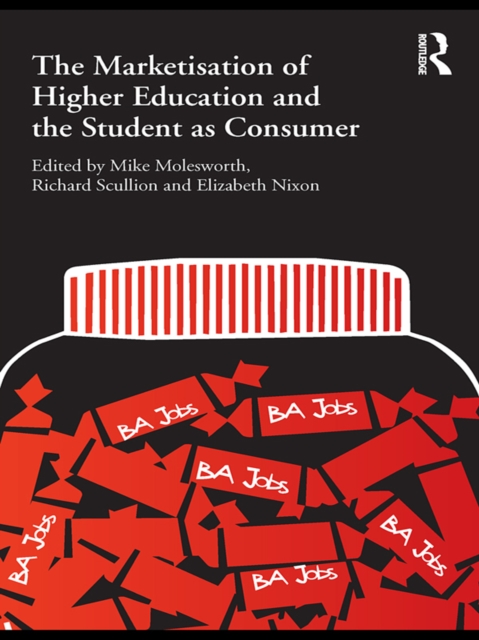
The Marketisation of Higher Education and the Student as Consumer
Until recently government policy in the UK has encouraged an expansion of Higher Education to increase participation and with an express aim of creating a more educated workforce. This expansion has led to competition between Higher Education institutions, with students increasingly positioned as consumers and institutions working to improve the extent to which they meet ‘consumer demands’.
Especially given the latest government funding cuts, the most prevalent outlook in Higher Education today is one of business, forcing institutions to reassess the way they are managed and promoted to ensure maximum efficiency, sales and ‘profits’. Students view the opportunity to gain a degree as a right, and a service which they have paid for, demanding a greater choice and a return on their investment. Changes in higher education have been rapid, and there has been little critical research into the implications. This volume brings together internationally comparative academic perspectives, critical accounts and empirical research to explore fully the issues and experiences of education as a commodity, examining:
the international and financial context of marketisation
the new purposes of universities
the implications of university branding and promotion
league tables and student surveys vs. quality of education
the higher education market and distance learning
students as ‘active consumers’ in the co-creation of value
changing student experiences, demands and focus.
With contributions from many of the leading names involved in Higher Education including Ron Barnett, Frank Furedi, Lewis Elton, Roger Brown and also Laurie Taylor in his journalistic guise as an academic at the University of Poppleton, this book will be essential reading for many.
1. Introduction to the Marketisation of Higher Education and the Student as Consumer Frank Furedi Section I: Marketisation of Higher Education in Context 2. The March of the Market Roger Brown 3. Markets, Government, Funding and the Marketisation of UK Higher Education Nick Foskett 4. The Marketised University: Defending the Indefensible Ronald Barnett 5. Adopting Consumer Time and the Marketing of Higher Education Paul Gibbs 6. Complexity Theory Lewis Elton Section II: The Marketised Higher Education Institution 7. Vision, Values and International Excellence Helen Sauntson and Liz Morrish 8. From Accrington Stanley to Academia? Stella Jones-Devitt and Catherine Samiei 9. Branding a University Chris Chapleo 10. Access Agreements, Widening Participation and Market Positionality Colin McCaig 11. ‘This place is not at all what I had expected’: Student Demand for Authentic Irish Experiences in Irish Studies Programmes Katherine Nielsen 12. The Student as Consumer Felix Maringe Section III: Students, Consumers and Citizens 13. The Consumer Metaphor Versus the Citizen Metaphor Johan Nordensvärd 14. Constructing Consumption Joanna Williams 15. 'A degree will make all your dreams come true': Higher Education as the Management of Consumer Desires Helen Haywood, Rebecca Jenkins and Mike Molesworth 16. How Choice in Higher Education can Create Conservative Learners Lizzie Nixon, Richard Scullion and Mike Molesworth 17. Pedagogy of Excess Mike Neary and Andy Hagyard 18. Arguments, Responsibility and What is to be Done About Marketisation Richard Scullion, Mike Molesworth and Lizzie Nixon 19. A Concluding Message from the Vice-Chancellor of Poppleton University Laurie Taylor
Mike Molesworth is Senior Lecturer in Online Marketing and Consumer Behaviour at the Media School, Bournemouth University, UK.
Richard Scullion is Senior Lecturer in Marketing Communications and Political Communications at the Media School, Bournemouth University, UK.
Elizabeth Nixon is Lecturer in Marketing Communications at the Media School, Bournemouth University, UK.
eBook

The challenge of establishing world-class universities
Governments are becoming increasingly aware of the important contribution that high performance, world-class universities make to global competitiveness and economic growth. There is growing recognition, in both industrial and developing countries, of the need to establish one or more world-class universities that can compete effectively with the best of the best around the world. Contextualizing the drive for world-class higher education institutions and the power of international and domestic university rankings, this book outlines possible strategies and pathways for establishing globally competitive universities and explores the challenges, costs, and risks involved. Its findings will be of particular interest to policy makers, university leaders, researchers, and development practitioners.
eBook

Global Shocks of Education, Health, and Environmental Footprint on National Development in the Twenty-First Century: A Threshold Structural VAR Analysis
This paper provides an insight on whether the global shock of education budget, health budget, and environmental footprint are supporting national development in the twenty-first century as world aggregate data analysis from 2000 to 2019 using the Threshold Structural Vector Autoregressive (ThSVAR) model. The findings revealed that global shocks of the education budget and health budget are partially causing economic growth, but the environmental footprint is partially decreasing it; global shocks of the education budget are substantially raising the human development index while health is partially raising it; global shocks of the education budget and health budget are partially reducing the rate of unemployment, but the environmental footprint is raising it. Furthermore, the levels to which education and health budgets are cost-effective for national development are 4.246523% of GDP and US$
e
6.768500
of health budget per capita for economic growth, 4.302660% of GDP and US$
e
6.901392
of health budget per capita for human development index, and 4.251330% of GDP and US$
e
6.768500
of health budget per capita for the unemployment rate. Moreover, education and health budgets are negligibly curbing environmental degradation. In addition, the levels to which education and health budgets are cost-effective for curbing environmental degradation are at 4.456587% of GDP and US$e6.901392 of health budget per capita. In line with these findings, a couple of policy recommendations and suggestions for further research were made.
Journal Article

Transatlantic moves to the market: the United States and the European Union
The theory of academic capitalism is used to explore US and EU marketization trajectories. Comparisons are made along the following dimensions: creation and expansion of intermediating organizations external to universities that promote closer relations between universities and markets; interstitial organizations that emerge from within universities that intersect various market oriented projects; narratives, discourses and social technologies that promote marketization and competition; expanded managerial capacity; new funding streams for research and programs close to the market; and new circuits of knowledge that move away from peer review and professional judgment as arbiters of excellence. We also consider the status of fields not closely integrated with external markets, and see fragmentation of the humanities, fine arts and (some) social sciences to be a sign of research universities marketization. We conclude that the US and EU are following very different paths to bring higher education closer to the market. The US move to the market was incremental and frequently led by a wide variety of non-governmental organizations, often with strong ties to the for-profit sector and participation by segments of universities prior to federal legislation or mandates. The European Commission is reverse engineering Anglo-American higher education models to reconstruct technologies of governance in uniquely European contexts that embed competition in nation-state initiatives. Although the discourse surrounding university marketization promises growth of high paying jobs prosperity, evidence to date suggests very uneven results for both the US and EU.
Journal Article

Making Reform Work
Making Reform Workis a practical narrative of ideas that begins by describing who is saying what about American higher educationùwho's angry, who's disappointed, and why. Most of the pleas for changing American colleges and universities that originate outside the academy are lamentations on a small number of too often repeated themes. The critique from within the academy focuses on issues principally involving money and the power of the market to change colleges and universities. Sandwiched between these perspectives is a public that still has faith in an enterprise that it really doesn't understand.Robert Zemsky, one of a select group of scholars who participated in Secretary of Education Margaret Spellings's 2005 Commission on the Future of Higher Education, signed off on the commission's report with reluctance. InMaking Reform Workhe presents the ideas he believesshouldhave come from that group to forge a practical agenda for change. Zemsky argues that improving higher education will require enlisting faculty leadership, on the one hand, and, on the other, a strategy for changing the higher education system writ large.
Directing his attention from what can't be done to what can be done, Zemsky provides numerous suggestions. These include a renewed effort to help students' performance in high schools and a stronger focus on the science of active learning, not just teaching methods. He concludes by suggesting a series of dislodging eventsùfor example, making a three-year baccalaureate the standard undergraduate degree, congressional rethinking of student aid in the wake of the loan scandal, and a change in the rules governing endowmentsùthat could break the gridlock that today holds higher education reform captive.
Making Reform Workoffers three rules for successful college and university transformation: don't vilify, don't play games, and come to the table with a well-thought-out strategy rather than a sharply worded lamentation.
eBook

Fiscal effects of budget referendums: evidence from New York school districts
This paper provides empirical evidence on how budget referendums affect school inputs by taking advantage of an exogenous enactment of budget referendums for small city school districts (SCSDs) in New York State in 1998. The paper shows that SCSDs reduce instructional spending and increase student-teacher ratios while preserving administrative spending in response to budget referendums. These empirical findings are obtained by difference-in-differences estimations on data processed with propensity score matching, and the results are robust to sensitivity analysis.
Journal Article

What explains trends in labor supply among U.S. undergraduates?
Recent cohorts of college enrollees are more likely to work, and work substantially more, than those in the past. October Current Population Survey data reveal that average labor supply among 18-to 22-year-old, full-time undergraduates nearly doubled between 1970 and 2000, rising from six hours to 11 hours per week. In 2000 over half of these \"traditional\" college students were working for pay in the reference week, and those who worked at all worked an average of 22 hours per week. After 2000, labor supply leveled off and then fell abruptly in the wake of the Great Recession to an average of eight hours per week in 2009. This paper considers several explanations for the long-term trend of rising employment — including changes in demographic composition and rising tuition costs — and considers whether the upward trend is likely to resume when economic conditions improve.
Journal Article