
Catalogue Search | MBRL


Are you sure you want to remove the book from the shelf?

{{itemTitle}}
648,454
result(s) for
"BUSINESS DEVELOPMENT"
Sort by:

The emigrant edge : how to make it big in America
\"Brian Buffini, an Irish immigrant who went from rags to riches, shares his strategies for anyone who wants to achieve the American dream. Born and raised in Dublin, Ireland, Brian Buffini immigrated to San Diego, California at the age of nineteen with only ninety-two dollars in his pocket. Since then, he has become a classic American rags-to-riches story. After discovering real estate, he quickly became one of the nation's top real estate moguls and founder of the largest business training company, Buffini & Co., in North America. But Brian isn't alone in his success: immigrants compose thirteen percent of the American population and are responsible for a quarter of all new businesses. In fact, Forbes magazine boasts that immigrants dominate most of the Forbes 400 list. So what are the secrets? In The Emigrant Edge, Brian shares seven characteristics that he and other successful immigrants have in common that can help anyone reach a higher level of achievement, no matter their vocation. He then challenges readers to leave the comfort of their current work conditions to apply these secrets and achieve the success of their dreams\"-- Provided by publisher.
Book

Why Australia prospered
This book is the first comprehensive account of how Australia attained the world's highest living standards within a few decades of European settlement, and how the nation has sustained an enviable level of income to the present. Beginning with the Aboriginal economy at the end of the eighteenth century, Ian McLean argues that Australia's remarkable prosperity across nearly two centuries was reached and maintained by several shifting factors. These included imperial policies, favorable demographic characteristics, natural resource abundance, institutional adaptability and innovation, and growth-enhancing policy responses to major economic shocks, such as war, depression, and resource discoveries.
Natural resource abundance in Australia played a prominent role in some periods and faded during others, but overall, and contrary to the conventional view of economists, it was a blessing rather than a curse. McLean shows that Australia's location was not a hindrance when the international economy was centered in the North Atlantic, and became a positive influence following Asia's modernization. Participation in the world trading system, when it flourished, brought significant benefits, and during the interwar period when it did not, Australia's protection of domestic manufacturing did not significantly stall growth. McLean also considers how the country's notorious origins as a convict settlement positively influenced early productivity levels, and how British imperial policies enhanced prosperity during the colonial period. He looks at Australia's recent resource-based prosperity in historical perspective, and reveals striking elements of continuity that have underpinned the evolution of the country's economy since the nineteenth century.
eBook

The process of economic development
\"The period since the publication of the third edition of The Process of Economic Development has been a time of immense change in the developing world. China, India and Brazil have enjoyed a period of huge economic growth while smaller countries such as Vietnam and Angola have also been subject to striking transformation. Environmental issues such as climate change have also had a huge impact, while issues of security in the Middle East and elsewhere have underlined the importance of natural resources and the ongoing forces of globalization.The fourth edition of this popular textbook has been updated to reflect the new challenges faced by developing countries across Asia, Latin America and Africa, while retaining its ever important emphasis on institutions, the importance of technology and the influence of global finance and business\"-- Provided by publisher.
Book

Business, politics, and the state in Africa
Africa's economies appear to have turned a corner. Commentators are beginning to ask whether a new generation of 'lions' is emerging to challenge the East Asian 'tigers'. This book examines the conditions necessary not just for growth in Africa but for a wider business and economic transformation. Drawing on studies of Rwanda, Ethiopia, Tanzania and Ghana, it argues, controversially, that neo-patrimonial governance need not be an obstacle to improved economic conditions
eBook

Airports, cities and regions
\"Since the emergence of urban systems, cities have developed in a mutually inter-dependent process of socio-economic dynamics and transportation linkages. In recent years, Airports worldwide have stepped beyond the stage of being pure infrastructure facilities while the complex dynamics that are taking place at and around international airports represent a crucial element in the post-industrial reorganisation of urban and regional systems. Airports are increasingly recognized as general urban activity centres; that is, key assets for cities and regions as economic generators and catalysts of investment in addition to being critical components of efficient city infrastructure. This book brings together contributions from renowned academic scholars and world leading practitioners to discuss insights gained from theory and practice. The first collection of papers reflects upon the general role and future of airports as well as their specific contribution to competitive advantages within a fast changing business and economic landscape. The second group of contributions ask about the role airports play within the innovation process that is inherently centred on generating and sharing knowledge. The third section of papers investigates the drivers of real estate developments on airport land and in the close vicinity of airports\"-- Provided by publisher.
Book
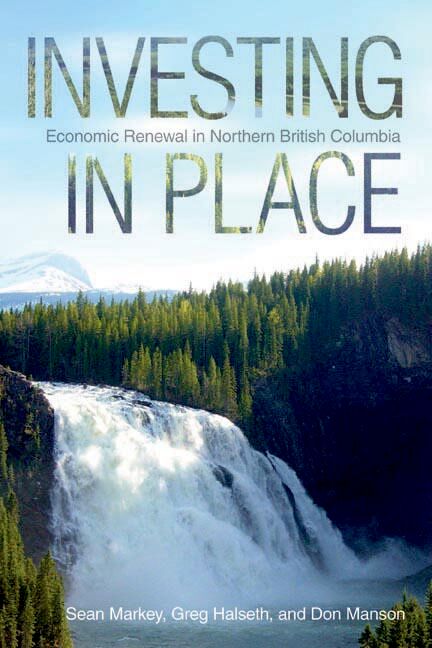
Investing in place : economic renewal in northern British Columbia
The future of northern British Columbia, a vast, resource-rich region of vibrant cultures and diverse communities, could be either driven by a narrow economic agenda or guided by innovative, place-based solutions that seek to build viable communities and resilient local and regional economies. Investing in Place is about creating the foundations for renewing northern British Columbia’s rural and small-town economies. Markey, Halseth, and Manson argue that renewal is not about nostalgic reliance on the policies and economic strategies of the past – rather, it is about building a pragmatic and innovative vision for development, one that acknowledges both the opportunities and the challenges posed by resource development and global and technological change. For policy-makers and residents alike the path to renewal lies in place-based development, which consists of people working together at all levels of the community and region to take advantage of local opportunities in a sustainable, responsible way.
eBook

The curve ahead : discovering the path to unlimited growth
\"Why do most growth companies stop growing? These fast-growing businesses are the engines of economic growth and wealth creation, but most fall behind the curve before reaching their potential. Executives are surprised when their business models mature sooner than expected, victims of the familiar S-Curve. Tragically, once-promising companies are often sold by investors too ready to throw in the towel. So what can leaders do to keep moving forward? To sustain growth, companies need to discover their next S-Curve. But few have a repeatable process for uncovering new opportunities before their core business stalls. The Curve Ahead offers a practical approach to sustaining long-term growth. It describes how growth companies can build innovation into the rhythm of their business operations and culture using design thinking, prototyping, business model design and other Innovation Power Tools. The Curve Ahead utilizes the power of storytelling to illustrate its messages. Power describes how LoJack and Groupon fell behind the curve, while Amazon, Jawbone, Darn Tough Socks and many others have fueled growth with a series of new S-Curves. This book will help thousands of mid-sized companies stay ahead of the curve and discover the path to unlimited revenue growth\"-- Provided by publisher.
Book

The Limits of Institutional Reform in Development
Developing countries commonly adopt reforms to improve their governments yet they usually fail to produce more functional and effective governments. Andrews argues that reforms often fail to make governments better because they are introduced as signals to gain short-term support. These signals introduce unrealistic best practices that do not fit developing country contexts and are not considered relevant by implementing agents. The result is a set of new forms that do not function. However, there are realistic solutions emerging from institutional reforms in some developing countries. Lessons from these experiences suggest that reform limits, although challenging to adopt, can be overcome by focusing change on problem solving through an incremental process that involves multiple agents.
eBook

Managerialism : a critique of an ideology
\"Many people have experienced management at work with some exposed to Managerialism. Once Managerialism had transcended the simplicity of managing companies it mutated into an ideology infiltrating nearly every eventuality of human life. Delivering a comprehensive definition of Managerialism, this book traces Managerialism's origins from simple factory administration to its current form as full-blown ideology that has infected private lives, public and educational institutions, society, the art, the economy, and even democracy. Today thousands of managers have graduated from Managerialism's main training facilities, namely management schools. They are ready to spread Managerialism's one-dimensional, anti-democratic, and authoritarian ideology that everything and anything can be managed through a specific set of managerial knowledge found in management studies. But there are also challenges to Managerialism. There are images of what lies beyond Managerialism. These post-managerial images include a rejection of the human and environmental destructiveness of Managerialism. And there are ways to create human and sustainable post-managerial living conditions\"-- Provided by publisher.
Book

Environmental Impacts of Transnational Corporations in the Global South
This volume explores the impact of Transnational Corporations (TNCs) on the environment of the Global South during this period of neoliberal globalization. It develops themes around transnational extractive activity; the impact of transnational capital on indigenous populations, and the role played by international institutions,.
eBook