
Catalogue Search | MBRL


Are you sure you want to remove the book from the shelf?

{{itemTitle}}
76
result(s) for
"Bakhtin, M. (...Mikhail...), 1895-1975"
Sort by:

Voicing relationships : a dialogic perspective
An expansion of Baxter′s earlier award winning work on relationship communuication and ′relational dialectics theory′, the 1996 Relating Dialogues and Dialectics (co-authored with Barbara Montgomery).
eBook

Dialogue and desire
Mikhail Bakhtin, the Russian philosopher and cultural critic, was one of the pioneers of the 'linguistic turn' in philosophy and is now widely associated with the concept of the dialogical self and dialogical psychotherapy. However, whilst dialogism is the concept for which Bakhtin is most well known in psychotherapy, it is, in isolation, open to a wide range of interpretations that can be claimed by diverse and conflicting ideological positions. The radical contribution that a more inclusive reading of Bakhtin could bring to psychotherapy only becomes apparent when dialogism is understood in the context of Bakhtin's philosophy as a whole, and when Bakhtin himself is brought into a dialogical relationship with other thinkers. By bringing Bakhtin into dialogue with the controversial French anthropologist, Rene Girard, the centrality of desire in language and human social life is woven into the concept of the dialogical self and the practice of dialogical psychotherapy. This book will be of keen interest to students interested in the contemporary relevance of Bakhtin's thinking as well as psychotherapists concerned with the complex relationship between language, consciousness and the art of psychotherapy.
eBook

Aristophanes and the carnival of genres
The comedies of Aristophanes are known not only for their boldly imaginative plots but for the ways in which they incorporate and orchestrate a wide variety of literary genres and speech styles. Unlike the writers of tragedy, who prefer a uniformly elevated tone, Aristophanes articulates his dramatic dialogue with striking literary and linguistic juxtapositions, producing a carnivalesque medley of genres that continually forces both audience and reader to readjust their perspectives. In this energetic and original study, Charles Platter interprets the complexities of Aristophanes' work through the lens of Mikhail Bakhtin's critical writing.
This book charts a new course for Aristophanic comedy, taking its lead from the work of Bakhtin. Bakhtin describes the way multiple voices—vocabularies, tones, and styles of language originating in different social classes and contexts—appear and interact within literary texts. He argues that the dynamic quality of literature arises from the dialogic relations that exist among these voices. Although Bakhtin applied his theory primarily to the epic and the novel, Platter finds in his work profound implications for Aristophanic comedy, where stylistic heterogeneity is the genre's lifeblood.
eBook

The rebirth of dialogue : Bakhtin, Socrates, and the rhetorical tradition
Dialogue has suffered a long eclipse in the history of philosophy and the history of rhetoric but has enjoyed a rebirth in the work of Hans-Georg Gadamer, Martin Buber, and Mikhail Bakhtin. Among twentieth-century figures, Bakhtin took a special interest in the history of the dialogue form. This book explores Bakhtin’s understanding of Socratic dialogue and the notion that dialogue is not simply a way of persuading others to accept our ideas, but a way of holding ourselves, and others, accountable for all of our thoughts, words, and actions. In supporting this premise, Bakhtin challenges the traditions of argument and persuasion handed down from Plato and Aristotle, and he offers, as an alternative, a dialogical rhetoric that restructures the traditional relationship between speakers and listeners, writers and readers, as a mutual testing, contesting, and creating of ideas. The author suggests that Bakhtin’s dialogical rhetoric is not restricted to oral discourse, but is possible in any medium, including written, graphic, and digital.
eBook
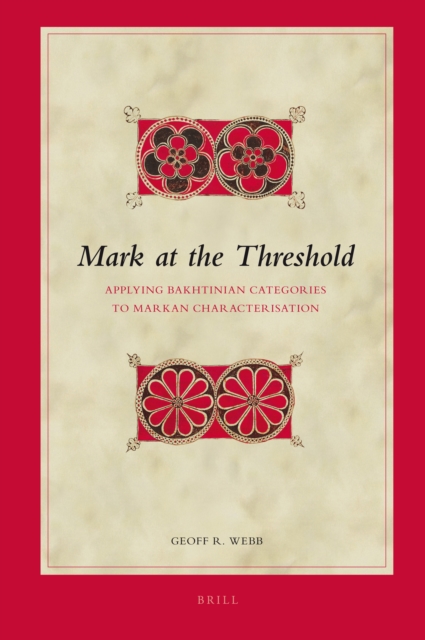
Mark at the Threshold
Drawing on the popular literature of the ancient world, this book offers a fresh look at issues surrounding Markan characterisation, and also calls for scholars to think more openly and flexibly about Markan genre.
eBook

A Dialogue of Voices
Focusing on feminist theorists such as Hélène Cixous, Teresa de Lauretis, Julia Kristeva, and Monique Wittig in conjunction with Bakhtin’s concepts of dialogism, heteroglossia, and chronotope, the authors offer close readings of texts from a wide range of multicultural genres, including nature writing, sermon composition, nineteenth-century British women’s fiction, the contemporary romance novel, Irish and French lyric poetry, and Latin American film.
eBook

Christianity in Bakhtin
The work of the great Russian theorist Mikhail Bakhtin has been examined from a wide variety of literary and theoretical perspectives. None of the many studies of Bakhtin begins to do justice, however, to the Christian dimension of his work. Christianity in Bakhtin for the first time fills this important gap. Having established the strong presence of a Christian framework in his early philosophical essays, Ruth Coates explores the way in which Christian motifs, though suppressed, continue to find expression in the work of Bakhtin's period of exile, and re-emerge in texts written during the time of his rehabilitation. Particular attention is paid to the themes of Creation, Fall, Incarnation and Christian love operating within metaphors of silence and exile, concepts which inform Bakhtin's world view as profoundly as they influence his biography.
eBook

Bakhtinian Perspectives on Language, Literacy, and Learning
This 2004 book represents a multidisciplinary collaboration that highlights the significance of Mikhail Bakhtin's theories to modern scholarship in the field of language and literacy. Book chapters examine such important questions as: What resources do students bring from their home/community environments that help them become literate in school? What knowledge do teachers need in order to meet the literacy needs of varied students? How can teacher educators and professional development programs better understand teachers' needs and help them to become better prepared to teach diverse literacy learners? What challenges lie ahead for literacy learners in the coming century? Chapters are contributed by scholars who write from varied disciplinary perspectives. In addition, other scholarly voices enter into a Bakhtinian dialogue with these scholars about their ideas. These 'other voices' help our readers push the boundaries of current thinking on Bakhtinian theory and make this book a model of heteroglossia and dialogic intertexuality.
eBook

The Contexts of Bakhtin
The fourteen essays collected in this volume, notwithstanding their diversity of subject matter and approach, share a concern with the contexts to which we need to refer in order to understand not only the origins, but also the potential of Mikhail Bakhtin's thought: contexts both immediate and oblique, personal and impersonal, intellectual and theoretical. Five of the essays are by well-known Russian scholars whose work on Bakhtin has not previously been translated in English; the other nine papers are by established and emerging Bakhtin specialists in North America, the United Kingdom, and Europe.
eBook
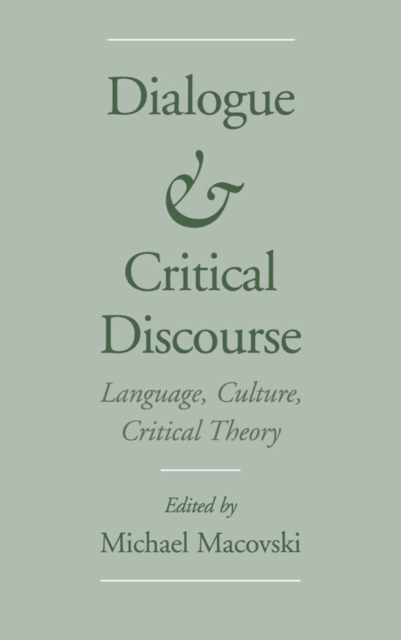
Dialogue and critical discourse : language, culture, critical theory
This interdisciplinary volume of collected, unpublished essays demonstrates the importance of the influential Russian formalist Mikhail Bakhtin's theory of dialogic meaning for a wide range of textual problems. The book is organized around three interlocking dimensions of this dialogue: Part I delineates dialogic interactions between voices of a single text; Part II traces such exchanges on an intertextual level; and Part III locates both kinds of exchanges within the dialogue between speakers, authors, and readers. Within this framework, such distinguished scholars as Deborah Tannen, Shirley Brice Heath, and John Searle address questions including rhetorical models for the establishment and exercise of political power, intimacy and understanding in literary speech, polyphonic narrative forms, the relationship between conversational and literary discourse, and the issue of literature as social action. The essays argue for a redefinition of literary meaning - one that is communal, interactive, and vocatively created. They demonstrate that literary meaning is not rendered by a single narrator, nor even by a solitary author, but is incrementally constructed and exchanged.
eBook