
Catalogue Search | MBRL


Are you sure you want to remove the book from the shelf?

{{itemTitle}}
5,958,923
result(s) for
"Ball"
Sort by:

I like to play
Looks at different games played with balls, including soccer, baseball, and basketball.
Book

FAMILY VIOLENCE AND FOOTBALL: THE EFFECT OF UNEXPECTED EMOTIONAL CUES ON VIOLENT BEHAVIOR
We study the link between family violence and the emotional cues associated with wins and losses by professional football teams. We hypothesize that the risk of violence is affected by the \"gain-loss\" utility of game outcomes around a rationally expected reference point. Our empirical analysis uses police reports of violent incidents on Sundays during the professional football season. Controlling for the pregame point spread and the size of the local viewing audience, we find that upset losses (defeats when the home team was predicted to win by four or more points) lead to a 10% increase in the rate of at-home violence by men against their wives and girlfriends. In contrast, losses when the game was expected to be close have small and insignificant effects. Upset wins (victories when the home team was predicted to lose) also have little impact on violence, consistent with asymmetry in the gain-loss utility function. The rise in violence after an upset loss is concentrated in a narrow time window near the end of the game and is larger for more important games. We find no evidence for reference point updating based on the halftime score.
Journal Article

Ball lightning : a popular guide to a longstanding mystery in atmospheric electricity
Ball lightning is an enigma. These luminous objects that appear occasionally during thunderstorms and can reach several meters in diameter have been a mystery to science for about 200 years. Despite several thousands of reported observations, their nature is still unknown. In this book, well documented cases of ball lightning are described and used to unravel some aspects of this mysterious form of atmospheric electricity. Throughout the book, the author discusses the various facets of the problem in an accessible but rigorous style, delivering a readable and informative text that will captivate the curious reader. He finally reaches the surprising conclusion that the solution to this puzzle may have been hidden in plain sight for many years.
Book

No Game for Boys to Play
From the untimely deaths of young athletes to chronic disease among retired players, roiling debates over tackle football have profound implications for more than one million American boys-some as young as five years old-who play the sport every year. In this book, Kathleen Bachynski offers the first history of youth tackle football and debates over its safety. In the postwar United States, high school football was celebrated as a \"moral\" sport for young boys, one that promised and celebrated the creation of the honorable male citizen. Even so, Bachynski shows that throughout the twentieth century, coaches, sports equipment manufacturers, and even doctors were more concerned with \"saving the game\" than young boys' safety-even though injuries ranged from concussions and broken bones to paralysis and death. By exploring sport, masculinity, and citizenship, Bachynski uncovers the cultural priorities other than child health that made a collision sport the most popular high school game for American boys. These deep-rooted beliefs continue to shape the safety debate and the possible future of youth tackle football.
eBook

Ball lightning
When Chen's parents are incinerated before his eyes by a blast of ball lightning, he devotes his life to cracking the secret of this mysterious natural phenomenon. His search takes him to stormy mountaintops, an experimental military weapons lab, and an old Soviet science station. The more he learns, the more he comes to realize that ball lightning is just the tip of an entirely new frontier. While Chen's quest for answers gives purpose to his lonely life, it also pits him against soldiers and scientists with motives of their own: a beautiful army major with an obsession with dangerous weaponry, and a physicist who has no place for ethical considerations in his single-minded pursuit of knowledge.
Book
Tackle football and traumatic brain injuries : law, ethics, and public health
A timely look at the ethical, legal, and policy issues surrounding brain injury and collision sports. American tackle football is an industry like any other. And like many industries, it sells a product that is dangerous to those who use it—or, in this case, those who play it. In Tackle Football and Traumatic Brain Injuries, Daniel S. Goldberg explores the connections among traumatic brain injury, collision sports, and the industry's continuing efforts to manufacture doubt. Focusing especially on youths and adolescents—the most vulnerable population that comprises over 99% of tackle football players in the US—Goldberg addresses the ethical and social implications of their participation in tackle football. Goldberg discusses the true scope of the danger and the costs to society and individuals of caring for injured participants. If these risks were to become widespread public knowledge, the profitability and perhaps even the viability of American football would be at risk. As the tackle football industry has consistently worked to mask the health hazards involved in playing football, it has used a particular tool that has proved highly effective in achieving this subterfuge: the manufacture of doubt. Goldberg advocates for using public health laws as a tool for countering these efforts at obfuscation, and he outlines specific policy proposals intended to address the population health and ethical problems presented by tackle football. The book draws on public health ethics, public health law, and the histories of occupational and public health to assess the limits of parental choice to expose their children to risks of injury. Should kids play tackle football at all—and who decides if they should? Goldberg offers practical answers to these critical legal, ethical, and social questions. Chris Nowinski, former Harvard football player and WWE wrestler, provides a timely and insider's perspective on these critical issues in the foreword.
eBook

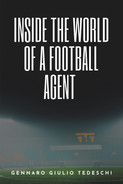
Inside the World of a Football Agent
Inside the World of a Football Agent provides a series of practical cases, experienced first-hand by the author, that will help the readers to immerse themselves in the reality of a football agent that interacts with presidents, CEO, sports directors, supporters, footballers, and their families. The audience for the book is represented by all the current or aspiring professionals involved in the football industry: from football agents who want to keep up to date with the latest legislation, to aspiring agents, sports directors or media, who want to understand what is often behind a yes or no in a complicated transfer negotiation.
eBook

The shared origins of football, rugby, and soccer
\"Reveals how ball games arose and took shape into seven distinct forms: American football, association football, Australian rules football, Canadian football, Gaelic football, rugby league football, and rugby union football ... [and] traces ball games back to the Mayans in Meso-America and the Han Dynasty in China, through ancient Egypt and Greece, and on through the rise of football in England and Scotland\"--Back cover.
Book

Does reducing the height of the tackle through law change in elite men’s rugby union (The Championship, England) reduce the incidence of concussion? A controlled study in 126 games
ObjectivesMost concussions in rugby union occur during tackles. We investigated whether legislation to lower maximum tackle height would change tackle behaviour, and reduce concussion incidence rate.MethodsIn an observational evaluation using a prospective cohort design, 12 elite men’s teams played in two competitions during the 2018/2019 season. The Championship (90 games) retained standard Laws of Rugby for the tackle; the Championship Cup (36 games) used revised laws—the maximum tackle height was lowered from the line of the shoulders on the ball carrier to the line of the armpits. Videos of tackles were analysed for ball carrier and tackler behaviour. Injury data were collected using standardised methods.ResultsIn the lowered tackle height setting, there was a significantly lower proportion of tackles; (1) in which ball carriers (rate ratio (RR) 0.83, 95% CI 0.79 to 0.86) and tacklers (RR 0.80, 95% CI 0.76 to 0.84) were upright, (2) in which the tackler’s initial contact was to the ball carrier’s head or neck (RR 0.70, 95% CI 0.58 to 0.84) and (3) in which initial contact was above the line of the ball carrier’s armpit (RR 0.84, 95% CI 0.80 to 0.88). Concussion incidence rate did not differ between conditions (RR 1.31, 95% CI 0.85 to 2.01). Unexpectedly, compared with the standard tackle height setting, tacklers in the lowered tackle height setting were themselves concussed at a higher rate as measured by; (1) incidence (RR 1.90, 95% CI 1.05 to 3.45) and (2) concussions per 1000 tackles (2.09, 95% CI 1.15 to 3.80).ConclusionsLegislating to lower the height of the tackle meant that tacklers made contact with the ball carrier’s head and neck 30% less often. This did not influence concussion incidence rates. Tacklers in the lowered tackle height setting suffered more concussions than did tacklers in the standard tackle height setting.
Journal Article