
Catalogue Search | MBRL


Are you sure you want to remove the book from the shelf?

{{itemTitle}}
14,303
result(s) for
"Ballads"
Sort by:


Ballad Collection, Lyric, and the Canon
The humble ballad, defined in 1728 as \"a song commonly sung up and down the streets,\" was widely used in elite literature in the eighteenth century and beyond. Authors ranging from John Gay to William Blake to Felicia Hemans incorporated the seemingly incongruous genre of the ballad into their work. Ballads were central to the Scottish Enlightenment's theorization of culture and nationality, to Shakespeare's canonization in the eighteenth century, and to the New Criticism's most influential work,Understanding Poetry. Just how and why did the ballad appeal to so many authors from the Restoration period to the end of the Romantic era and into the twentieth century? Exploring the widespread breach of the wall that separated \"high\" and \"low,\" Steve Newman challenges our current understanding of lyric poetry. He shows how the lesser lyric of the ballad changed lyric poetry as a whole and, in so doing, helped to transform literature from polite writing in general into the body of imaginative writing that became known as the English literary canon. For Newman, the ballad's early lack of prestige actually increased its value for elite authors after 1660. Easily circulated and understood, ballads moved literature away from the exclusive domain of the courtly, while keeping it rooted in English history and culture. Indeed, elite authors felt freer to rewrite and reshape the common speech of the ballad. Newman also shows how the ballad allowed authors to access the \"common\" speech of the public sphere, while avoiding what they perceived as the unpalatable qualities of that same public's increasingly avaricious commercial society.
eBook


The Anglo-Scottish Ballad and its Imaginary Contexts
This is the first book to combine contemporary debates in ballad studies with the insights of modern textual scholarship. Just like canonical literature and music, the ballad should not be seen as a uniquely authentic item inextricably tied to a documented source, but rather as an unstable structure subject to the vagaries of production, reception, and editing. Among the matters addressed are topics central to the subject, including ballad origins, oral and printed transmission, sound and writing, agency and editing, and textual and melodic indeterminacy and instability. While drawing on the time-honoured materials of ballad studies, the book offers a theoretical framework for the discipline to complement the largely ethnographic approach that has dominated in recent decades. Primarily directed at the community of ballad and folk song scholars, the book will be of interest to researchers in several adjacent fields, including folklore, oral literature, ethnomusicology, and textual scholarship.
eBook

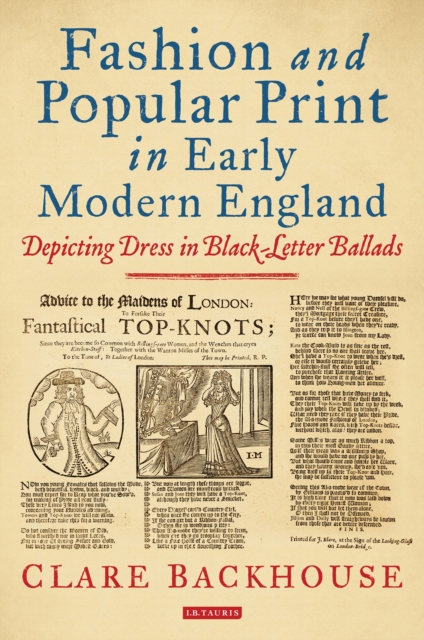
Fashion and Popular Print in Early Modern England
Fashion featured in black-letter broadside ballads over a hundred years before fashion magazines appeared in England. In the seventeenth century, these single-sheet prints contained rhyming song texts and woodcut pictures, accessible to almost everyone in the country. Dress was a popular subject for ballads, as well as being a commodity with close material and cultural connections to them.This book analyses how the distinctive words and images of these ballads made meaning, both in relation to each other on the ballad sheet and in response to contemporary national events, sumptuary legislation, religious practice, economic theory, the visual arts and literature. In this context, Clare Backhouse argues, seventeenth-century ballads increasingly celebrated the proliferation of print and fashionable dress, envisioning new roles for men and women in terms of fashion consumption and its importance to national prosperity. The book demonstrates how the hitherto overlooked but extensive source material that these ballads offer can enrich the histories of dress, art and culture in early modern England.
eBook


“El Pablote”: Revisiting the First Drug Trafficker-Themed Ballad / “El Pablote”: una nova mirada al primer corrido dedicat a un traficant de drogues / “El Pablote”: una nueva mirada al primer corrido dedicado a un traficante de drogas
Si bé la narcocultura s’associa amb el Mèxic de finals del segle XX i inicis del XXI, aquest fenomen cultural té les seves arrels en les primeres dècades del segle XX. Aquest assaig explora els orígens de la narcocultura fent una revisió del que probablement és el primer narcocorrido. “El Pablote” va ser gravat en 1931 i dedicat al narcotraficant de Ciudad Juárez Pablo González, conegut com a Pablote així com el rei de la morfina a Ciudad Juárez.
Journal Article