
Catalogue Search | MBRL


Are you sure you want to remove the book from the shelf?

{{itemTitle}}
24
result(s) for
"Bananas Fiction."
Sort by:

Banana dream
Eleven-year-old Iraqi, Mooz, yearns to taste the bananas that have been made unavailable by warfare.
CHILDBOOK


The hungry little monkey
Little Monkey is very hungry, but none of the other jungle animals seems able to tell him how to peel and eat his banana.
Book

Realist Magic and the Invented Tokyos of Murakami Haruki and Yoshimoto Banana
Mishima and Kawabata represent a Japanese cultural nationaUsm based on the notion of a unique Japanese aesthetic sensibiUty that both transcends the everyday and opposes - for all of their debts of influence - the contamination of Japanese culture by anything foreign. The moral force is, of course, Tokyo itself, the global city that envelops everything and ensures that it stays on track. In this sense, while mass cultural texts have \"as much content ... as the older social realisms,\" the difference between the latter and mass culture is that \"mass culture represses [social problems, illusions, delusions, ideological clashes] by the narrative construction of imaginary resolutions and by the projection of an optical iUusion of social harmony\" (\"Reification\" 25-26).6 These popular and therefore palatable fictional solutions to the dangers of global Tokyo could therefore be read as a release from the existing (or threatening) social order into a kind of fantastic banaUty - the Utopian longing for ordinary life.
Journal Article

Pete the cat and the bad banana
Pete the Cat bites into a bad banana and vows never to eat bananas again, even though he generally likes the fruit.
Book

The banana zone of Santa Marta: the planters of the 'Green gold'
ABSTRACT IN FRENCH: Dans l'empire de la United Fruit, la Zone Bananière de Santa Marta s'est distinguée par le nombre important des planteurs locaux. Ceux-ci sont d'autre part au coeur du drame majeur de l'histoire de la Zone, la grève de 1928. Complétée par les témoignages et les chroniques sur la grève, l'historiographie permet de connaître assez bien ce groupe de planteurs mais, dans un registre qui va de la tragédie à la farce, le récit de fiction contribue aussi à cette connaissance. // ABSTRACT IN SPANISH: En el imperio de la United Fruit, la Zona Bananera de Santa Marta se distinguió por el importante número de los productores locales. Estos tuvieron además un papel central en el gran drama de la historia de la Zona, la huelga de 1928. Completada por los testimonios y las crónicas sobre la huelga, la historiografía permite conocer bastante bien ese grupo de productores pero, con enfoques que van desde lo trágico hasta lo grotesco, el relato de ficción también contribuye a ese conocimiento. // ABSTRACT IN ENGLISH: Within the United Fruit's empire, Santa Marta's Banana Zone had become famous for its large number of local planters. Besides, these same planters where in the heart of the mayor tragedy of the Zone's history: the 1928 strike. Complemented by evidences and chronicles of the strike, historiography permits to get quite well acquainted with this group of planters but, in a register leading from tragedy to farce, literary fiction provides also a good contribution to this knowledge. Reprinted by permission of Presses Universitaires du Mirail
Journal Article
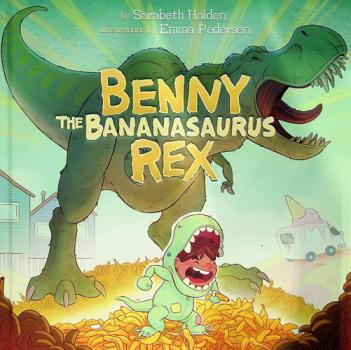
Benny the bananasaurus rex
\"Benny loves bananas. He eats them morning, noon, and night. He even rides a bike with a yellow banana seat. In fact, Benny has a secret, he hopes one day he will turn into a banana! And if there is one thing Benny knows, it's that with a little imagination anything is possible. A funny and relatable story of a little boy who can be anything he wants to be (whether it's a dinosaur, or a banana, or both!) with a big imagination and a bit of help from his anaana.\"-- Provided by publisher.