
Catalogue Search | MBRL


Are you sure you want to remove the book from the shelf?

{{itemTitle}}
277
result(s) for
"Baroque literature History and criticism."
Sort by:

Baroque horrors
Baroque Horrors turns the current cultural and political conversation from the familiar narrative patterns and self-justifying allegories of abjection to a dialogue on the history of our modern fears and their monstrous offspring. When life and death are severed from nature and history, \"reality\" and \"authenticity\" may be experienced as spectator sports and staged attractions, as in the \"real lives\" captured by reality TV and the \"authentic cadavers\" displayed around the world in the Body Worlds exhibitions. Rather than thinking of virtual reality and staged authenticity as recent developments of the postmodern age, Castillo looks back to the Spanish baroque period in search for the roots of the commodification of nature and the horror vacui that accompanies it. Aimed at specialists, students, and readers of early modern literature and culture in the Spanish and Anglophone traditions as well as anyone interested in horror fantasy, Baroque Horrors offers new ways to rethink broad questions of intellectual and political history and relate them to the modern age.
eBook

Benjamin's Library
In Benjamin’s Library, Jane O. Newman offers, for the first time in any language, a reading of Walter Benjamin’s notoriously opaque work, Origin of the German Tragic Drama that systematically attends to its place in discussions of the Baroque in Benjamin’s day. Taking into account the literary and cultural contexts of Benjamin’s work, Newman recovers Benjamin’s relationship to the ideologically loaded readings of the literature and political theory of the seventeenth-century Baroque that abounded in Germany during the political and economic crises of the Weimar years. To date, the significance of the Baroque for Origin of the German Tragic Drama has been glossed over by students of Benjamin, most of whom have neither read it in this context nor engaged with the often incongruous debates about the period that filled both academic and popular texts in the years leading up to and following World War I. Armed with extraordinary historical, bibliographical, philological, and orthographic research, Newman shows the extent to which Benjamin participated in these debates by reconstructing the literal and figurative history of sixteenth- and seventeenth-century books that Benjamin analyzes and the literary, art historical and art theoretical, and political theological discussions of the Baroque with which he was familiar. In so doing, she challenges the exceptionalist, even hagiographic, approaches that have become common in Benjamin studies. The result is a deeply learned book that will infuse much-needed life into the study of one of the most influential thinkers of the twentieth century.
eBook
Baroque fictions : revisioning the classical in Marguerite Yourcenar
This volume is the first in-depth study of the French novelist Marguerite Yourcenar's fiction to contend that the author's texts exhibit in unexpected ways numerous characteristics of the neobaroque. This subversive, postmodern aesthetic privileges extravagant artistic play, flux, and heterogeneity. In demonstrating the affinity of Yourcenar's texts with the neobaroque, the author of this study casts doubt on their presumed transparency and stability, qualities associated with the French neoclassical tradition of the past century, where the Yourcenarian oeuvre is most often placed. Yourcenar's election to the prestigious, tradition-bound French Academy in 1981 as its first female \"immortal\" cemented her already well-established niche in the twentieth-century French literary pantheon. A self-taught classicist, historian, and modern-day French moralist, Yourcenar has been praised for her polished, \"classical\" style and analyzed for her use of myth and universal themes. While those factors at first seem to justify amply the neoclassical label by which Yourcenar is most widely recognized, this study's close reading of four of her fictions reveals instead the texts' opacity and subversive resistance to closure, their rejection of stable interpretations, and their deconstruction of postmodern Grand Narratives. Theirs is a neobaroque \"logic,\" which stresses the absence of theoretical assurances and the limitations of reason. The coincidence of the new millennium -- which in so many ways reflects Yourcenar's disquieting vision -- and her centenary in 2003 affords not so much an excuse to reject the author's neoclassical label, but rather the obligation to reassess it in light of contemporary discourses. This study will be of interest to students of twentieth-century French fiction and comparative literature, especially that of the latter half of the
twentieth century.
eBook

The Female Baroque in Early Modern English Literary Culture
This is a contribution to the revival of early modern women's writings and cultural production in English that began in the 1980s. Its originality is twofold: it links women's writing in English with the wider context of Baroque culture, and it introduces the issue of gender into discussion of the Baroque.
eBook
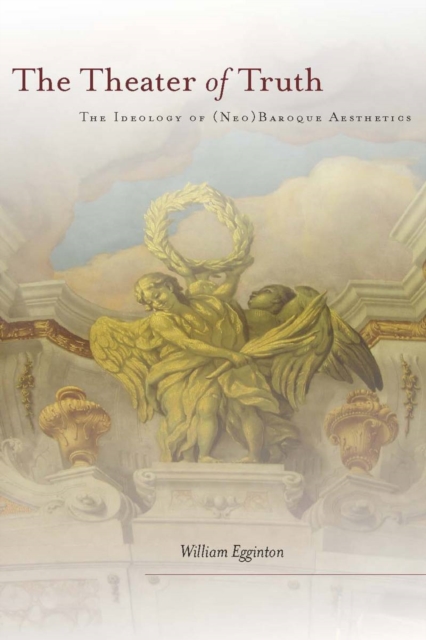
The Theater of Truth
The Theater of Truth argues that seventeenth-century baroque and twentieth-century neobaroque aesthetics have to be understood as part of the same complex. The Neobaroque, rather than being a return to the stylistic practices of a particular time and place, should be described as the continuation of a cultural strategy produced as a response to a specific problem of thought that has beset Europe and the colonial world since early modernity. This problem, in its simplest philosophical form, concerns the paradoxical relation between appearances and what they represent. Egginton explores expressions of this problem in the art and literature of the Hispanic Baroques, new and old. He shows how the strategies of these two Baroques emerged in the political and social world of the Spanish Empire, and how they continue to be deployed in the cultural politics of the present. Further, he offers a unified theory for the relation between the two Baroques and a new vocabulary for distinguishing between their ideological values.
eBook
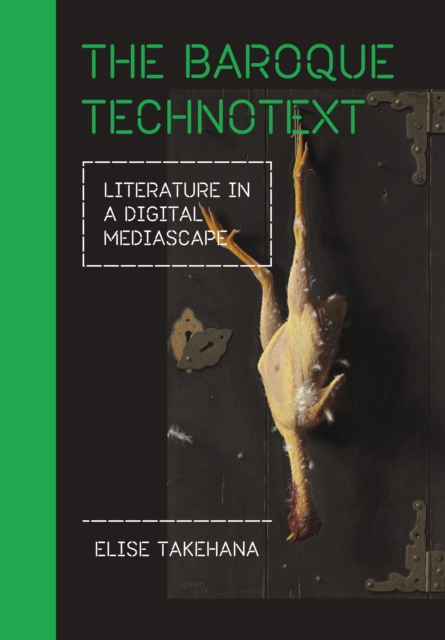
The Baroque Technotext
An analysis of the role of baroque and neo-baroque aesthetics in technotexts, reframing critical debate of contemporary experiments in literary practice in the late age of print. Works by Jonathan Safran Foer, Chris Ware and David Clark are investigated alongside other authors and media such as digital media, film, visual art and interface design.
eBook
Baroque
What is the Baroque?Where did it come from and where did it go?Why do we have to ask these questions?Because art historians seem largely satisfied with their answers and most scholars of German literature are not satisfied, yet have stopped asking.
eBook
Emblematics in Hungary : a study of the history of symbolic representation in Renaissance and Baroque literature
The book series 'Frühe Neuzeit' - founded in 1987 by Jörg Jochen Berns, Gotthard Frühsorge, Klaus Garber, Wilhelm Kühlmann and Jan-Dirk Müller - publishes editions, monographs and collected volumes advancing fundamental research in the field. It does not seek to produce wide-ranging overviews, premature syntheses or pretentious constructions but takes the long route of detailed work and the exploration of submerged traditions.
eBook
