
Catalogue Search | MBRL


Are you sure you want to remove the book from the shelf?

{{itemTitle}}
5
result(s) for
"Bartók, Béla, 1881-1945 Criticism and interpretation."
Sort by:


Music divided
Music Divided explores how political pressures affected musical life on both sides of the iron curtain during the early years of the cold war. In this groundbreaking study, Danielle Fosler-Lussier illuminates the pervasive political anxieties of the day through particular attention to artistic, music-theoretical, and propagandistic responses to the music of Hungary's most renowned twentieth-century composer, Béla Bartók. She shows how a tense period of political transition plagued Bartók's music and imperiled those who took a stand on its aesthetic value in the emerging socialist state. Her fascinating investigation of Bartók's reception outside of Hungary demonstrates that Western composers, too, formulated their ideas about musical style under the influence of ever-escalating cold war tensions. Music Divided surveys Bartók's role in provoking negative reactions to \"accessible\" music from Pierre Boulez, Hermann Scherchen, and Theodor Adorno. It considers Bartók's influence on the youthful compositions and thinking of Bruno Maderna and Karlheinz Stockhausen, and it outlines Bartók's legacy in the music of the Hungarian composers András Mihály, Ferenc Szabó, and Endre Szervánszky. These details reveal the impact of local and international politics on the selection of music for concert and radio programs, on composers' choices about musical style, on government radio propaganda about music, on the development of socialist realism, and on the use of modernism as an instrument of political action.
eBook
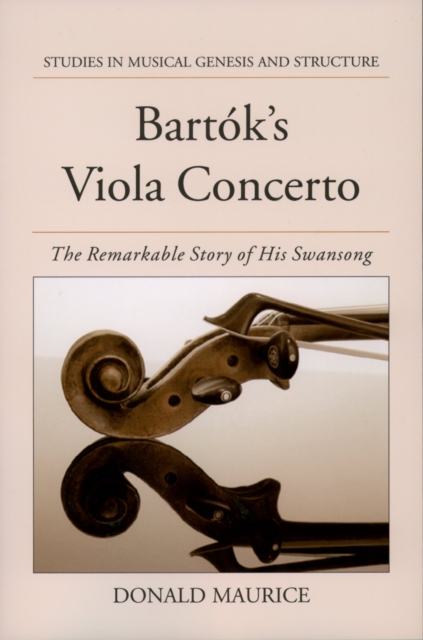
Bartók's viola concerto : the remarkable story of his Swansong
Tells the intriguing story of Bela Bartok's viola concerto, a work left unfinished at his death in 1945. Drawing on interviews and documents that reveal previously unavailable information, it discusses the commission, the reconstruction by Tibor Serly, events leading up to the premiere, its reception over the second half of the twentieth century, the revisions, and future possibilities.
eBook

Bartók's viola concerto
\"When Bela Bartok died in September of 1945, he left a partially completed viola concerto commissioned by the virtuoso violist William Primrose. Yet, while no definitive version of the work exists, this concerto has become arguably the most-performed viola concerto in the world. The story of how the concerto came to be, from its commissioning by Primrose to its first performance to the several completions that are performed today is told here in Bartok's Viola Concerto: The Remarkable Story of His Swansong.\"--BOOK JACKET. Source: National Library of New Zealand Te Puna Matauranga o Aotearoa, licensed by the Department of Internal Affairs for re-use under the Creative Commons Attribution 3.0 New Zealand Licence.
Book
