
Catalogue Search | MBRL


Are you sure you want to remove the book from the shelf?

{{itemTitle}}
18,240
result(s) for
"Basic income"
Sort by:

Universal basic income
\"An EKS book describing the arguments for and against a universal basic income, drawing on research from around the world, with a particular focus on likelihood of adoption within the United States\"-- Provided by publisher.
Book
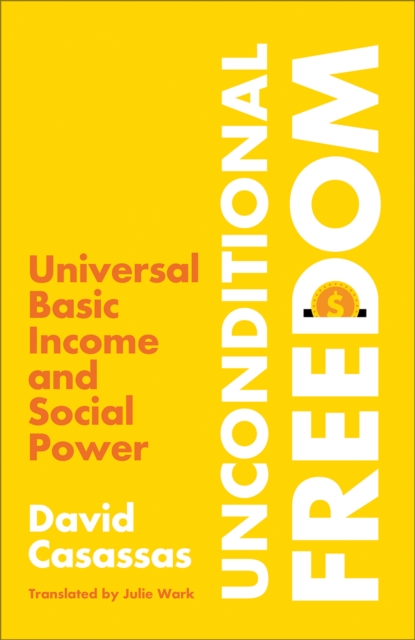
Unconditional Freedom
'A carefully argued case for basic income as central to a democratic transformation of society' Carole Pateman, Distinguished Professor Emeritus, UCLA 'This path-breaking work throws new light on how we understand work, freedom, and emancipation in today's highly precariatised and insecure world... A must-read' Sarath Davala, Chair, Basic Income Earth Network As the rich get richer and take more of our wealth, our democratic freedoms are also in danger. The elite are gaining large profits without contributing back to society, hollowing out our public services and institutions and preventing the vast majority of us from living our lives to the fullest. In Unconditional Freedom, David Casassas argues that for us to live freely, we need unconditional resources such as Universal Basic Income. In a sharp and lucid analysis, he shows that UBI would not only liberate us from the nightmare of social exclusion and precarious employment, it would also increase our bargaining power as individuals and collectives, opening doors to democratise our lives.
eBook


Universal Basic Income in the United States and Advanced Countries
We discuss the potential role of universal basic incomes (UBIs) in advanced countries. A feature of advanced economies that distinguishes them from developing countries is the existence of well-developed, if often incomplete, safety nets. We develop a framework for describing transfer programs that is flexible enough to encompass most existing programs as well as UBIs, and we use this framework to compare various UBIs to the existing constellation of programs in the United States. A UBI would direct much larger shares of transfers to childless, nonelderly, nondisabled households than existing programs, and much more to middle-income rather than poor households. A UBI large enough to increase transfers to low-income families would be enormously expensive. We review the labor supply literature for evidence on the likely impacts of a UBI. We argue that the ongoing UBI pilot studies will do little to resolve the major outstanding questions.
Journal Article

The future of work, technology, and basic income
\"Technological advances in computerization and robotics threaten to eliminate countless jobs from the labor market in the near future. These advances have reignited the debate about universal basic income. The essays in this collection offer unique and compelling perspectives on the ever-changing nature of work and the plausibility of a universal basic income to address the elimination of jobs from the workforce. The essays address a number of topics related to these issues, including the prospects of libertarian and anarchist justifications for a universal basic income, the positive impact of a basic income on intimate laborers such as sex workers and surrogates, the nature of \"bad work\" and who will do it if everyone receives a basic income, whether a universal basic income is objectionably paternalistic, and viable alternatives to a universal basic income. This book raises complex questions and avenues for future research about universal basic income and the future of work in our increasingly technological society. It will be of keen interest to graduate students and scholars in political philosophy, economics, political science, and public policy who are interested in these debates\"-- Provided by publisher.
Book

The Case for Basic Income
In a job market upended by COVID-19--with Canadians caught in the grip of precarious labour, stagnant wages, a climate crisis, and the steady creep of automation--an ever-louder chorus of voices calls for a liveable and obligation-free basic income.
eBook

The guarantee : inside the fight for America's next economy
\"From the president of the Economic Security Project, a book that shows how a just future is around the corner, if we are ready to seize it\"-- Provided by publisher.
BOOK

Effects of guaranteed basic income interventions on poverty‐related outcomes in high‐income countries: A systematic review and meta‐analysis
Background High‐income countries offer social assistance (welfare) programs to help alleviate poverty for people with little or no income. These programs have become increasingly conditional and stringent in recent decades based on the premise that transitioning people from government support to paid work will improve their circumstances. However, many people end up with low‐paying and precarious jobs that may cause more poverty because they lose benefits such as housing subsidies and health and dental insurance, while incurring job‐related expenses. Conditional assistance programs are also expensive to administer and cause stigma. A guaranteed basic income (GBI) has been proposed as a more effective approach for alleviating poverty, and several experiments have been conducted in high‐income countries to investigate whether GBI leads to improved outcomes compared to existing social programs. Objectives The aim of this review was to conduct a synthesis of quantitative evidence on GBI interventions in high‐income countries, to compare the effectiveness of various types of GBI versus “usual care” (including existing social assistance programs) in improving poverty‐related outcomes. Search Methods Searches of 16 academic databases were conducted in May 2022, using both keywords and database‐specific controlled vocabulary, without limits or restrictions on language or date. Sources of gray literature (conference, governmental, and institutional websites) were searched in September 2022. We also searched reference lists of review articles, citations of included articles, and tables of contents of relevant journals in September 2022. Hand searching for recent publications was conducted until December 2022. Selection Criteria We included all quantitative study designs except cross‐sectional (at one timepoint), with or without control groups. We included studies in high income countries with any population and with interventions meeting our criteria for GBI: unconditional, with regular payments in cash (not in‐kind) that were fixed or predictable in amount. Although two primary outcomes of interest were selected a priori (food insecurity, and poverty level assessed using official, national, or international measures), we did not screen studies on the basis of reported outcomes because it was not possible to define all potentially relevant poverty‐related outcomes in advance. Data Collection and Analysis We followed the Campbell Collaboration conduct and reporting guidelines to ensure a rigorous methodology. The risk of bias was assessed across seven domains: confounding, selection, attrition, motivation, implementation, measurement, and analysis/reporting. We conducted meta‐analyses where results could be combined; otherwise, we presented the results in tables. We reported effect estimates as standard mean differences (SMDs) if the included studies reported them or provided sufficient data for us to calculate them. To compare the effects of different types of interventions, we developed a GBI typology based on the characteristics of experimental interventions as well as theoretical conceptualizations of GBI. Eligible poverty‐related outcomes were classified into categories and sub‐categories, to facilitate the synthesis of the individual findings. Because most of the included studies analyzed experiments conducted by other researchers, it was necessary to divide our analysis according to the “experiment” stage (i.e., design, recruitment, intervention, data collection) and the “study” stage (data analysis and reporting of results). Main Results Our searches yielded 24,476 records from databases and 80 from other sources. After screening by title and , the full texts of 294 potentially eligible articles were retrieved and screened, resulting in 27 included studies on 10 experiments. Eight of the experiments were RCTs, one included both an RCT site and a “saturation” site, and one used a repeated cross‐sectional design. The duration ranged from one to 5 years. The control groups in all 10 experiments received “usual care” (i.e., no GBI intervention). The total number of participants was unknown because some of the studies did not report exact sample sizes. Of the studies that did, the smallest had 138 participants and the largest had 8019. The risk of bias assessments found “some concerns” for at least one domain in all 27 studies and “high risk” for at least one domain in 25 studies. The risk of bias was assessed as high in 21 studies due to attrition and in 22 studies due to analysis and reporting bias. To compare the interventions, we developed a classification framework of five GBI types, four of which were implemented in the experiments, and one that is used in new experiments now underway. The included studies reported 176 poverty‐related outcomes, including one pre‐defined primary outcome: food insecurity. The second primary outcome (poverty level assessed using official, national, or international measures) was not reported in any of the included studies. We classified the reported outcomes into seven categories: food insecurity (as a category), economic/material, physical health, psychological/mental health, social, educational, and individual choice/agency. Food insecurity was reported in two studies, both showing improvements (SMD = −0.57, 95% CI: −0.65 to −0.49, and SMD = −0.41, 95% CI: −0.57 to −0.26) which were not pooled because of different study designs. We conducted meta‐analyses on four secondary outcomes that were reported in more than one study: subjective financial well‐being, self‐rated overall physical health, self‐rated life satisfaction, and self‐rated mental distress. Improvements were reported, except for overall physical health or if the intervention was similar to existing social assistance. The results for the remaining 170 outcomes, each reported in only one study, were summarized in tables by category and subcategory. Adverse effects were reported in some studies, but only for specific subgroups of participants, and not consistently, so these results may have been due to chance. Authors' Conclusions The results of the included studies were difficult to synthesize because of the heterogeneity in the reported outcomes. This was due in part to poverty being multidimensional, so outcomes covered various aspects of life (economic, social, psychological, educational, agency, mental and physical health). Evidence from future studies would be easier to assess if outcomes were measured using more common, validated instruments. Based on our analysis of the included studies, a supplemental type of GBI (provided along with existing programs) may be effective in alleviating poverty‐related outcomes. This approach may also be safer than a wholesale reform of existing social assistance approaches, which could have unintended consequences.
Journal Article

Bootstraps need boots : one Tory's lonely fight to end poverty in Canada
\"For more than four decades, Hugh Segal has been one of the leading voices of progressive conservatism in Canada. A self-described Red Tory warrior who disdained \"boot strap\" approaches to poverty, he has always promoted policies, especially a basic annual income, to help the most economically vulnerable. Why would a life-long Tory support something so radical? In this revealing memoir, Segal shares how his life and experiences brought him to this most unlikely of places, beginning with his childhood in a poor immigrant family in Montreal to his time as a chief of staff for Prime Minister Mulroney and to his more recent work as an advisor on basic income for the Ontario Liberal government. This book is a passionate argument for why a basic annual income makes economic sense - and for why it is the right thing to do.\"-- Provided by publisher.
Book

COVID-19 and welfare state support: the case of universal basic income
The COVID-19 pandemic has revived discussions about universal basic income (UBI) as a potential crisis response. Yet despite favorable circumstances, little actual policy change in this area was observed. This article seeks to explain this absence of policy change and to reflect on the prospects for introducing UBI schemes after the pandemic in European democracies. I argue that public opinion on UBI provides few electoral incentives to push for social policy change. Using prepandemic data from 21 European democracies and pandemic data from the UK, I show that political support for UBI has been divided between different groups who advocate conflicting policy goals and who hold divergent views about existing welfare state arrangements. While support for UBI might have increased during the pandemic, the underlying political dividing lines are likely to have remained intact. Due to these enduring divisions and the stable support for existing social policy arrangements over an untested policy, the prospects for introducing UBI schemes in the post-pandemic world remain uncertain.
Journal Article