
Catalogue Search | MBRL


Are you sure you want to remove the book from the shelf?

{{itemTitle}}
11
result(s) for
"Basque language Grammar, Comparative Spanish."
Sort by:
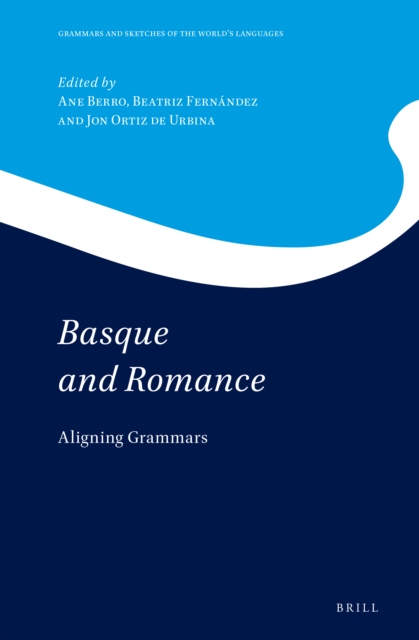
Basque and Romance : aligning grammars
Aligning Grammars: Basque and Romance offers a theoretically-informed in-depth description of several linguistic structures of Basque and surrounding Romance languages. Its goal is to shed some light on the linguistic systems of these languages and their interactions.
eBook

Operation LiLi: Using Crowd-Sourced Data and Automatic Alignment to Investigate the Phonetics and Phonology of Less-Resourced Languages
Less-resourced languages are usually left out of phonetic studies based on large corpora. We contribute to the recent efforts to fill this gap by assessing how to use open-access, crowd-sourced audio data from Lingua Libre for phonetic research. Lingua Libre is a participative linguistic library developed by Wikimedia France in 2015. It contains more than 670k recordings in approximately 150 languages across nearly 740 speakers. As a proof of concept, we consider the Inventory Size Hypothesis, which predicts that, in a given system, variation in the realization of each vowel will be inversely related to the number of vowel categories. We investigate data from 10 languages with various numbers of vowel categories, i.e., German, Afrikaans, French, Catalan, Italian, Romanian, Polish, Russian, Spanish, and Basque. Audio files are extracted from Lingua Libre to be aligned and segmented using the Munich Automatic Segmentation System. Information on the formants of the vowel segments is then extracted to measure how vowels expand in the acoustic space and whether this is correlated with the number of vowel categories in the language. The results provide valuable insight into the question of vowel dispersion and demonstrate the wealth of information that crowd-sourced data has to offer.
Journal Article

Language distance and non-native syntactic processing: Evidence from event-related potentials
In this study, we explore native and non-native syntactic processing, paying special attention to the language distance factor. To this end, we compared how native speakers of Basque and highly proficient non-native speakers of Basque who are native speakers of Spanish process certain core aspects of Basque syntax. Our results suggest that differences in native versus non-native language processing strongly correlate with language distance: native/non-native processing differences obtain if a syntactic parameter of the non-native grammar diverges from the native grammar. Otherwise, non-native processing will approximate native processing as levels of proficiency increase. We focus on three syntactic parameters: (i) the head parameter, (ii) argument alignment (ergative/accusative), and (iii) verb agreement. The first two diverge in Basque and Spanish, but the third is the same in both languages. Our results reveal that native and non-native processing differs for the diverging syntactic parameters, but not for the convergent one. These findings indicate that language distance has a significant impact in non-native language processing.
Journal Article

The acquisition of copula verbs in Basque by bilinguals
This article focuses on the acquisition of copula verbs in Basque by Basque–Spanish bilinguals. Basque and Spanish have two copula verbs: izan and egon and ser and estar, respectively. Basque copulas are similar to their Spanish counterparts in terms of the grammatical contexts in which they are used. However, Basque and Spanish differ in one specific property, the progressive, which is built with izan in Basque. This article assumes the theoretical framework of Zagona for Basque because copula selection can be accounted for by this approach. The present study is the first one to address the issue of the acquisition of copula verbs by Basque–Spanish bilingual children in Basque; we analyze the language used in a storytelling task by 19 Basque-dominant bilinguals compared to that used by 19 child L2 Basque learners, in order to elucidate whether both groups of bilingual children use the copula in a target-like way in Basque. The study shows that no copula choice errors are produced by any of the participants with any predicates. The distribution of the predicates very much resembles the distribution of the predicates in previous studies for Spanish. Adhering to Zagona’s framework, the progressive was included in our study. In this respect, the progressive is used in a target-deviant manner, a finding that can be attributed to crosslinguistic influence. These results are ultimately attributed to children’s parallel knowledge of both interpretable and uninterpretable features, although uninterpretable features seem to be acquired a little earlier.
Journal Article

Faster and Further Morphosyntactic Development of CLIL vs. EFL Basque-Spanish Bilinguals Learning English in High-School
A general advantage in proficiency has been repeatedly reported for learners receiving Content and Language Integrated Learning (CLIL) when compared to learners who only receive English lessons. However, fine-grained studies addressing the aspects which make up this general advantage are still scarce. Within this context, this paper concentrates on the morphosyntactic development of two groups of (Basque-Spanish) adolescents learning English in high-school over a two-year period. One group (n = 15) received CLIL instruction and English classes while the other group (n = 11) only received English classes. The results indicate a clear advantage for the CLIL group, which seems to be at a further developmental stage. Nonetheless, both groups improve over the two years and, unlike previous claims in schools, no signs of fossilization are found although inaccuracies in inflection still exist. In light of these results, the value of increasing exposure in the form of CLIL lessons in high-school is discussed.
Journal Article
Object–verb and verb–object in Basque and Spanish monolinguals and bilinguals
The aim of this article is to analyse the acquisition of object–verb/verb–object word order in Spanish and Basque by monolinguals (L1), early simultaneous bilinguals (2L1) and successive bilinguals, exposed to their second language before ages 5–6 (child L2). In this study, the second language (child L2) is acquired naturalistically, in a preschool setting with no formal instruction for the Basque L2 speakers and by environmental contact for the Spanish L2 speakers. Spanish and Basque are differentiated by their canonical word order as subject–verb–object and subject–object–verb, respectively. In Spanish, the subject–verb–object order is predominant (almost exclusive) in narrative contexts, whereas in Basque, both object–verb and verb–object word orders are possible in these contexts for pragmatic reasons, with a similar use in everyday language. The productions of a few L1 and 2L1 subjects are analysed longitudinally within the 1;06–3;00 age span. Cross-sectional data from 49 subjects who developed a child L2 are analysed at ages 5 and 8. The results reveal that the bilingual children apply the same syntactic patterns as the monolinguals in their respective languages independently of 2L1 or child L2 acquisition.
Journal Article
Double object constructions in L3 English: An exploratory study of morphological and semantic constraints
The present study examines the acquisition of double object constructions (DOCs) (Susan gave Peter an apple) by 90 Basque/Spanish learners of English as a third language (L3). The aim of this study was to explore whether (i) learners established a distinction when accepting DOCs vs. prepositional phrase constructions (PPCs) (Susan gave an apple to Peter), (ii) they were sensitive to the morphological and semantic constraints found in English DOCs and (iii) proficiency effects could be observed. Results from a self-paced reading task and an auto-paced reading task showed that Basque/Spanish learners were more accurate in morphosyntactic properties than in semantic ones. Even though learners showed difficulties in both morphological and semantic constraints, these seem to be overcome by increasing proficiency.
Journal Article
Delay, interference and bilingual development: The acquisition of verbal morphology in children learning Basque and Spanish
In this article, I examine the acquisition of verbal agreement morphology in a cross-sectional study of 20 bilingual children and 19 monolingual children acquiring Basque and Spanish. The results indicate that some of the bilingual children produce more root infinitives (RIs) in Basque than monolingual children do. I claim that this discrepancy is a consequence of different patterns of exposure to Basque that the children receive, rather than being attributable to cross-linguistic influence from Spanish. I discuss the implications of these findings for theories of bilingual development as well as for morphological acquisition more generally.
Journal Article