
Catalogue Search | MBRL


Are you sure you want to remove the book from the shelf?

{{itemTitle}}
1,091
result(s) for
"Basque language."
Sort by:
Noun phrases and nominalization in Basque : syntax and semantics
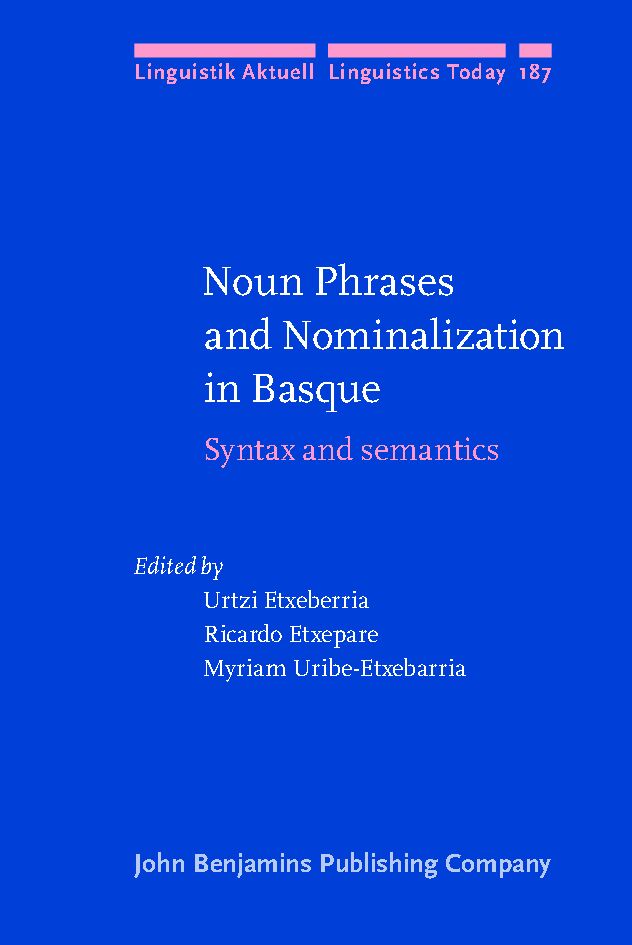
This paper makes two claims about non-finite constituents headed by the affixes -tu/-i/-n/-Ø in Basque. First the semantics of these elements in modal contexts indicates that the standard analysis of these constituents as aspectual phrases is incorrect. We argue that -tu/-i/-n/-Ø are merged as infinitival markers, which we take to be of category n. In perfective contexts the verb+-tu/-i/-n/-Ø raises to a null perfective modal. Second, we argue that differences in behaviour of -tu/-i/-n/-Ø-headed constituents across contexts are usefully expressed in terms of variation in the richness of nominal and verbal functional layers following Alexiadou et al. (2009, 2010, 2011).
eBook


Standard Basque : a progressive grammar
The first modern pedagogically oriented reference to the grammar of standard Basque (Euskara Batua), in two volumes: Part 1 presents detailed grammar lessons, Part 2 glosses and supplementary materials.
eBook
Basque and Romance : aligning grammars
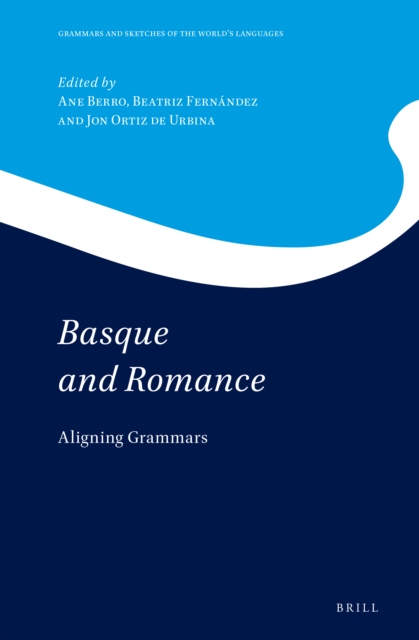
Aligning Grammars: Basque and Romance offers a theoretically-informed in-depth description of several linguistic structures of Basque and surrounding Romance languages. Its goal is to shed some light on the linguistic systems of these languages and their interactions.
eBook


Towards Multilingual Education
This volume focuses on issues such as the learning, use and
assessment of languages in education, the age factor, the
teaching of English as an international language and
multilingualism at the university, in educational contexts in
which several languages are taught either as subjects or
languages of instruction. Jasone Cenoz proposes the 'Continua
of Multilingual Education' as a tool to identify different
types of multilingual schools and focuses on Basque educational
research to discuss issues that are relevant for other
contexts. 'Towards Multilingual Education: Basque Educational
Research in International Perspective' is an up to date and
comprehensive review of research involving Basque, Spanish and
English in Basque schools. The book will be of great value to
researchers, professionals and students interested in
multilingualism and multilingual education all over the
world.
eBook
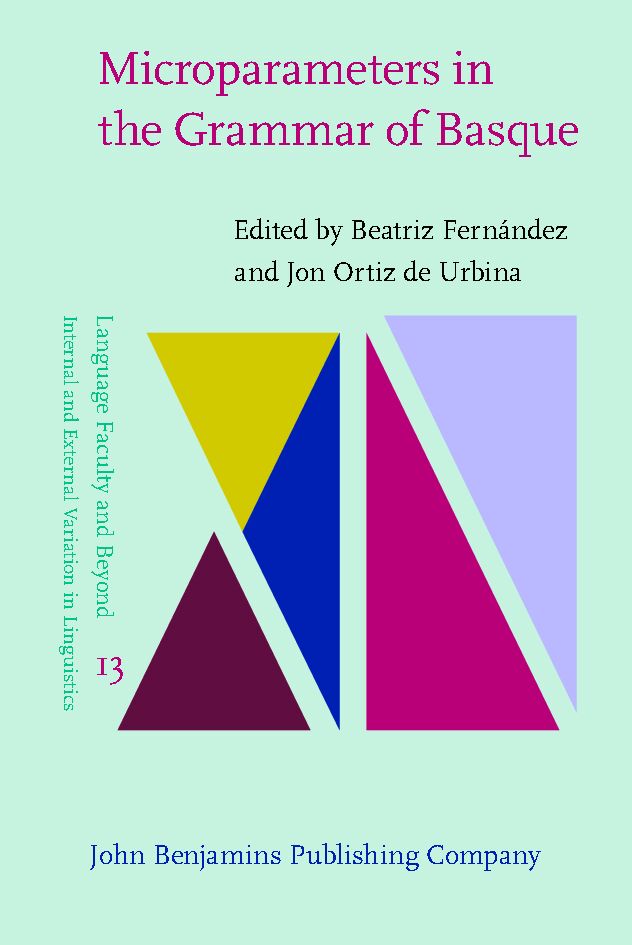
Microparameters in the Grammar of Basque
This book is an endeavor to present and analyze some standard topics in the grammar of Basque from a micro-comparative perspective. From case and agreement to word order and the left periphery, and including an incursion into determiners, the book combines fine-grained theoretical analyses with empirically detailed descriptions. Working from a micro-parametric perspective, the contributions to the volume address in depth some of the exuberant variation attested in the different dialects and subdialects of Basque. At the same time, although the contributions focus mainly on Basque data, cross-linguistic evidence is also presented and discussed. After all, the goal pursued in this book is to attempt to explain variation in Basque as a particular instantiation of variation in human language at large. The volume presents and analyzes a wide range of empirical phenomena, many typologically marked among European languages, and will therefore be a welcome resource to linguists looking for detailed description and/or theoretical discussion.
eBook