
Catalogue Search | MBRL


Are you sure you want to remove the book from the shelf?

{{itemTitle}}
8,398
result(s) for
"Beat generation."
Sort by:


Scattered Poems
Just as he upended the conventions of the novel with On the Road, Jack Kerouac revolutionized American poetry in this ingenious collection Bringing together selections from literary journals and his private notebooks, Jack Kerouac's Scattered Poems exemplifies the Beat Generation icon's innovative approach to language. Kerouac's poems, populated by hitchhikers, Chinese grocers, Buddhist saints, and cultural figures from Rimbaud to Harpo Marx, evoke the primal and the sublime, the everyday and the metaphysical. Scattered Poems, which includes the playfully instructive \"How to Meditate,\" the sensory \"San Francisco Blues,\" and an ode to Kerouac's fellow Beat Allen Ginsberg, is rich in striking images and strident urgency. Kerouac's widespread influences feel new and fresh in these poems, which echo the rhythm of improvisational jazz music, and the centuries-old structure of Japanese haiku. In rebelling against the dry rules and literary pretentiousness he perceived in early twentieth-century poetry, Kerouac pioneered a poetic style informed by oral tradition, driven by concrete language with neither embellishment nor abstraction, and expressed through spontaneous, uncensored writing.
eBook


The Town and the City
A quintessential American family is pulled apart by war and the rapidly changing tides of society in Jack Kerouac's captivating first novel Published seven years before his iconic On the Road, Jack Kerouac's debut novel follows the experiences of one family as they navigate the seismic cultural shifts following World War II. Inspired by Kerouac's own New England youth, the eight Martin children enjoy an idyllic upbringing in a small Massachusetts mill-town. Middle son Peter, a budding intellectual and promising athlete, most strongly feels the lure of the future. When war breaks out, the siblings' lives are interrupted by military service; their parents must sell their house after the family business goes bankrupt; and Peter, eager to see the world, voyages overseas as a Merchant Marine. After returning home, Peter is drawn to the kinetic energy of New York City and the progressive, bohemian ideas springing from its denizen young poets, writers, and artists. His new friends are fictionalized versions of Kerouac's contemporaries: Allen Ginsberg (as Leon Levinsky), Lucien Carr (as Kenneth Wood), and William Burroughs (as Will Dennison), and other members of the Beat Generation. Seen by Peter's parents as hoodlums and junkies, the Beats challenge conventional American ideas of everything from authority and religion to marriage and domestic life.
eBook

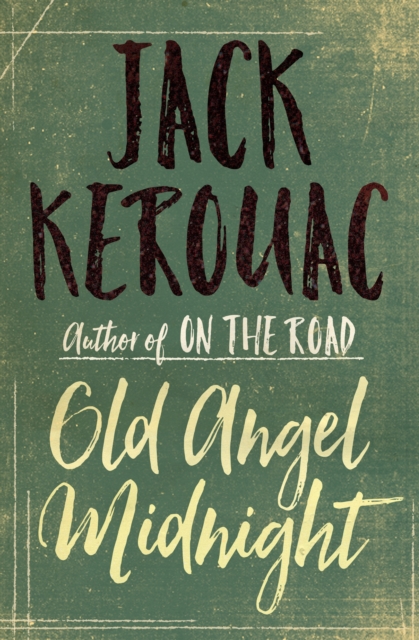
Old Angel Midnight
A sensory narrative poem capturing the rhythms of the universe and secrets of the subconscious with stunning linguistic dexterity from the author of On the Road A spontaneous writing project in the form of an extended prose poem, this sonorous and spiritually playful book is one of Jack Kerouac's most boldly experimental works. Collected from five notebooks dating from 1956 to 1959—a time in which Kerouac was immersed in Buddhist theory— Old Angel Midnight is comprised of sixty-seven short sections unified by an unwavering dedication to sounds, the subconscious, and verbal ingenuity. Friday Afternoon in the Universe, in all directions in & out you got your men women dogs children horses pones tics perts parts pans pools palls pails parturiences and petty Thieveries that turn into heavenly Buddha. Thus begins Kerouac's Joycean language dance. From birdsong to dharmic verse, street jargon to French slang, the resonances of the universe come blaring in though the windows, unfurling their meaning as the mind lets go and listens.
eBook


The sensation of groove engages motor and reward networks
The sensation of groove has been defined as the pleasurable desire to move to music, suggesting that both motor timing and reward processes are involved in this experience. Although many studies have investigated rhythmic timing and musical reward separately, none have examined whether the associated cortical and subcortical networks are engaged while participants listen to groove-based music. In the current study, musicians and non-musicians listened to and rated experimentally controlled groove-based stimuli while undergoing functional magnetic resonance imaging. Medium complexity rhythms elicited higher ratings of pleasure and wanting to move and were associated with activity in regions linked to beat perception and reward, as well as prefrontal and parietal regions implicated in generating and updating stimuli-based expectations. Activity in basal ganglia regions of interest, including the nucleus accumbens, caudate and putamen, was associated with ratings of pleasure and wanting to move, supporting their important role in the sensation of groove. We propose a model in which different cortico-striatal circuits interact to support the mechanisms underlying groove, including internal generation of the beat, beat-based expectations, and expectation-based affect. These results show that the sensation of groove is supported by motor and reward networks in the brain and, along with our proposed model, suggest that the basal ganglia are crucial nodes in networks that interact to generate this powerful response to music.
Journal Article


Short-Term Heart Rate Variability—Influence of Gender and Age in Healthy Subjects
In the recent years, short-term heart rate variability (HRV) describing complex variations of beat-to-beat interval series that are mainly controlled by the autonomic nervous system (ANS) has been increasingly analyzed to assess the ANS activity in different diseases and under various conditions. In contrast to long-term HRV analysis, short-term investigations (<30 min) provide a test result almost immediately. Thus, short-term HRV analysis is suitable for ambulatory care, patient monitoring and all those applications where the result is urgently needed. In a previous study, we could show significant variations of 5-min HRV indices according to age in almost all domains (linear and nonlinear) in 1906 healthy subjects from the KORA S4 cohort. Based on the same group of subjects, general gender-related influences on HRV indices are to be determined in this study. Short-term 5-min HRV indices from linear time and frequency domain and from nonlinear methods (compression entropy, detrended fluctuation analysis, traditional and segmented Poincaré plot analysis, irreversibility analysis, symbolic dynamics, correlation and mutual information analysis) were determined from 782 females and 1124 males. First, we examined the gender differences in two age clusters (25-49 years and 50-74 years). Secondly, we investigated the gender-specific development of HRV indices in five age decade categories, namely for ages 25-34, 35-44, 45-54, 55-64 and 65-74 years. In this study, significant modifications of the indices according to gender could be obtained, especially in the frequency domain and correlation analyses. Furthermore, there were significant modifications according to age in nearly all of the domains. The gender differences disappeared within the last two age decades and the age dependencies disappeared in the last decade. To summarize gender and age influences need to be considered when performing HRV studies even if these influences only partly differ.
Journal Article