
Catalogue Search | MBRL


Are you sure you want to remove the book from the shelf?

{{itemTitle}}
927
result(s) for
"Becker, Gary"
Sort by:


Gary Becker's A Theory of the Allocation of Time
Becker's (1965) paper, 'A Theory of the Allocation of Time' revolutionised the modelling of household behaviour, by unifying Marshallian demand functions for goods with labour supply and related time use decisions within the household. In this article, we first summarise Becker's time allocation model and associated key contributions, then we show how his original framework extends to modern collective household models.
Journal Article

Human capital for humans : an accessible introduction to the economic science of people
\"An everyday introduction to the most consequential science of modern life. University of Chicago economist Gary Becker won the Nobel Prize largely for his advancement of human capital theory-the idea that investing in a person's knowledge and skills has a wide range of economic effects. Becker's writing on the subject was technical, but his teaching, especially in his famous doctoral course at UChicago, remains legendary for its accessibility, brilliance, and applications to everyday life. In Human Capital for Humans, economist and former Becker student Pablo A. Peña channels this classroom approach to produce an accessible, essential guide to understanding the science that has become synonymous with modern life and the economy. With an illustrative and immersive style, Peña unpacks the human capital approach to domains such as parenting, aging, marriage, health, and household labor. The result is not only intellectually elevated, but an essential introduction for learners and teachers of this subject across business, management, economics, policy, and beyond\"-- Provided by publisher.
BOOK

Gary Becker's early work on human capital: Collaborations and distinctiveness
In a prolific and illustrious career, the late Gary Becker (1930 - 2014) developed what he would later call \"the economic approach to human behaviour\". One of the most significant strands of that research was that which focused on human capital, occuping a significant part of his career, especially in his early years. In this paper we will focus on Becker's early work in human capital up to the publication of his book in 1964, a period that laid the foundations for his career and in which he tested the possibilities of (and the resistance to) this economic approach to human behaviour. We will explore the context in which the book was developed and the interactions with other people that were laying the foundations for human capital research, namely those working at the Chicago and Columbia Departments of Economics.
Journal Article

Gary Becker: Model Economic Scientist
This paper presents Gary Becker's approach to conducting creative, empirically fruitful economic research. It describes the traits and methodology that made him such a productive and influential scholar.
Journal Article
Gary Becker as Teacher
This paper looks at the work of Gary S. Becker, American economist, professor of sociology, friend, and colleague of Kevin M. Murphy. Murphy discusses the traditional approach of Becker's teaching and ideas as they were expressed through his wealth of content and style in course design; his discussions on the role of preferences, technology, and constraints as they influence household production; and his emphasis on the importance of markets and desire for more. Murphy recognizes Becker's teaching style as groundbreaking, unapologetic, and pure economics.
Journal Article
Gary Becker's Impact on Economics and Policy
Gary Becker was one of the greatest thinkers of the 20th century. He advanced social science by introducing economic thinking into areas that were thought to be off limits. Because his theory was motivated by his desire to explain the world, his analyses were highly policy relevant. His work on discrimination, deterrence of crime, fertility, human capital, and the family all produced implications that were testable and verified by his and others' empirical research. Equally important, each research area provided policy guidance and many of his ideas have been implemented by government and non-government organizations.
Journal Article

GARY BECKER ON THE QUANTITY AND QUALITY OF CHILDREN
Before Gary Becker, fertility choice was widely considered to be outside the realm of economic analysis. Apart from intellectual tradition, one reason for this was that the data on fertility did not immediately suggest an economic mechanism. In industrialized countries, fertility had declined strongly over time, even though family incomes were rising. Similarly, in many studies using cross-sectional data the relationship between family income and fertility had been shown to be either flat or declining. To many observers, these observations suggested that the “taste” for children had waned over time and that high income families placed less value on childbearing than the poor.
Journal Article
BECKER AND THE DEMOGRAPHIC TRANSITION
It was a different era when Gary Becker did his groundbreaking work on the economics of fertility, during the years from the late 1950 through the early 1990s. There was great concern then about the “population explosion” due to sustained high fertility in the developing world after mortality declined following World War II. In 1968, Paul Ehrlich published “The Population Bomb” predicting disaster and mass starvation due to rapid population growth: “The battle to feed all of humanity is over. In the 1970s, the world will undergo famines – hundreds of millions of people are going to starve to death. . . .” Robert McNamara, then the President of the World Bank, in 1984 said “Short of thermonuclear war itself, population growth is the gravest issue the world faces over the decades immediately ahead. If we do not act, the problem will be solved by famine, riots, insurrection and war.”
Journal Article
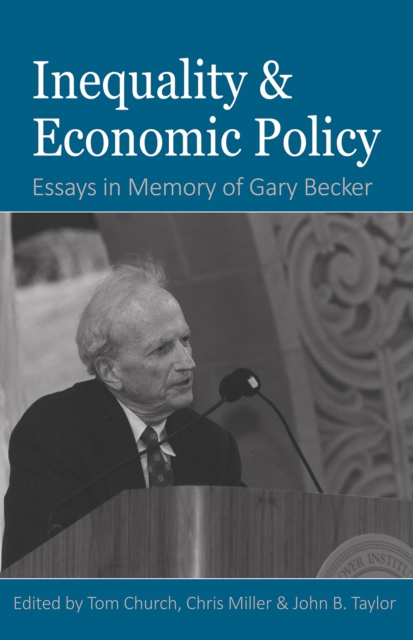
Inequality and Economic Policy
Drawing from a 2014 Hoover Institution Conference on Inequality in honor of Gary Becker, a group of distinguished contributors explore various measures of inequality in America and address the issue of whether or not it is increasing. In looking at this question and examining policy implications, the authors draw on research on human capital and intergenerational mobility. The authors suggest that the emphasis on inequality and redistribution, while not wrong, is nevertheless misplaced, for it may lead us to adopt policies that will disrupt the progress we have made while doing nothing to promote the kind of growth that is essential to national progress.
eBook