
Catalogue Search | MBRL


Are you sure you want to remove the book from the shelf?

{{itemTitle}}
864
result(s) for
"Becker, Gary S"
Sort by:


Gary Becker's early work on human capital: Collaborations and distinctiveness
In a prolific and illustrious career, the late Gary Becker (1930 - 2014) developed what he would later call \"the economic approach to human behaviour\". One of the most significant strands of that research was that which focused on human capital, occuping a significant part of his career, especially in his early years. In this paper we will focus on Becker's early work in human capital up to the publication of his book in 1964, a period that laid the foundations for his career and in which he tested the possibilities of (and the resistance to) this economic approach to human behaviour. We will explore the context in which the book was developed and the interactions with other people that were laying the foundations for human capital research, namely those working at the Chicago and Columbia Departments of Economics.
Journal Article

Gary Becker as Teacher
This paper looks at the work of Gary S. Becker, American economist, professor of sociology, friend, and colleague of Kevin M. Murphy. Murphy discusses the traditional approach of Becker's teaching and ideas as they were expressed through his wealth of content and style in course design; his discussions on the role of preferences, technology, and constraints as they influence household production; and his emphasis on the importance of markets and desire for more. Murphy recognizes Becker's teaching style as groundbreaking, unapologetic, and pure economics.
Journal Article
Gary Becker's Impact on Economics and Policy
Gary Becker was one of the greatest thinkers of the 20th century. He advanced social science by introducing economic thinking into areas that were thought to be off limits. Because his theory was motivated by his desire to explain the world, his analyses were highly policy relevant. His work on discrimination, deterrence of crime, fertility, human capital, and the family all produced implications that were testable and verified by his and others' empirical research. Equally important, each research area provided policy guidance and many of his ideas have been implemented by government and non-government organizations.
Journal Article

Does internet use benefit health?—PSM-DID evidence from China’s CHARLS
Amid the increasing global internet penetration, understanding the impact of internet use on residents’ health is crucial. This aids in formulating more effective health policies and provides empirical evidence for promoting health equity and improving overall public health. Drawing on the China Health and Retirement Longitudinal Study (CHARLS), this paper employs the Propensity Score Matching-Difference in Differences (PSM-DID) method to examine the impact of the internet on individual health and further explores the pathways through which the internet affects health. We introduce the research background and significance in the introduction. Then, in the theoretical analysis, it incorporates internet variables into the Becker health demand model to analyze changes in health demand and impact pathways. The empirical analysis tests the theoretical findings, leading to empirical results. Finally, the study discusses the results and provides relevant recommendations. The findings indicate significant positive effects of the internet on both physical and psychological health. These effects are realized through reducing health information asymmetry, lowering health costs, and increasing exposure to health-promoting environments. In the heterogeneity analysis, economic-related internet content shows a significant positive impact on resident health. Intensive internet use adversely affects psychological health. The beneficial effects of the internet on health are more pronounced among older individuals, those covered by medical insurance, and regions with higher levels of digital economy. Based on these findings, the study offers policy recommendations concerning individuals’ internet use patterns, the digital evolution of the healthcare industry, and government infrastructure development.
Journal Article
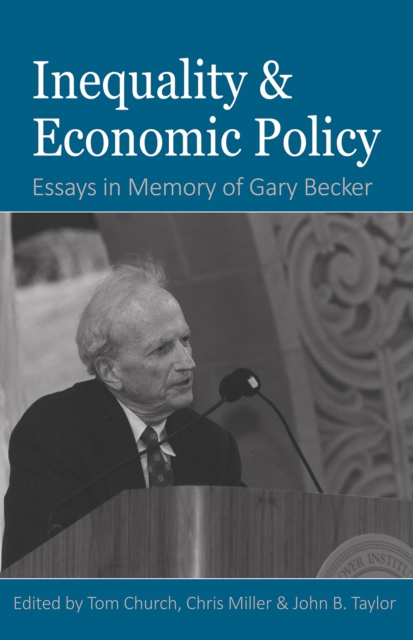
Inequality and Economic Policy
Drawing from a 2014 Hoover Institution Conference on Inequality in honor of Gary Becker, a group of distinguished contributors explore various measures of inequality in America and address the issue of whether or not it is increasing. In looking at this question and examining policy implications, the authors draw on research on human capital and intergenerational mobility. The authors suggest that the emphasis on inequality and redistribution, while not wrong, is nevertheless misplaced, for it may lead us to adopt policies that will disrupt the progress we have made while doing nothing to promote the kind of growth that is essential to national progress.
eBook

BECKER AND THE DEMOGRAPHIC TRANSITION
It was a different era when Gary Becker did his groundbreaking work on the economics of fertility, during the years from the late 1950 through the early 1990s. There was great concern then about the “population explosion” due to sustained high fertility in the developing world after mortality declined following World War II. In 1968, Paul Ehrlich published “The Population Bomb” predicting disaster and mass starvation due to rapid population growth: “The battle to feed all of humanity is over. In the 1970s, the world will undergo famines – hundreds of millions of people are going to starve to death. . . .” Robert McNamara, then the President of the World Bank, in 1984 said “Short of thermonuclear war itself, population growth is the gravest issue the world faces over the decades immediately ahead. If we do not act, the problem will be solved by famine, riots, insurrection and war.”
Journal Article

Gary Becker Remembered
Gary Becker was an intellectual giant. No one had a greater impact on broadening economics and making its impact fell throughout the social sciences than Becker. Indeed, Milton Friedman once described Gary Becker as the most important social scientist of the second half of the twentieth century. For those of us who knew him, he was the most creative thinker we ever encountered. It was his astounding imagination that made many of his early critics think of him as a heretic. Becker was a scientist in the true sense of the word. He was innovative yet rigorous, open to new thought yet disciplined in sticking to the established rules of analysis. Most importantly, he extended the boundaries of economics to much of social science.
Journal Article
GARY BECKER ON HUMAN CAPITAL
Gary Becker’s work on “human capital” started around 1960. It was motivated by the rising interest in economic growth at the time. As stated in the introduction to the first edition of his book, Human Capital, “The origin of this study can be traced to the finding that a substantial growth in incomes in the US remains after the growth of physical capital and labor has been accounted for”. This unexplained residual suggested to several researchers that unmeasured features of the quality of the labor force must also be brought into consideration. While econometricians such as Edward Denison, Dale Jorgenson, and Zvi Griliches turned to seek better data that would reduce the scope of the unexplained residual, Becker constructed a detailed and original theory regarding the possible effects of a major unobserved and all inclusive factor, termed, human capital, would have on observed outcomes such as wages and education and their variation over time and among individual types. Most of the theoretical results reported in the three editions of Human Capital, 1964, 1975, and 1995 are already anticipated in a single early paper that was published in the Journal of Political Economy in 1962.
Journal Article

What Do Labour Economics and Industrial Relations Have to Say to Each Other?/Qu'ont a se dire l'economie du travail et les relations industrielles?
Mutual gains can be made through greater cross-pollination between labour economics and industrial relations. The paper is organized around common criticisms of labour economics, with examples from industrial relations. Such criticisms, and their underlying principles, often explain important concepts in industrial relations, which can provide insights that may enhance labour economics. The intent here is to apply a forward-looking lens to advance theoretical and empirical reflection on current and future aspects of work and employment.
Journal Article