
Catalogue Search | MBRL


Are you sure you want to remove the book from the shelf?

{{itemTitle}}
3,886
result(s) for
"Belarus"
Sort by:


The kings and the pawns
For many years, the history of Byelorussia under Nazi occupation was written primarily from the perspective of the resistance movement. This movement, a reaction to the brutal occupation policies, was very strong indeed. Still, as the author shows, there existed in Byelorussia a whole web of local institutions and organizations which, some willingly, others with reservations, participated in the implementation of various aspects of occupation policies. The very sensitivity of the topic of collaboration has prevented researchers from approaching it for many years, not least because in the former Soviet territories ideological considerations have played an important role in preserving the topic's \"untouchable\" status. Focusing on the attitude of German authorities toward the Byelorussians, marked by their anti-Slavic and particularly anti-Byelorussian prejudices on the one hand and the motives of Byelorussian collaborators on the other, the author clearly shows that notwithstanding the postwar trend to marginalize the phenomenon of collaboration or to silence it altogether, the local collaboration in Byelorussia was clearly visible and pervaded all spheres of life under the occupation.
eBook


The Belarusian Shtetl
For centuries Jewish shtetls were an active part of Belarusian
life; today, they are gone. The Belarusian Shtetl is a
landmark volume which offers, for the first time in English, an
illuminating look at the shtetls' histories, the lives lived and
lost in them, and the memories, records, and physical traces of
these communities that remain today.
Since 2012, under the auspices of the Sefer Center for
University Teaching of Jewish Civilization, teams of scholars and
students from many different disciplines have returned to the sites
of former Jewish shtetls in Belarus to reconstruct their past.
These researchers have interviewed a wide range of both Jews and
non-Jews to find and document traces of Shtetl history, to gain
insights into community memories, and to discover surviving markers
of identity and ethnic affiliation. In the process, they have also
unearthed evidence from old cemeteries and prewar houses and the
stories behind memorials erected for Holocaust victims.
Drawing on the wealth of information these researchers have
gathered, The Belarusian Shtetl creates compelling and
richly textured portraits of the histories and everyday lives of
each shtetl. Important for scholars and accessible to the public,
these portraits set out to return the Jewish shtetls to their
rightful places of prominence in the histories and legacies of
Belarus.
eBook
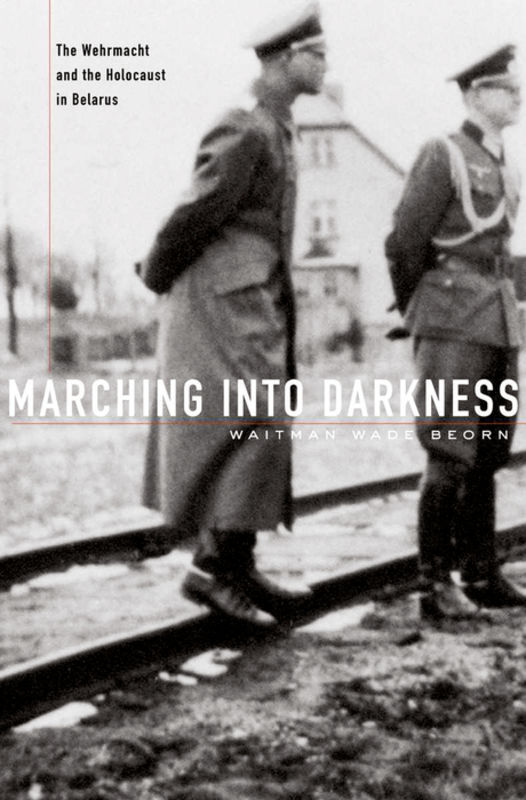
Marching into darkness : the Wehrmacht and the Holocaust in Belarus
On October 10, 1941, the entire Jewish population of the Belarusian village of Krucha was rounded up and shot. This atrocity was the work of footsoldiers in a regular German army unit, acting on its own initiative. Marching into Darkness paints a searing portrait of the Wehrmacht's descent into ever more intimate participation in genocide.
eBook


Occupation in the East
A nuanced, eye-opening portrait of the lives of thousands of Germans, for whom Warsaw and Minsk became home, following their occupation by the Third Reich. Describes their unity in their self-conception as a \"master race.\" Examines how they engaged in acts of shocking brutality against Poles, Belarusians, and Jews, while social conditions became increasingly conducive to systematic mass murder.
eBook


The Rise and Fall of Belarusian Nationalism, 1906–1931
Modern Belarusian nationalism emerged in the early twentieth century during a dramatic period that included a mass exodus, multiple occupations, seven years of warfare, and the partition of the Belarusian lands. In this original history, Per Anders Rudling traces the evolution of modern Belarusian nationalism from its origins in late imperial Russia to the early 1930s.The revolution of 1905 opened a window of opportunity, and debates swirled around definitions of ethnic, racial, or cultural belonging. By March of 1918, a small group of nationalists had declared the formation of a Belarusian People's Republic (BNR), with territories based on ethnographic claims. Less than a year later, the Soviets claimed roughly the same area for a Belarusian Soviet Socialist Republic (BSSR). Belarusian statehood was declared no less than six times between 1918 and 1920. In 1921, the treaty of Riga officially divided the Belarusian lands between Poland and the Soviet Union. Polish authorities subjected Western Belarus to policies of assimilation, alienating much of the population. At the same time, the Soviet establishment of Belarusian-language cultural and educational institutions in Eastern Belarus stimulated national activism in Western Belarus. Sporadic partisan warfare against Polish authorities occurred until the mid-1920s, with Lithuanian and Soviet support. On both sides of the border, Belarusian activists engaged in a process of mythmaking and national mobilization. By 1926, Belarusian political activism had peaked, but then waned when coups d'états brought authoritarian rule to Poland and Lithuania. The year 1927 saw a crackdown on the Western Belarusian national movement, and in Eastern Belarus, Stalin's consolidation of power led to a brutal transformation of society and the uprooting of Belarusian national communists.As a small group of elites, Belarusian nationalists had been dependent on German, Lithuanian, Polish, and Soviet sponsors since 1915. The geopolitical rivalry provided opportunities, but also liabilities. After 1926, maneuvering this complex and progressively hostile landscape became difficult. Support from Kaunas and Moscow for the Western Belarusian nationalists attracted the interest of the Polish authorities, and the increasingly autonomous republican institutions in Minsk became a concern for the central government in the Kremlin.As Rudling shows, Belarus was a historic battleground that served as a political tool, borderland, and buffer zone between greater powers. Nationalism arrived late, was limited to a relatively small elite, and was suppressed in its early stages. The tumultuous process, however, established the idea of Belarusian statehood, left behind a modern foundation myth, and bequeathed the institutional framework of a proto-state, all of which resurfaced as building blocks for national consolidation when Belarus gained independence in 1991.
eBook