
Catalogue Search | MBRL


Are you sure you want to remove the book from the shelf?

{{itemTitle}}
2,175
result(s) for
"Belize"
Sort by:

Frommer's Belize
\"Belize is a rising star. With all of the natural allure of Costa Rica, it adds to the mix towering ancient pyramids, superb scuba diving and snorkeling (along the world's second-longest coral reef system), and a culture that's warm and welcoming. Author Ali Wunderman has been covering the country for years and uses her expertise to help you craft the vacation of your dreams.\"--Amazon.com.
Book
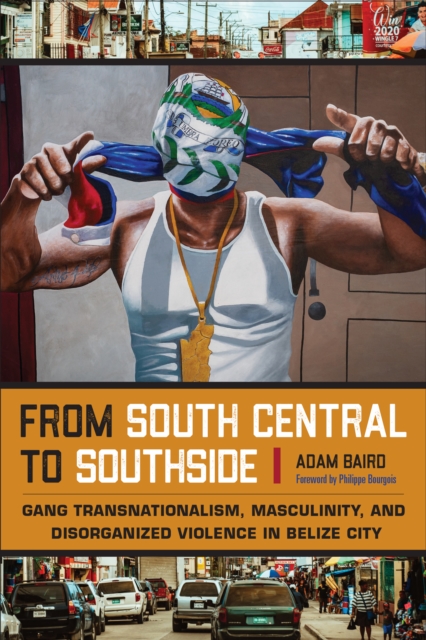
From South Central to Southside
When he visited in 2011, sociologist Adam Baird wondered what the Bloods and Crips were doing in Southside Belize City.He soon discovered that migrant Belizean members of colors gangs from South Central Los Angeles were deported there in the 1980s.
eBook


Classic Maya Provincial Politics
Most treatments of large Classic Maya sites such as Caracol and Tikal regard Maya political organization as highly centralized. Because investigations have focused on civic buildings and elite palaces, however, a critical part of the picture of Classic Maya political organization has been missing.The contributors to this volume chart the rise and fall of the Classic Maya center of Xunantunich, paying special attention to its changing relationships with the communities that comprised its hinterlands. They examine how the changing relationships between Xunantunich and the larger kingdom of Naranjo affected the local population, the location of their farms and houses, and the range of economic and subsistence activities in which both elites and commoners engaged. They also examine the ways common people seized opportunities and met challenges offered by a changing political landscape.The rich archaeological data in this book show that incorporating subject communities and people-and keeping them incorporated-was an on-going challenge to ancient Maya rulers. Until now, archaeologists have lacked integrated regional data and a fine-grained chronology in which to document short-term shifts in site occupations, subsistence strategies, and other important practices of the daily life of the Maya. This book provides a revised picture of Maya politics-one of different ways of governing and alliance formation among dominant centers, provincial polities, and hinterland communities.
eBook


Chan
The farming community of Chan thrived for over twenty centuries, surpassing the longevity of many larger Maya urban centers. Between 800 BC and 1200 AD it was a major food production center, and this collection of essays reveals the important role played by Maya farmers in the development of ancient Maya society.
Chan offers a synthesis of compelling and groundbreaking discoveries gathered over ten years of research at this one archaeological site in Belize. The contributors develop three central themes, which structure the book. They examine how sustainable farming practices maintained the surrounding forest, allowing the community to exist for two millennia. They trace the origins of elite Maya state religion to the complex religious belief system developed in small communities such as Chan. Finally, they describe how the group-focused political strategies employed by local leaders differed from the highly hierarchical strategies of the Classic Maya kings in their large cities.
In breadth, methodology, and findings, this volume scales new heights in the study of Maya society and culture.
eBook


A Natural History of Belize
Belize's Chiquibul Forest is one of the largest remaining expanses of tropical moist forest in Central America. It forms part of what is popularly known as the Maya Forest. Battered by hurricanes over millions of years, occupied by the Maya for thousands of years, and logged for hundreds of years, this ecosystem has demonstrated its remarkable ecological resilience through its continued existence into the twenty-first century. Despite its history of disturbance, or maybe in part because of it, the Maya Forest is ranked as an important regional biodiversity hot spot and provides some of the last regional habitats for endangered species such as the jaguar, the scarlet macaw, Baird's tapir, and Morelet's crocodile. A Natural History of Belize presents for the first time a detailed portrait of the habitats, biodiversity, and ecology of the Maya Forest, and Belize more broadly, in a format accessible to a popular audience. It is based in part on the research findings of scientists studying at Las Cuevas Research Station in the Chiquibul Forest. The book is unique in demystifying many of the big scientific debates related to rainforests. These include \"Why are tropical forests so diverse?\"; \"How do flora and fauna evolve?\"; and \"How do species interact?\" By focusing on the ecotourism paradise of Belize, this book illustrates how science has solved some of the riddles that once perplexed the likes of Charles Darwin, and also shows how it can assist us in managing our planet and forest resources wisely in the future.
eBook

Traveling with sugar : chronicles of a global epidemic
\"Traveling with Sugar reframes the rising diabetes epidemic as part of a five-hundred-year-old global history of sweetness and power. Amid eerie injuries, changing bodies, amputated limbs, and untimely deaths, many people across the Caribbean and Central America simply call the affliction \"sugar\"--Or, as some in Garifuna Belize say, \"traveling with sugar.\" A decade in the making, this book reveals a series of crâonicas--a word meaning both slow-moving story and slow-moving disease. It profiles the careful work of those \"still fighting it,\" as they grapple with unequal material infrastructures and unsettling dilemmas. Guiding us into the surprising landscapes of global diabetes, these individuals speak back to science and policy misrecognitions that have prematurely cast their lost limbs and deaths as normal. Facing a new incarnation of blood sugar, they practice their arts of maintenance and repair, illuminating ongoing struggles to survive and remake larger systems of food, land, technology, and medicine\"--Provided by publisher.
Book

Ancient Maya Cities of the Eastern Lowlands
For more than a century researchers have studied Maya ruins, and sites like Tikal, Palenque, Copán, and Chichén Itzá have shaped our understanding of the Maya. Yet the lowlands of Belize, which were once home to a rich urban tradition that persisted and evolved for almost 2,000 years, are treated as peripheral to these great Classic period sites. The hot and humid climate and dense forests are inhospitable and make preservation of the ruins difficult, but this oft-ignored area reveals much about Maya urbanism and culture.
Using data collected from different sites throughout the Maya lowlands, including the Vaca Plateau and the Belize River Valley, Brett Houk presents the first synthesis of these unique monuments and discusses methods for mapping and excavating. Considering the sites through the theoretical lenses of the built environment and ancient urban planning, Houk vividly reconstructs their political history, how they fit into the larger political landscape of the Classic Maya, and how the ancient cities fell apart over time.
eBook