
Catalogue Search | MBRL


Are you sure you want to remove the book from the shelf?

{{itemTitle}}
454
result(s) for
"Bellettrie."
Sort by:


The German Student Movement and the Literary Imagination
Through a close reading of novels by Ulrike Kolb, Irmtraud Morgner, Emine Sevgi Ozdamar, Bernhard Schlink, Peter Schneider, and Uwe Timm, this book traces the cultural memory of the 1960s student movement in German fiction, revealing layers of remembering and forgetting that go beyond conventional boundaries of time and space. These novels engage this contestation by constructing a palimpsest of memories that reshape readers' understanding of the 1960s with respect to the end of the Cold War, the legacy of the Third Reich, and the Holocaust. Topographically, these novels refute assertions that East Germans were isolated from the political upheaval that took place in the late 1960s and 1970s. Through their aesthetic appropriations and subversions, these multicultural contributions challenge conventional understandings of German identity and at the same time lay down claims of belonging within a German society that is more openly diverse than ever before.
eBook

Film adaptation and its discontents : from Gone with the wind to The passion of the Christ
Most books on film adaptation—the relation between films and their literary sources—focus on a series of close one-to-one comparisons between specific films and canonical novels. This volume identifies and investigates a far wider array of problems posed by the process of adaptation.
Beginning with an examination of why adaptation study has so often supported the institution of literature rather than fostering the practice of literacy, Thomas Leitch considers how the creators of short silent films attempted to give them the weight of literature, what sorts of fidelity are possible in an adaptation of sacred scripture, what it means for an adaptation to pose as an introduction to, rather than a transcription of, a literary classic, and why and how some films have sought impossibly close fidelity to their sources.
After examining the surprisingly divergent fidelity claims made by three different kinds of canonical adaptations, Leitch's analysis moves beyond literary sources to consider why a small number of adapters have risen to the status of auteurs and how illustrated books, comic strips, video games, and true stories have been adapted to the screen. The range of films studied, from silent Shakespeare to Sherlock Holmes to The Lord of the Rings, is as broad as the problems that come under review.
eBook

Electronic literature : new horizons for the literary
A visible presence for some two decades, electronic literature has already produced many works that deserve the rigorous scrutiny critics have long practiced with print literature. Only now, however, with Electronic Literature by N. Katherine Hayles, do we have the first systematic survey of the field and an analysis of its importance, breadth, and wide-ranging implications for literary study. Hayles’s book is designed to help electronic literature move into the classroom. Her systematic survey of the field addresses its major genres, the challenges it poses to traditional literary theory, and the complex and compelling issues at stake. She develops a theoretical framework for understanding how electronic literature both draws on the print tradition and requires new reading and interpretive strategies. Grounding her approach in the evolutionary dynamic between humans and technology, Hayles argues that neither the body nor the machine should be given absolute theoretical priority. Rather, she focuses on the interconnections between embodied writers and users and the intelligent machines that perform electronic texts. Through close readings of important works, Hayles demonstrates that a new mode of narration is emerging that differs significantly from previous models. Key to her argument is the observation that almost all contemporary literature has its genesis as electronic files, so that print becomes a specific mode for electronic text rather than an entirely different medium. Hayles illustrates the implications of this condition with three contemporary novels that bear the mark of the digital.
eBook

White Civility
InWhite CivilityDaniel Coleman breaks the long silence in Canadian literary and cultural studies around Canadian whiteness and examines its roots as a literary project of early colonials and nation-builders.
eBook

Fictions of Dignity
Over the past fifty years, debates about human rights have assumed an increasingly prominent place in postcolonial literature and theory. Writers from Salman Rushdie to Nawal El Saadawi have used the novel to explore both the possibilities and challenges of enacting and protecting human rights, particularly in the Global South. InFictions of Dignity, Elizabeth S. Anker shows how the dual enabling fictions of human dignity and bodily integrity contribute to an anxiety about the body that helps to explain many of the contemporary and historical failures of human rights, revealing why and how lives are excluded from human rights protections along the lines of race, gender, class, disability, and species membership. In the process, Anker examines the vital work performed by a particular kind of narrative imagination in fostering respect for human rights. Drawing on phenomenology, Anker suggests how an embodied politics of reading might restore a vital fleshiness to the overly abstract, decorporealized subject of liberal rights.
Each of the novels Anker examines approaches human rights in terms of limits and paradoxes. Rushdie'sMidnight's Childrenaddresses the obstacles to incorporating rights into a formerly colonized nation's legal culture. El Saadawi'sWoman at Point Zerotakes up controversies over women's freedoms in Islamic society. InDisgrace, J. M. Coetzee considers the disappointments of post-apartheid reconciliation in South Africa. And inThe God of Small Things, Arundhati Roy confronts an array of human rights abuses widespread in contemporary India. Each of these literary case studies further demonstrates the relevance of embodiment to both comprehending and redressing the failures of human rights, even while those narratives refuse simplistic ideals or solutions.
eBook

Strangers in Blood
Strangers in Blood explores, in a range of early modern literature, the association between migration to foreign lands and the moral and physical degeneration of individuals. Arguing that, in early modern discourse, the concept of race was primarily linked with notions of bloodline, lineage, and genealogy rather than with skin colour and ethnicity, Jean E. Feerick establishes that the characterization of settler communities as subject to degenerative decline constituted a massive challenge to the fixed system of blood that had hitherto underpinned the English social hierarchy.
Considering contexts as diverse as Ireland, Virginia, and the West Indies, Strangers in Blood tracks the widespread cultural concern that moving out of England would adversely affect the temper and complexion of the displaced individual, changes that could be fought only through willed acts of self-discipline. In emphasizing the decline of blood as found at the centre of colonial narratives, Feerick illustrates the unwitting disassembling of one racial system and the creation of another.
eBook
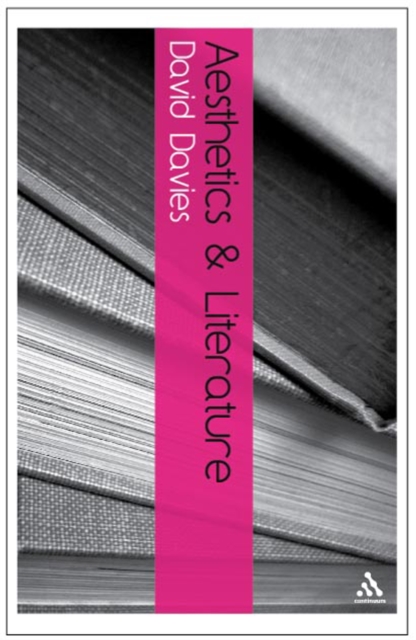
Aesthetics and Literature
The Continuum Aesthetics series looks at the aesthetic questions and issues raised by all major art forms. Stimulating, engaging and highly readable, the series offers food for thought not only for students of aesthetics, but also for anyone with an interest in philosophy and the arts. Aesthetics and Literature places philosophical aesthetics at the heart of thinking about literature. The book takes concrete examples from the traditional and contemporary literary arts and uses them to introduce all the central philosophical issues in literature. David Davies considers, with stimulating insight and great clarity, the nature of literature and fiction, artistic uses of language, and the nature of fictional characters. He goes on to explore our emotional responses to literature, the cognitive value and ethical values of literature and the accountability of the literary arts. The book offers a clear, non-technical analysis of each key issue, its broader significance and the principal positions that philosophers have taken on it. Davies presents the relevant philosophical background in a manner that is accessible to philosophy studentsand lay readers alike. Anyone interested in the philosophy of literature will find this book a rich source of ideas, insight and information. Combining a clear and engaging style with a sophisticated treatment of a fascinating subject, Aesthetics and Literature is a valuable contribution to contemporary aesthetics.
eBook

Censorship and Literature in Fascist Italy
Examining the breadth and scope of censorship in Fascist Italy, from Mussolini's role as 'prime censor' to the specific experiences of female writers, this is a fascinating look at the vulnerability of culture under a dictatorship.
eBook

Victorian Literature
How were the genres of literature changed by new methods of serialization and publishing? How did a widespread culture of performance emerge in the period to shape as well as to be shaped by the novel and poetry? David Amigoni draws on the most recent critical approaches to the novel, Victorian melodrama and poetry to answer these and other questions. The work of Charles Dickens, George Eliot, Oscar Wilde, Alfred Tennyson, Robert Browning, Christina Rossetti, Thomas Hardy, Thomas Carlyle and Mathew Arnold are explored in relation to ideas about fiction, journalism, drama, poetry, the New Woman, gothic, horror and the Victorian sage.
Key Features
Detailed readings of key texts provide models of how to read criticallyDemonstrates the interaction between genres to help think through modes of artistic experimentation and innovation in the periodExamines Neo-Victorian fiction, a popular genre todayStudent resources include electronic and reference sources, further reading and an extensive glossary of key critical terms and historical issues
eBook