
Catalogue Search | MBRL


Are you sure you want to remove the book from the shelf?

{{itemTitle}}
626
result(s) for
"Benefactors"
Sort by:

The embedded portrait : Giotto, Giottino, Angelico
\"A new study of the early Renaissance portrait\"-- Provided by publisher.
Book


In the garden of fugitives
\"Almost twenty years after forbidding him to contact her, Vita receives a letter from a man who has long stalked her from a distance. Once, Royce was her benefactor and she was one of his brightest protégées. Now Royce is ailing and Vitas career as a filmmaker has stalled, and both have reasons for wanting to settle accounts. They enter into an intimate game of words, played according to shifting rules of engagement. Beyond their murky shared history, they are both aware they can use each other to free themselves from deeper pasts. Vita is processing the shameful inheritance of her birthplace, and making sense of the disappearance of her beloved. Royce is haunted by memories of the untimely death of his first love, an archaeologist who worked in the Garden of the Fugitives in Pompeii. Between whats been repressed and what has been disguised are disturbances that reach back through decades, even centuries. But not everything from the past is precious: each gorgeous age is built around a core of rottenness\"--Amazon.com.
Book


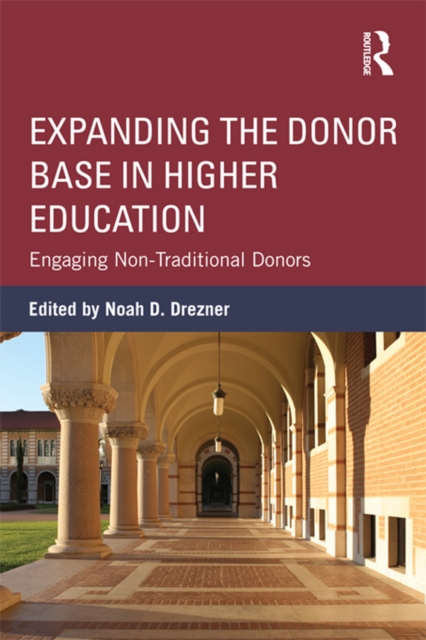
Expanding the Donor Base in Higher Education
Winner of the Association of Fundraising Professionals 2014 Skystone Partners Research Prize in Philanthropy and Fundraising
Traditionally, institutions have relied on wealthy White men to reach their fundraising goals. But as state investment in public higher education lessens and institutions look to philanthropy to move from excellence to eminence, advancement officers continually need to engage all populations, including many that have historically been excluded from fundraising strategies. Based on theory, research, and past practice, Expanding the Donor Base in Higher Education explores how colleges and universities can build culturally sensitive fundraising and engagement strategies. This edited book presents emerging research on different communities that have not traditionally been approached for fundraising-including Lesbian, Gay, Bisexual, Transgender, and Queer (LGBTQ) alumni, African Americans, Latinos, graduate students, young alumni, women, and faculty donors. Chapters discuss and analyze successful programs and provide practical suggestions and strategies to create and implement fundraising programs that engage these new donor populations. Expanding the Donor Base in Higher Education is an essential resource for any institution looking to expand their pool of donors and cultivate a more philanthropic mindset among alumni and students.
eBook

Philanthropy and American higher education
\"Philanthropy and American Higher Education follows the issues that have persisted in giving and receiving philanthropy to American colleges and universities from the seventeenth century to present day. Through historical, philosophical, economic and legal perspectives, along with data analysis, Thelin and Trollinger outline their belief that support of higher education through philanthropy is central to the historic and future character of colleges and universities. This timely work is essential to the present and future financial planning and academic direction of institutions, and the future of philanthropy for colleges and universities across the country\"-- Provided by publisher.
Book

Intangible Benefactors and the Contribution of Construal Level and Attitude Accessibility in Predicting Gratitude and Expansive Emotions
We tested whether manipulating construal level would change the experience of gratitude or other expansive emotions (gratitude, awe, compassion) and negative emotions. We also examined whether construal level was correlated with the type of gratitude benefactor that participants spontaneously listed, focusing especially on God and non-theistic intangible benefactors compared to tangible human benefactors. We manipulated construal level in 265 U.S.-based CloudResearch participants to test preregistered hypotheses that high-level construals would elicit more examples of gratitude toward intangible benefactors and increase expansive emotions. We conducted additional exploratory analyses, investigating whether attitude accessibility of God as a benefactor was correlated with increases in expansive emotions. High construal level manipulation was associated with more frequently listing non-theistic intangible benefactors. Further, trait construal level predicted expansive emotions. Additionally, attitude accessibility of God as a benefactor was positively related to expansive emotions. We discuss future research possibilities to differentiate between gratitude toward tangible and intangible benefactors and the use of attitude accessibility as an implicit measure of benefactor importance.
Journal Article