
Catalogue Search | MBRL


Are you sure you want to remove the book from the shelf?

{{itemTitle}}
85
result(s) for
"Benelux countries"
Sort by:


Books and Prints at the Heart of the Catholic Reformation in the Low Countries (16th-17th Centuries)
Often considered the advent of mass media, the use of books and prints by Protestants has been widely studied and has generated a rich and plentiful bibliography. In contrast, the production and use of the same media by the proponents of the Counter-Reformation have not received the attention they deserve, especially in the context of the Low Countries. The twelve chapters in this volume provide new perspectives on the efficacy of the handpress book industry to support the Catholic strategy in the Spanish Low Countries and underline the mutually beneficial relationship between the Counter-Reformation and the typographic world. This volume represents an important contribution to our understanding of the sociocultural and socioeconomic background of the Catholic Netherlands.
eBook


Pious memories : the wall-mounted memorial in the Burgundian Netherlands
In Pious Memories Douglas Brine examines the context, function, and meaning of early Netherlandish memorials (in the form of sculptures, paintings, and brasses), and the role they played in commemorating the dead in the Low Countries during the fifteenth century.
eBook


Cities of Commerce
Cities of Commerce develops a model of institutional change in European commerce based on urban rivalry. Cities continuously competed with each other by adapting commercial, legal, and financial institutions to the evolving needs of merchants. Oscar Gelderblom traces the successive rise of Bruges, Antwerp, and Amsterdam to commercial primacy between 1250 and 1650, showing how dominant cities feared being displaced by challengers while lesser cities sought to keep up by cultivating policies favorable to trade. He argues that it was this competitive urban network that promoted open-access institutions in the Low Countries, and emphasizes the central role played by the urban power holders--the magistrates--in fostering these inclusive institutional arrangements. Gelderblom describes how the city fathers resisted the predatory or reckless actions of their territorial rulers, and how their nonrestrictive approach to commercial life succeeded in attracting merchants from all over Europe.
Cities of Commerce intervenes in an important debate on the growth of trade in Europe before the Industrial Revolution. Challenging influential theories that attribute this commercial expansion to the political strength of merchants, this book demonstrates how urban rivalry fostered the creation of open-access institutions in international trade.
eBook

The logic of political conflict in medieval cities : Italy and the Southern Low Countries, 1370-1440
This title traces the logic of urban political conflict in late medieval Europe's most heavily urbanised regions, Italy and the Southern Low Countries, revealing how conflict in these regions gave rise to a distinct form of political organisation.
Book

Literary Cultures and Public Opinion in the Low Countries, 1450-1650
In the early modern Low Countries, literary culture functioned on several levels simultaneously: it provided learning, pleasure, and entertainment while also shaping public debate. From a ditty in Dutch sung in the streets to a funeral poem in Latin composed to be read for or by intimate friends, from a play performed for a prince to a comedy written for pupils – literary texts and performances often dealt with highly controversial topics of religion or politics, on a local or national, but also on a supranational scale. This volume sets out to analyse the role and function of literary culture in the formation of early modern public opinion, and proposes ways in which a modern scholar might approach early modern works of literature and other traces of literary culture to explore early modern public opinion making. The cases presented in this volume bring the Dutch and Latin literary cultures of the Low Countries in the focus of international debates on the history of public opinion.
eBook

Lotharingia : a personal history of Europe's lost country
\"From the bestselling author of Germania, Lotharingia is the third installment in Simon Winder's personal history of Europe\"-- Provided by publisher.
Book
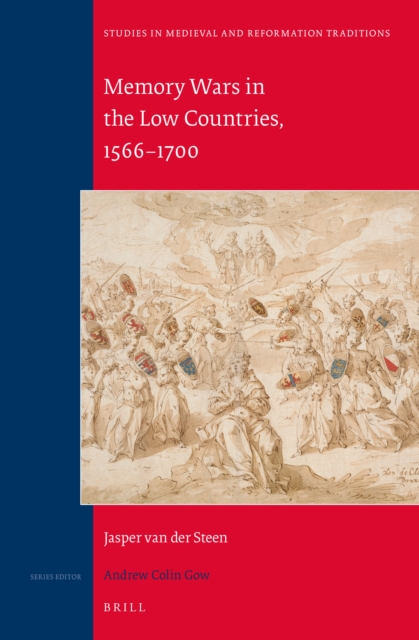
Memory Wars in the Low Countries, 1566-1700
In Memory Wars in the Low Countries, 1566-1700 Jasper van der Steen explains how the political exploitation of the public memory of the Revolt in the Netherlands influenced the formation of distinct 'national' identities in the Dutch Republic and the Habsburg Netherlands.
eBook