
Catalogue Search | MBRL


Are you sure you want to remove the book from the shelf?

{{itemTitle}}
11
result(s) for
"Berbers Algeria Ethnic identity."
Sort by:

Decolonizing Indigenous education: an Amazigh/Berber ethnographic journey
\"In this work exploring the Kayble people of Algeria and their educational journeys, Si Belkacem Taieb explores an epistemological and ontological framework for Kayble education. He does so by undertaking a narrative inquiry: an auto-ethnographic journey, in which the journey of one's self and the journey of one's people are inextricably intertwined.In a postcolonial cultural journey in an indigenous, North African Kayble landscape and the development of an Amazigh educational philosophy, Taieb writes the sociological foundations of an Amazigh educational system: one that removes Amazigh education from its colonial heritage and restores it to the people who create and use it\"-- Provided by publisher.
Book

Decolonizing indigenous education : an Amazigh/Berber ethnographic journey
Using auto-ethnography, Taieb narrates the journey of developing a educational philosophy from and for the Kayble of Algeria and undertakes to write the sociological foundations of an Kayble education system.
eBook

The Berber Identity Movement and the Challenge to North African States
Like many indigenous groups that have endured centuries of subordination, the Berber/Amazigh peoples of North Africa are demanding linguistic and cultural recognition and the redressing of injustices. Indeed, the movement seeks nothing less than a refashioning of the identity of North African states, a rewriting of their history, and a fundamental change in the basis of collective life. In so doing, it poses a challenge to the existing political and sociocultural orders in Morocco and Algeria, while serving as an important counterpoint to the oppositionist Islamist current.
This is the first book-length study to analyze the rise of the modern ethnocultural Berber/Amazigh movement in North Africa and the Berber diaspora. Bruce Maddy-Weitzman begins by tracing North African history from the perspective of its indigenous Berber inhabitants and their interactions with more powerful societies, from Hellenic and Roman times, through a millennium of Islam, to the era of Western colonialism. He then concentrates on the marginalization and eventual reemergence of the Berber question in independent Algeria and Morocco, against a background of the growing crisis of regime legitimacy in each country. His investigation illuminates many issues, including the fashioning of official national narratives and policies aimed at subordinating Berbers in an Arab nationalist and Islamic-centered universe; the emergence of a counter-movement promoting an expansive Berber \"imagining\" that emphasizes the rights of minority groups and indigenous peoples; and the international aspects of modern Berberism.
eBook

Amazigh Politics in the Wake of the Arab Spring
On television, the Arab Spring took place in Cairo, Tunis, and
the city-states of the Persian Gulf. Yet the drama of 2010, and the
decade of subsequent activism, extended beyond the cities-indeed,
beyond Arabs. Bruce Maddy-Weitzman brings to light the sustained
post-Arab Spring political movement of North Africa's Amazigh
people.
The Amazigh movement did not begin with the Arab Spring, but it
has changed significantly since then. Amazigh Politics in the
Wake of the Arab Spring details the increasingly material
goals of Amazigh activism, as protest has shifted from the arena of
ethnocultural recognition to that of legal and socioeconomic
equality. Amazigh communities responded to the struggles for
freedom around them by pressing territorial and constitutional
claims while rejecting official discrimination and neglect. Arab
activists, steeped in postcolonial nationalism and protective of
their hegemonic position, largely refused their support, yet
flailing regimes were forced to respond to sharpening Amazigh
demands or else jeopardize their threadbare legitimacy. Today the
Amazigh question looms larger than ever, as North African
governments find they can no longer ignore the movement's
interests.
eBook
Amazigh Cinema
A collection of graduate research by Indigenous social work scholars Stitching Our Stories Together showcases emerging scholars who, by centering their own nations, communities, and individual realities, demonstrate how Indigenous knowledges can challenge settler ideas and myths around pan-Indigeneity. This collection is bookended with reflections from the scholars' thesis supervisors, who describe their philosophy of mentoring and supporting students through an Indigenous lens, and how their pedagogies embrace the significance of relationality in Indigenous worldviews. Stitching Our Stories Together points toward a future where Indigenous ways of knowing and being take their rightful place in spaces of higher learning and social work practice—a necessary intervention in a discipline that has historically been complicit in colonialist harm.
eBook

A Saharan archive and its afterlives
An archive in Mbembe’s (in: Hamilton C et al. (eds) Refiguring the archive. Kluwer, Dordrecht, pp 19–26, 2002) interrogation of the institution is necessarily defined by two elements: “the building itself and the documents stored there” (2002:19). In this paper I argue that Tifinagh writing in the form or rock inscriptions in the Algerian Sahara constitutes a materially different kind of desert archive that nonetheless fulfils the role of “instituting imaginary” that Mbembe attributes to the archive. Tifinagh is a relative of the ancient Libyco-Berber script, and is used by Kel Ahaggar Tuareg, an Amazigh (Berber) people, as a yet unbroken writing practice that has existed for centuries. Consulted by French colonial actors in the late nineteenth and early twentieth centuries, the Tifinagh archive contributed to the European invention of its Tuareg authors as “close others” whom they placed on a racial hierarchy above Arabs. In the post-independence era of Arab nation building in North Africa, governments attempted to suppressed expressions of Amazigh culture and identity, and relegated Tifinagh to the domain of folklore. In the popular revindication of Amazigh identity in the twentieth and twenty-first centuries activists such as those of the Agraw Imazighen or the Berber Academy consulted the Tifinagh archive to resuscitate an alphabet that had disappeared from use in North Africa in late antiquity. Ultimately, although this desert archive presents a materiality that is at odds with Mbembe’s notion of the archive, it nonetheless accomplishes many of the functions he attributes to the archive.
Journal Article
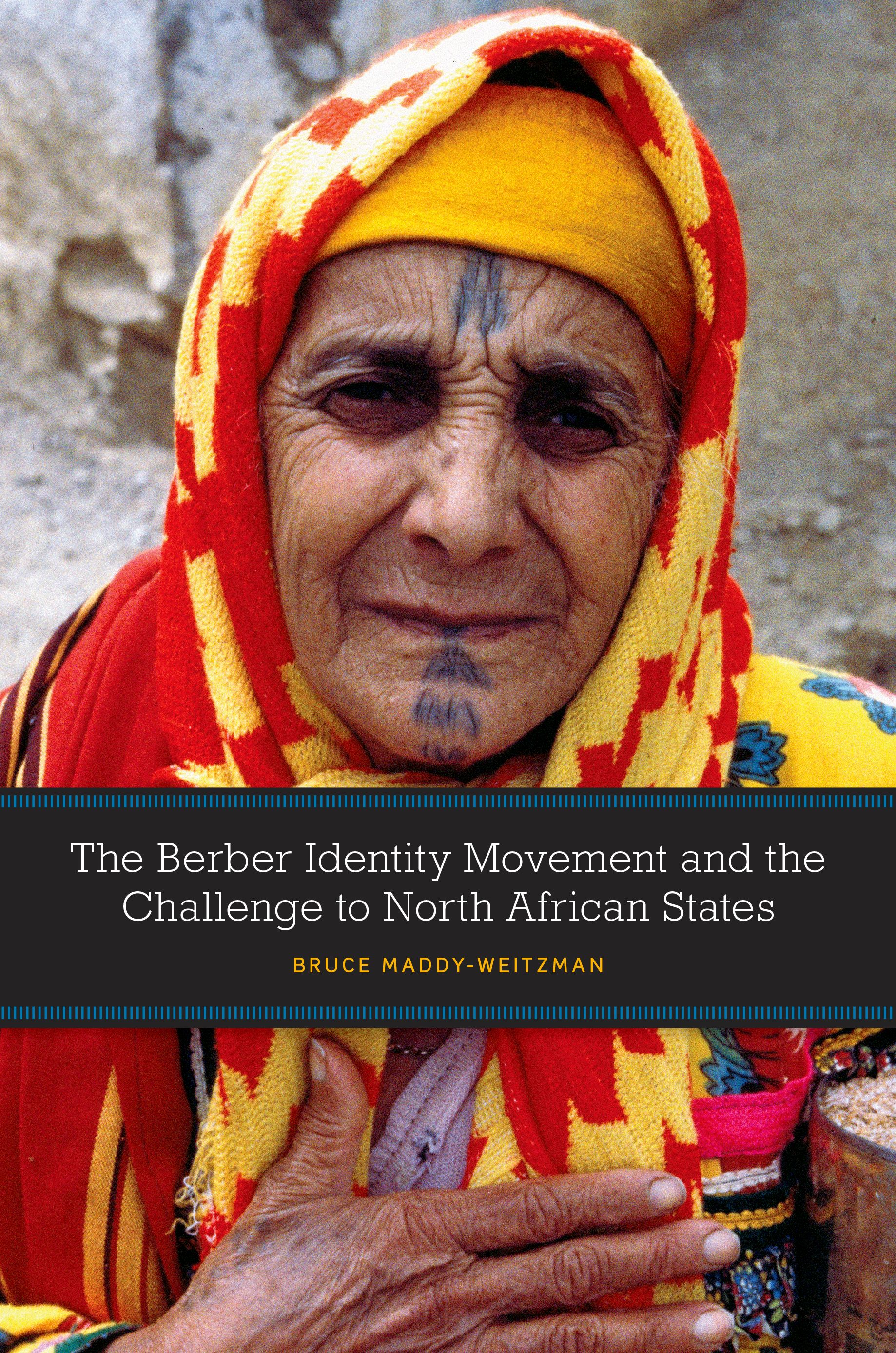
The Berber Identity Movement and the Challenge to North African States
Like many indigenous groups that have endured centuries of subordination, the Berber/Amazigh peoples of North Africa are demanding linguistic and cultural recognition and the redressing of injustices. Indeed, the movement seeks nothing less than a refashioning of the identity of North African states, a rewriting of their history, and a fundamental change in the basis of collective life. In so doing, it poses a challenge to the existing political and sociocultural orders in Morocco and Algeria, while serving as an important counterpoint to the oppositionist Islamist current. This is the first book-length study to analyze the rise of the modern ethnocultural Berber/Amazigh movement in North Africa and the Berber diaspora. Bruce Maddy-Weitzman begins by tracing North African history from the perspective of its indigenous Berber inhabitants and their interactions with more powerful societies, from Hellenic and Roman times, through a millennium of Islam, to the era of Western colonialism. He then concentrates on the marginalization and eventual reemergence of the Berber question in independent Algeria and Morocco, against a background of the growing crisis of regime legitimacy in each country. His investigation illuminates many issues, including the fashioning of official national narratives and policies aimed at subordinating Berbers in an Arab nationalist and Islamic-centered universe; the emergence of a counter-movement promoting an expansive Berber \"imagining\" that emphasizes the rights of minority groups and indigenous peoples; and the international aspects of modern Berberism.
eBook

Berber culture on the world stage : from village to video
[S]ure to interest a number of different audiences, from language
and music scholars to specialists on North Africa... a superb book, clearly
written, analytically incisive, about very important issues that have not been
described elsewhere. -- John Bowen, Washington University In
this nuanced study of the performance of cultural identity, Jane E. Goodman travels
from contemporary Kabyle Berber communities in Algeria and France to the colonial
archives, identifying the products, performances, and media through which Berber
identity has developed. In the 1990s, with a major Islamist insurgency underway in
Algeria, Berber cultural associations created performance forms that challenged
Islamist premises while critiquing their own village practices. Goodman describes
the phenomenon of new Kabyle song, a form of world music that transformed village
songs for global audiences. She follows new songs as they move from their producers
to the copyright agency to the Parisian stage, highlighting the networks of
circulation and exchange through which Berbers have achieved global
visibility.
eBook

Language Attitudes and Ethnic Language Loss in Algeria: The Case of the Chaoui Variety Among Young Users in the City of Oran
This article surveys language use in the city of Oran, Algeria. It aimed to study the language attitudes of a small community of Chaoui speakers towards their language with the other languages spoken in the city, namely Standard Arabic, Algerian Arabic, and French. The results showed that though the Chaoui speech community is still emotionally attached to its ethnic language and considers it part and parcel of its identity, the Chaoui language is clearly witnessing a decline, which might eventually lead to death. The other languages, however, maintain themselves thanks to tight domain division, whereby Standard Arabic is used in official and formal situations, French, in the sciences, and Algerian Arabic, in informal interpersonal communication. The study concludes by stressing the role of schools in maintaining the country’s ethnic languages to allow them to survive outside their regions.
Journal Article

TENSIONS OF NATIONALISM: THE MZABI STUDENT MISSIONS IN TUNIS AND THE POLITICS OF ANTICOLONIALISM
This article examines the significant yet largely overlooked role of the Mzabis, a community from the northern edges of the Algerian desert, in Algerian and Tunisian anticolonialism and nationalism. In so doing, it pursues two aims: first, to shed light on the importance of Tunis to the politicization of the Mzabis in the 1920s and to their induction into local and regional anticolonial and national movements; and second, to highlight the tensions of subsuming regional identities into overarching national identities by focusing on Mzabi political activists’ negotiation of the relationship between the Mzab and Algeria as a national project. The article also explores the spectrum of political possibilities and alternatives envisioned by Mzabis as they participated in religious reform, anticolonial, and nationalist movements. This spectrum, I argue, conveys the fluid relationship between local, national, and regional identities, thus undermining teleological readings of national identity formation.
Journal Article