
Catalogue Search | MBRL


Are you sure you want to remove the book from the shelf?

{{itemTitle}}
148
result(s) for
"Biblical Model"
Sort by:

Biblical Models for the Practice of Forgiveness in Public Life
The aim of this article is that to remind the fact that forgiveness is not a practice that should be held captive for the religious life of a person or human community. Rather, it should be a practice of the public life of a society. Yet, there are biblical models for such a practice of forgiveneness, both in the Old Testament and the New Testament. Therefore, for the biblical model embodied by the prophet Jeremiah, the article will continue with the biblical model embodied by John the Baptist. The two are proeminent figure in the Bible, one in the Old Testament and one in the New Testament. The third model is that embodied by Jesus Christ, the central person in the New Testament. From the exploration of the three models, the paper will continue with the coordinates of Church’s participation in Christ’s model. It will end with the way the practice of forgiveness is reflected in Romanian society and politics after 1989.
Journal Article

Breed se verstaan van ’n bybelse pastorale model: ’n Verkennende, beskrywende perspektief
Breed’s understanding of a biblical pastoral model: An exploratory, descriptive perspective. This article was aimed at providing a perspective on Professor Gert Breed’s theoretical contribution to pastoral studies by exploring and describing his understanding of a biblical pastoral model. Breed’s model is the product of decades of research, practical experience as a minister in the Reformed Churches in South Africa and over a decade of theoretical knowledge and experience in training and tertiary academic education. Breed’s model currently forms the foundation of and framework for Reformed Churches in South Africa (RCSA) (Gereformeerde Kerke in Suid-Afrika [GKSA]) candidate students’ training in pastoral studies at the Theological School in Potchefstroom, as well as for equipping other prospective practitioners for pastoral ministry. Although Breed has been using this model with great success in his own ministry, as well as in tertiary training, a comprehensive perspective on his model had not yet been published. Contribution: The aim of this article was therefore to provide an explorative and descriptive perspective on the content of Breed’s understanding of a biblical pastoral model.
Journal Article

Storytelling in the Works of Bunyan, Grimmelshausen, Defoe, and Schnabel
The modern novel appeared during the period of secularization and intellectual change that took place between 1660 and 1740. This book examines John Bunyan's 'Grace Abounding' and 'The Pilgrim's Progress', Johann Grimmelshausen's 'Simplicissimus', Daniel Defoe's 'Robinson Crusoe', and J. G. Schnabel's 'Insel Felsenburg' as prose works that reflect the stages in this transition. The protagonists in these works try to learn to use language in a pure, uncorrupted way. Their attitudes towards language are founded on their understanding of the Bible, and when they tell their life stories, they follow the structure of the Bible, because they accept it as \"the\" paradigmatic story. Thus the Bible becomes a tool to justify the value of telling \"any\" story. The authors try to give their own texts some of Scripture's authority by imitating the biblical model, but this leads to problems with closure and other tensions. If Bunyan's explicitly religious works affirm the value of individual narratives as part of a single, universal story, Grimmelshausen's and Defoe's protagonists effectively replace the sacred text with their own powerful, authoritative stories. J. G. Schnabel illustrates the extent of the secularization process in 'Insel Felsenburg' when he defends the entertainment value of escapist fiction and uses the Bible as the fictional foundation of his utopian civilization: arguments about the moral value of narrative give way to the depiction of storytelling as an end in itself. But Bunyan, Grimmelshausen, Defoe, and Schnabel all use positive examples of the transfiguring effect of reading and telling stories, whether sacred or secular, to justify the value of their own works. Janet Bertsch teaches at Wolfson and Trinity College, Cambridge.
eBook

Designing the Present
This chapter contains section titled:
Forging State and Nation
Sir Thomas More's Utopia
The Literature of Folly
The Writing of Travel and Exploration
Houses and Gardens
City Comedy and the Court
Book Chapter
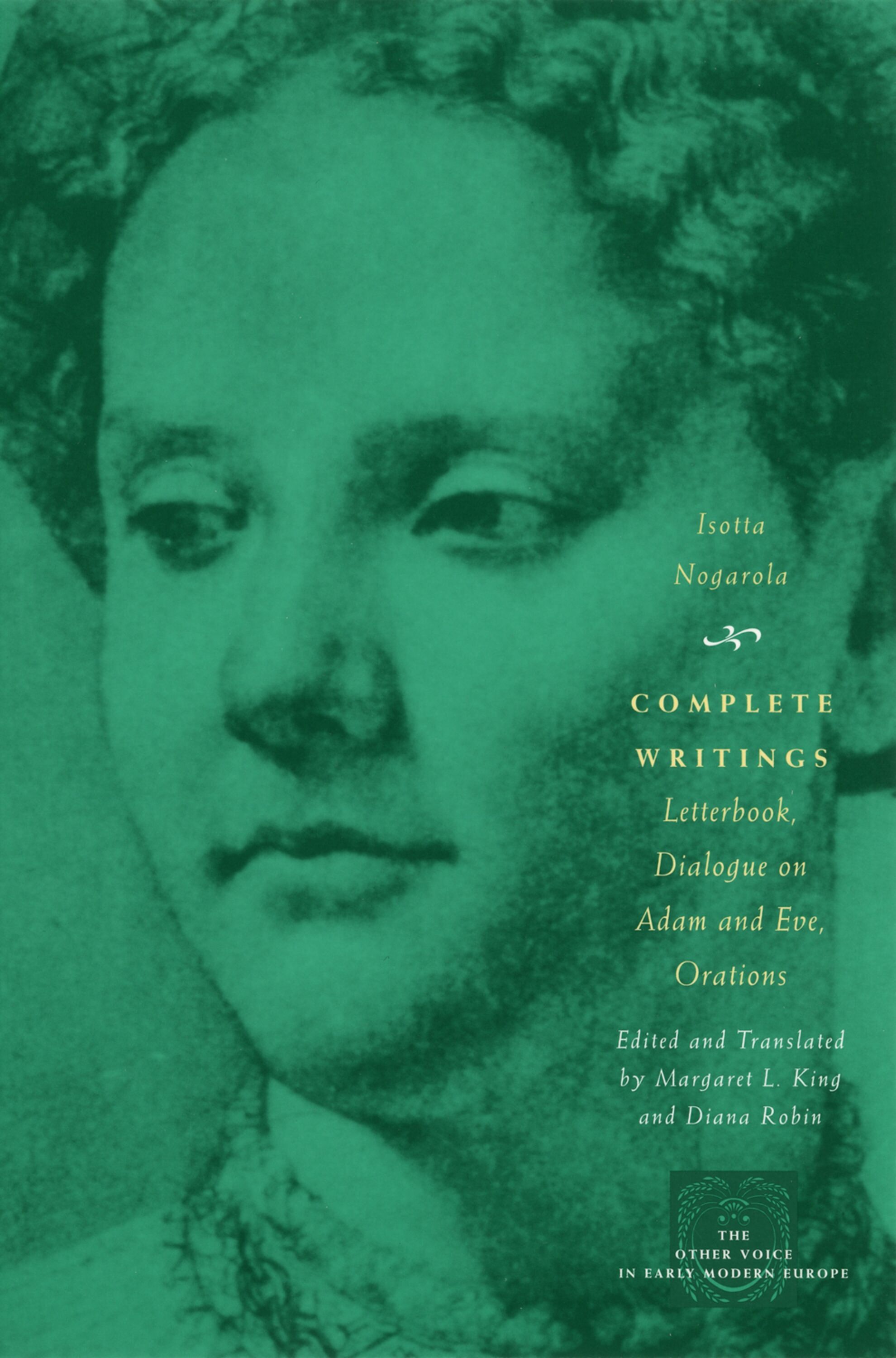
Complete writings
Renowned in her day for her scholarship and eloquence, Isotta Nogarola (1418-66) remained one of the most famous women of the Italian Renaissance for centuries after her death. And because she was one of the first women to carve out a place for herself in the male-dominated republic of letters, Nogarola served as a crucial role model for generations of aspiring female artists and writers. This volume presents English translations of all of Nogarola's extant works and highlights just how daring and original her convictions were. In her letters and orations, Nogarola elegantly synthesized Greco-Roman thought with biblical teachings. And striding across the stage in public, she lectured the Veronese citizenry on everything from history and religion to politics and morality. But the most influential of Nogarola's works was a performance piece, Dialogue on Adam and Eve, in which she discussed the relative sinfulness of Adam and Eve—thereby opening up a centuries-long debate in Europe on gender and the nature of woman and establishing herself as an important figure in Western intellectual history. This book will be a must read for teachers and students of Women's Studies as well as of Renaissance literature and history.
eBook

“So He Set a Royal Diadem on Her Head”—Queen Esther in Contemporary American Jewish Midrashic Poetry
Feminist poets and scholars have transformed Queen Esther from a relatively silent biblical figure into a complex literary character, yet systematic analysis of their interpretive strategies remains limited. This study examines how these poets employ feminist hermeneutical frameworks to reimagine Esther’s experiences and choices. Using a close-reading methodology, the analysis applies Alicia Ostriker’s hermeneutical modes (suspicion, desire, and indeterminacy) and Wendy Zierler’s hermeneutics of identification to poems by Janet Ruth Heller, Carol Barrett, Caryn Mirriam-Goldberg, Stacey Zisook Robinson, Jill Hammer, Enid Dame, Yala Korwin, and Bonnie Lyons from the late twentieth and early twenty-first centuries. The poems organize into three thematic categories: transformation and identity formation during Esther’s preparation for queenship; the interior and moral costs of her heroic actions; and retrospective reflections comparing her strategic compliance with Vashti’s direct defiance. The analysis reveals that these poets challenge traditional binary oppositions between the two queens, positioning both strategic accommodation and direct refusal as legitimate forms of feminist resistance within patriarchal structures. By giving Esther a first-person voice and exploring her interior life, these works create a new literary midrash that addresses contemporary concerns about women’s agency while maintaining deep engagement with Jewish textual tradition.
Journal Article

Biblical Perspectives as a Guide to Research on Life’s Origin and History
The more than thirty spacetime theorems developed over the past five decades establish that the universe and its spacetime dimensions have emerged from a cause/causal agent beyond the cosmos. Thus, to infer that this cause/causal agent may have intervened in the origin and history of Earth and Earth’s life resides well within the bounds of reason. Meanwhile, proponents of each of the three prevailing naturalistic models (abiogenesis, panspermia, and directed panspermia) for the origin and history of Earth’s life have marshaled arguments and evidence that effectively undermine and refute the other two models. A biblical perspective and approach to Earth’s life can help resolve this impasse. While a superficial and pervasive appeal to divine intervention thwarts scientific advance, so does a rigid adherence to naturalism. A productive way forward is to identify which models (or parts of models), whether naturalistic, theistic, or a combination, most effectively narrow, rather than widen, knowledge gaps, minimize anomalies, offer the most comprehensive and detailed explanation of the data, and prove most successful in predicting scientific discoveries.
Journal Article
From Verse to Vision: Exploring AI-Generated Religious Imagery in Bible Teaching
This article critically analyses the use of generative Artificial Intelligence (GenAI)—specifically, the DALL·E system within the ChatGPT-4o environment—for creating visualisations of biblical scenes for teaching purposes. As part of a case study examining the Baptism of Jesus in the Jordan (Mt 3:13–17; cf. Mark 1:9–11; Luke 3:21–22; John 1:31, 34) and the Last Supper (Mt 26:17–30; cf. Mark 14:12–16; Luke 22:7–13), four AI-generated images are analysed. Two were created using general, non-specific prompts, while the other two were based on more precise queries containing references to Catholic symbolism and the images’ intended educational use. A comparison of these variants reveals a lack of theological depth and symbolic oversimplification in AI-generated images, as well as a tendency to reproduce Western cultural stereotypes. Despite their aesthetic appeal and quick availability, these images do not reflect the complexity of the biblical or spiritual contexts of the scenes depicted. This study aims to evaluate the theological, symbolic, and pedagogical value of AI-generated images and to provide practical recommendations for their responsible use in Bible didactics. In conclusion, the authors argue that GenAI can support biblical teaching when used consciously, critically, and reflectively.
Journal Article

Noah and Moses in Acts 15: Group Models and the Novelty of the Way
This article argues that Acts 15 alludes both to commandments associated with Noah and pentateuchal legislation on the gerim, though without consistently developing either of these allusions. As a result, this chapter presents the Way as a novel movement that both corresponds with and transcends familiar categories. By discussing Acts’ simultaneous evoking and negation of other models (voluntary associations, Bacchic mystery cults, philosophical schools and ethnic groups), I argue that Acts 15 reflects a literary strategy evident throughout Acts. This strategy enabled the author of Acts to anchor the Way into the structures and traditions of the early Roman Empire.
Journal Article

Her influence: The constructive roles of women in the lives of Moses and Boaz
This article critiques the constructive roles of women in the lives of Moses and Boaz applying feminist biblical criticism as a theory. By critiquing the significant yet often downplayed contributions of women such as Jochebed, Miriam, Ruth and Naomi, the aim is to provide a more inclusive and multifaceted understanding of their roles in different biblical texts. In the process, feminist biblical criticism, as a theory, unmasks the pervasive influence of sexism in both the biblical texts and their interpretive traditions, contesting traditional readings that subjugate women’s voices and agency. Ultimately, this article makes two notable findings. Firstly, the central role of Jochebed and Miriam in ensuring Moses’ survival and rise to leadership underscores how their actions were fundamental to the unfolding of Israel’s history. Secondly, the proactive agency of Ruth and Naomi demonstrated through their strategic decisions and mutual support, facilitated social and familial redemption and thereby transformed Boaz’s life and legacy. These notable findings underline the indispensable contributions of women in the two biblical figures and call for a (re)consideration of their roles in biblical history and contemporary contexts. Inevitably, I conclude that by reclaiming the voices and experiences of women, this article advocates for a more unprejudiced (re)interpretation of sacred canon, promoting gender justice and inclusivity in contemporary religious and cultural practices.Intradisciplinary and/or interdisciplinary implications: Examining the constructive roles of women challenges male-orientated interpretations in theology and intersects with literary, historical, sociological, gender and cultural discourses, advancing inclusive and non-partisan understandings of biblical texts.
Journal Article