
Catalogue Search | MBRL


Are you sure you want to remove the book from the shelf?

{{itemTitle}}
106
result(s) for
"Bilingualer Unterricht"
Sort by:

Translanguaging and the Transdisciplinary Framework for Language Teaching and Learning in a Multilingual World
The goal of this article is to engage in the examination and study of translanguaging, a rapidly expanding conceptual-cum-theoretical, analytical, and pedagogical lens that directly draws from contemporary perspectives on bi/multilingualism and that in many ways both informs and challenges existing theoretical positions and pedagogical practices on which much of the work of modern languages scholars has been based. (Verlag, adapt.).
Journal Article
Reframing the Debate on Language Separation: Toward a Vision for Translanguaging Pedagogies in the Dual Language Classroom
The policy of strict separation of languages for academic instruction dominates dual language bilingual education programming. This article explores the dynamic bilingual practices of two experienced bilingual teachers in a two-way dual language public school in Texas and contributes to current research problematizing language separation. Data included interviews, field notes, and classroom interaction video in a pre-kindergarten and a first grade classroom. The instructional practices of the two teachers suggested powerful strategies to promote bilingual identities. Drawing on identity theory, particularly the notions of positioning and investment, the authors attempt to contribute to recent research offering teachers potential translanguaging instructional strategies. These strategies include: (a) modeling dynamic bilingual language practices, (b) positioning students as bilingual (even before they are), and (c) celebrating and drawing attention to language crossing. In combining these strategies, teachers move toward using students' bilingual language practices as a resource for academic instruction. (Verlag, adapt.).
Journal Article
Translanguaging in the Bilingual Classroom: A Pedagogy for Learning and Teaching?
The article reports on research that questions commonsense understandings of a bilingual pedagogy predicated on what Cummins (2005, 2008) refers to as the \"two solitudes\" assumption (2008, p. 65). It sets out to describe a flexible bilingual approach to language teaching and learning in Chinese and Gujarati community language schools in the United Kingdom. The authors argue for a release from monolingual instructional approaches and advocate teaching bilingual children by means of bilingual instructional strategies, in which two or more languages are used alongside each other. In developing this argument, the article takes a language ecology perspective and seeks to describe the interdependence of skills and knowledge across languages. (Verlag, adapt.).
Journal Article
Pedagogies and Practices in Multilingual Classrooms: Singularities in Pluralities
Bilingual classrooms most often have strict language arrangements about when and who should speak what language to whom. This practice responds to diglossic arrangements and models of bilingualism developed in the 20th century. However, in the 21st century, heteroglossic bilingual conceptualizations are needed in which the complex discursive practices of multilingual students, their translanguagings, are used in sense-making and in tending to the singularities in the pluralities that make up multilingual classrooms today. Examining the case of a network of U.S. secondary schools for newcomer immigrants, the International High Schools, this article looks at how students' plurilingual abilities are built through seven principles that support dynamic plurilingual practices in instruction-heterogeneity, collaboration, learner-centeredness, language and content integration, language use from students up, experiential learning, and local autonomy and responsibility. As a result, students become not only more knowledgeable and academically successful but also more confident users of academic English, better at translanguaging, and more plurilingual-proficient. The article presents translanguaging in education as the constant adaptation of linguistic resources in the service of meaning-making and in tending to the singularities in the pluralities that make up multilingual classrooms today. (Verlag).
Journal Article

English learner labeling
Prior research has shown that English learner (EL) classification is consequential for students; however, less is known about how EL classification affects student outcomes. In this study, we examine one hypothesized mechanism: teacher perceptions. Using a national data set (Early Childhood Longitudinal Study-Kindergarten Cohort of 2010-2011 or ECLS-K:2011), we use coarsened exact matching to estimate the effect of kindergarten EL status on teachers' perceptions of students' academic skills. We further explore whether that impact is moderated by instructional setting (bilingual vs. English immersion). We find evidence that EL classification results in lower teacher perceptions. This impact is, however, moderated by bilingual environments. In bilingual classrooms, we do not find evidence that EL classification results in diminished perceptions. This study adds to research on teacher perceptions and the effects of EL classification. (DIPF/Orig.).
Journal Article
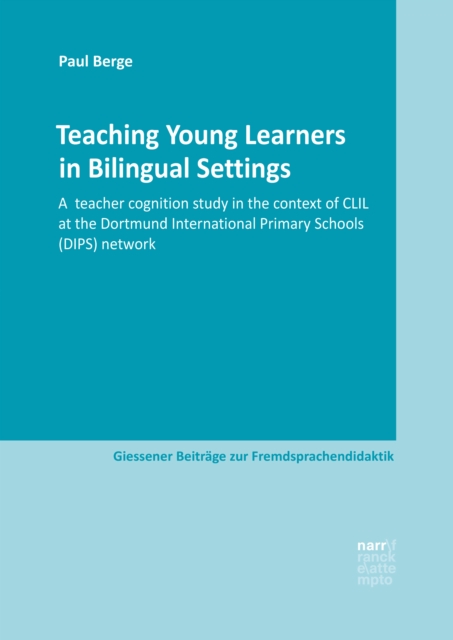
Teaching Young Learners in Bilingual Settings
Bilingual education, or CLIL, at primary school varies greatly across European educational contexts. Teaching Young Learners in Bilingual Settings reports on a study that explored one such CLIL context in Dortmund, Germany. Through interviews and classroom observations, the researcher and author sought not only to document some of what takes place in CLIL classrooms but to describe and understand teachers' thoughts and beliefs about their CLIL teaching practices. This research contributes to a better understanding of primary school CLIL programs and teachers and is relevant for researchers working in the fields of foreign language education, bilingual education, and language teacher cognition research. Furthermore, the insights into CLIL teachers' thinking can support CLIL teachers, administrators, and policy makers as they seek to further develop CLIL pedagogy and programs.
eBook
Effects of Plurilingual Teaching on Grammatical Development in Early Foreign-Language Learning
This article reports two intervention studies testing the effects of plurilingual teaching on grammatical development among primary-school students learning English as a foreign language (FL). In a pre-posttest control-group design, more than 200 9-10-year old majority language German and minority language students received plurilingual FL teaching (intervention group) or regular FL-only teaching (control group). Study 1 on the acquisition of wh-questions showed that systematic cross-linguistic comparisons of the FL with the majority language and minority languages facilitate acquisition of object questions. In Study 2 on passives, the intervention and the control groups both demonstrated comparable gains. We suggest that plurilingual teaching has advantages when the majority language differs from the target language (Study 1) yet not when a phenomenon is comparable across languages (Study 2). In neither study did learners show generalization to related grammatical phenomena. Finally, majority language and minority language students did not perform differently, which suggests that plurilingual FL teaching is suitable for all FL learners. These findings demonstrate that plurilingual FL teaching facilitates grammatical development by increasing learners' awareness of cross-linguistic similarities and differences.
Journal Article
Focus on Multilingualism: A Study of Trilingual Writing
In this article, the authors analyze the relationship between studies in second language acquisition and studies in bilingualism as areas that have been traditionally ignored but which share some common perspectives. Then they look at new trends in both areas that are compatible with a holistic perspective in the study of multilingualism. Based on these trends, the authors propose \"Focus on Multilingualism,\" an approach that looks at the whole linguistic repertoire of multilingual speakers and language learners and at the relationships between the languages when conducting research, teaching, or assessing different languages. In the second part of the article, they report on the results of an exploratory study on the development of writing skills in three languages: Basque, Spanish, and English. They also explore different ways to look at the three languages and their interaction by focusing on the multilingual speaker and his or her languages rather than each of the specific languages in isolation. The results indicate that the languages are related to each other in different ways and that multilingual speakers develop their creativity in these language practices. It is argued that by focusing on the different languages, we can gain new insights about the way languages are learned and used. (Verlag, adapt.).
Journal Article

From pilots to policies: Challenges for implementing intercultural bilingual education in Latin America
For the past four decades, intercultural bilingual education (IBE) has been a common policy prescription to address Indigenous/non-Indigenous education gaps in Latin America. Initiatives have grown from small, localised pilots to national and state-level initiatives across thousands of schools. While there is some rigorous evidence of the effectiveness of IBE pilot initiatives at a small scale, there is very little evidence that expanding them to a larger scale benefits learners to the same extent. This article reviews the existing evidence on IBE’s effectiveness and identifies a number of challenges in replicating success at scale. The authors identify factors which have limited our understanding of IBE’s effectiveness, as well as factors which may have contributed to less-than-ideal outcomes for larger programmes, including uneven coverage, varying teacher quality, and limited resource availability for smaller Indigenous languages. Addressing these issues will be crucial for improving IBE programmes’ ability to operate successfully at scale.
Journal Article

Schools for the future Europe
Schools for the Future Europe brings together a team of leading academics, policy makers and education professionals to explore the emergence, development and application of European education policy up to the 2009 Lisbon Treaty and beyond. The book charts the historical development of a Europe-wide education policy, and examines how that policy has sought to address such issues as European citizenship, human rights and bilingual schooling. Taking as examples the intended future extension of the European Schools and the European Baccalaureate, and a case study of work towards the first British European Academy or Free School at Culham, UK, the book critically explores the interplay of EU action programmes, policy and rhetoric on secondary education. In the final section, the editors draw on the insights of the previous chapters to outline an achievable programme for the future development of education policy structures and practice in schools for Europe.
Book