
Catalogue Search | MBRL


Are you sure you want to remove the book from the shelf?

{{itemTitle}}
15,606
result(s) for
"Bioclimatology."
Sort by:


Prediction of unprecedented biological shifts in the global ocean
Impermanence is an ecological principle1 but there are times when changes occur nonlinearly as abrupt community shifts (ACSs) that transform the ecosystem state and the goods and services it provides2. Here, we present a model based on niche theory3 to explain and predict ACSs at the global scale. We test our model using 14 multi-decadal time series of marine metazoans from zooplankton to fish, spanning all latitudes and the shelf to the open ocean. Predicted and observed fluctuations correspond, with both identifying ACSs at the end of the 1980s4–7 and 1990s5,8. We show that these ACSs coincide with changes in climate that alter local thermal regimes, which in turn interact with the thermal niche of species to trigger long-term and sometimes abrupt shifts at the community level. A large-scale ACS is predicted after 2014—unprecedented in magnitude and extent—coinciding with a strong El Niño event and major shifts in Northern Hemisphere climate. Our results underline the sensitivity of the Arctic Ocean, where unprecedented melting may reorganize biological communities5,9, and suggest an increase in the size and consequences of ACS events in a warming world.Abrupt community shifts, for marine species from zooplankton to fish, are shown to occur with local climate changes in which warming pushes species beyond their thermal niche. This modelling approach suggests future events will be larger and have more broad-reaching impacts.
Journal Article
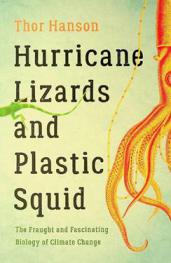
Hurricane lizards and plastic squid : the fraught and fascinating biology of climate change
\"In his three previous books-Feathers, The Triumph of Seeds, and Buzz-Thor Hanson has taken his readers on unforgettable journeys into nature, rendered with great storytelling, the soul of a poet, and the insight of a biologist. In this new book, he is doing it again, but exploring one of the most vital scientific and cultural issues of our time: climate change. As a young biologist, Hanson by his own admission watched with some detachment as our warming planet presented plants and animals with an ultimatum: change or face extinction. But his detachment turned to both concern and awe, as he observed the remarkable narratives of change playing out in each plant and animal he studied. In Hurricane Lizards and Plastic Squid, Hanson tells the story of how nature-both plants and animals, from beech trees to beetles-are meeting the challenges of rapid climate change head-on, adjusting, adapting, and sometimes noticeably evolving. Brown pelicans are fleeing uphill, seeking out new lives in the mountains. Gorillas in Uganda are turning to new food sources, such as eucalyptus trees (which humans only imported to Africa in the past several decades), as their old sources wain. Auklets, a little sea bird, aren't so lucky: changes in the lifecycles of their primary food source means they return at specific times of year to oceanic feeding grounds expecting plankton blooms that are no longer there. As global warming transforms and restructures the ecosystems in which these animals and others live, Hanson argues, we are forced to conclude that climate change will not have just one effect: Some transformations are beneficial. Others, and perhaps most, are devastating, wiping out entire species. One thing is constant: with each change an organism undergoes, the delicate balance of interdependent ecosystems is tipped, forcing the evolution of thousands more species, including us. To understand how, collectively, these changes are shaping the natural world and the future of life, Hanson looks back through deep time, examining fossil records, pollen, and even the tooth enamel of giant wombats and mummified owl pellets. Together, these records of our past tell the story of ancient climate change, shedding light on the challenges faced by today's species, the ways they will respond, and how these strategies will determine the fate of ecosystems around the globe. Ultimately, the story of nature's response to climate change is both fraught and fascinating, a story of both disaster and resilience, and, sometimes, hope. Lyrical and thought-provoking, Hurricane Lizards and Plastic Squid is poised to transform the conversation around climate change, shifting the focus from humans to the lattice of life, of which humans are just a single point\"-- Provided by publisher.
Book

Primary Production, an Index of Climate Change in the Ocean: Satellite-Based Estimates over Two Decades
Primary production by marine phytoplankton is one of the largest fluxes of carbon on our planet. In the past few decades, considerable progress has been made in estimating global primary production at high spatial and temporal scales by combining in situ measurements of primary production with remote-sensing observations of phytoplankton biomass. One of the major challenges in this approach lies in the assignment of the appropriate model parameters that define the photosynthetic response of phytoplankton to the light field. In the present study, a global database of in situ measurements of photosynthesis versus irradiance (P-I) parameters and a 20-year record of climate quality satellite observations were used to assess global primary production and its variability with seasons and locations as well as between years. In addition, the sensitivity of the computed primary production to potential changes in the photosynthetic response of phytoplankton cells under changing environmental conditions was investigated. Global annual primary production varied from 38.8 to 42.1 Gt C yr − 1 over the period of 1998–2018. Inter-annual changes in global primary production did not follow a linear trend, and regional differences in the magnitude and direction of change in primary production were observed. Trends in primary production followed directly from changes in chlorophyll-a and were related to changes in the physico-chemical conditions of the water column due to inter-annual and multidecadal climate oscillations. Moreover, the sensitivity analysis in which P-I parameters were adjusted by ±1 standard deviation showed the importance of accurately assigning photosynthetic parameters in global and regional calculations of primary production. The assimilation number of the P-I curve showed strong relationships with environmental variables such as temperature and had a practically one-to-one relationship with the magnitude of change in primary production. In the future, such empirical relationships could potentially be used for a more dynamic assignment of photosynthetic rates in the estimation of global primary production. Relationships between the initial slope of the P-I curve and environmental variables were more elusive.
Journal Article


Relatively stable response of fruiting stage to warming and cooling relative to other phenological events
The timing of the fruit-set stage (i.e., start and end of fruit set) is crucial in a plant's life cycle, but its response to temperature change is still unclear. We investigated the timing of seven phenological events, including fruit-set dates during 3 yr for six alpine plants transplanted to warmer (approximately +3.5 °C in soils) and cooler (approximately -3.5 °C in soils) locations along an altitudinal gradient in the Tibetan area. We found that fruit-set dates remained relatively stable under both warming and cooling during the 3-yr transplant experiment. Three earlier phenological events (emergence of first leaf, first bud set, and first flowering) and two later phenological events (first leaf coloring and complete leaf coloring) were earlier by 4.8-8.2 d/°C and later by 3.2-7.1 d/°C in response to warming. Conversely, cooling delayed the three earlier events by 3.8-6.9 d/°C and advanced the two later events by 3.2-8.1 d/°C for all plant species. The timing of the first and/or last fruit-set dates, however, did not change significantly compared to earlier and later phenological events. Statistical analyses also showed that the dates of fruit set were not significantly correlated or had lower correlations with changes of soil temperature relative to the earlier and later phenological events. Alpine plants may thus acclimate to changes in temperature for their fruiting function by maintaining relatively stable timings of fruit set compared with other phenological events to maximize the success of seed maturation and dispersal in response to short-term warming or cooling.
Journal Article


Elevation alters ecosystem properties across temperate treelines globally
Temperature is a primary driver of the distribution of biodiversity as well as of ecosystem boundaries(1,2). Declining temperature with increasing elevation in montane systems has long been recognized as a major factor shaping plant community biodiversity, metabolic processes, and ecosystem dynamics(3,4). Elevational gradients, as thermoclines, also enable prediction of long-term ecological responses to climate warming(5-7). One of the most striking manifestations of increasing elevation is the abrupt transitions from forest to treeless alpine tundra(8). However, whether there are globally consistent above-and belowground responses to these transitions remains an open question(4). To disentangle the direct and indirect effects of temperature on ecosystem properties, here we evaluate replicate treeline ecotones in seven temperate regions of the world. We find that declining temperatures with increasing elevation did not affect tree leaf nutrient concentrations, but did reduce ground-layer community-weighted plant nitrogen, leading to the strong stoichiometric convergence of ground-layer plant community nitrogen to phosphorus ratios across all regions. Further, elevation-driven changes in plant nutrients were associated with changes in soil organic matter content and quality (carbon to nitrogen ratios) and microbial properties. Combined, our identification of direct and indirect temperature controls over plant communities and soil properties in seven contrasting regions suggests that future warming may disrupt the functional properties of montane ecosystems, particularly where plant community reorganization outpaces treeline advance.
Journal Article

Rapid adaptive responses to climate change in corals
Pivotal to projecting the fate of coral reefs is the capacity of reef-building corals to acclimatize and adapt to climate change. Transgenerational plasticity may enable some marine organisms to acclimatize over several generations and it has been hypothesized that epigenetic processes and microbial associations might facilitate adaptive responses. However, current evidence is equivocal and understanding of the underlying processes is limited. Here, we discuss prospects for observing transgenerational plasticity in corals and the mechanisms that could enable adaptive plasticity in the coral holobiont, including the potential role of epigenetics and coral-associated microbes. Well-designed and strictly controlled experiments are needed to distinguish transgenerational plasticity from other forms of plasticity, and to elucidate the underlying mechanisms and their relative importance compared with genetic adaptation.
Journal Article