
Catalogue Search | MBRL


Are you sure you want to remove the book from the shelf?

{{itemTitle}}
3,143
result(s) for
"Biology Biography."
Sort by:


William Louis Poteat : a leader of the progressive-era South
William Louis Poteat (1856-1938), the son of a conservative Baptist slaveholder, became one of the most outspoken southern liberals during his lifetime.He was a rarity in the South for openly teaching evolution beginning in the 1880s, and during his tenure as president of Wake Forest College (1905-1927) his advocacy of social Christianity stood.
eBook


Pioneers of microbiology and the Nobel prize
We are swamped with information and each day seems to bring new discoveries that must be considered. Never before in the history of science have so many scientists been as active as today. It has become a major problem for the expert just to keep up with the literature in his or her own field of research. Why, then, should experts and their poor students worry about the pioneers of microbiology, those half-forgotten scientists who a century ago devoted their lives to a new science that was on its way to revolutionizing medicine?
With so many new facts and problems screaming for our attention, it is easy to lose sight of the long road that we have travelled in order to get to the point where we are now. Tracing the path of those who have gone before us will help us to see our own scientific goals and efforts in a more revealing perspective.
The great figures who are at the center of interest in this book - Robert Koch, Emil von Behring, Paul Ehrlich and Elie Metchnikoff - were far from uncontroversial during their lifetimes. It is interesting to see how they were judged by their peers at the Karolinska Institutet when they were considered for the Nobel Prize.
Pioneers of Microbiology and the Nobel Prize has been written in such a way that it can be enjoyed even without an extensive knowledge of microbiology and medicine. In fact, a considerable part of the book portrays the state of medicine during the middle of the 19th century, when bacteriology can be said to have made its debut on the medical scene.
eBook

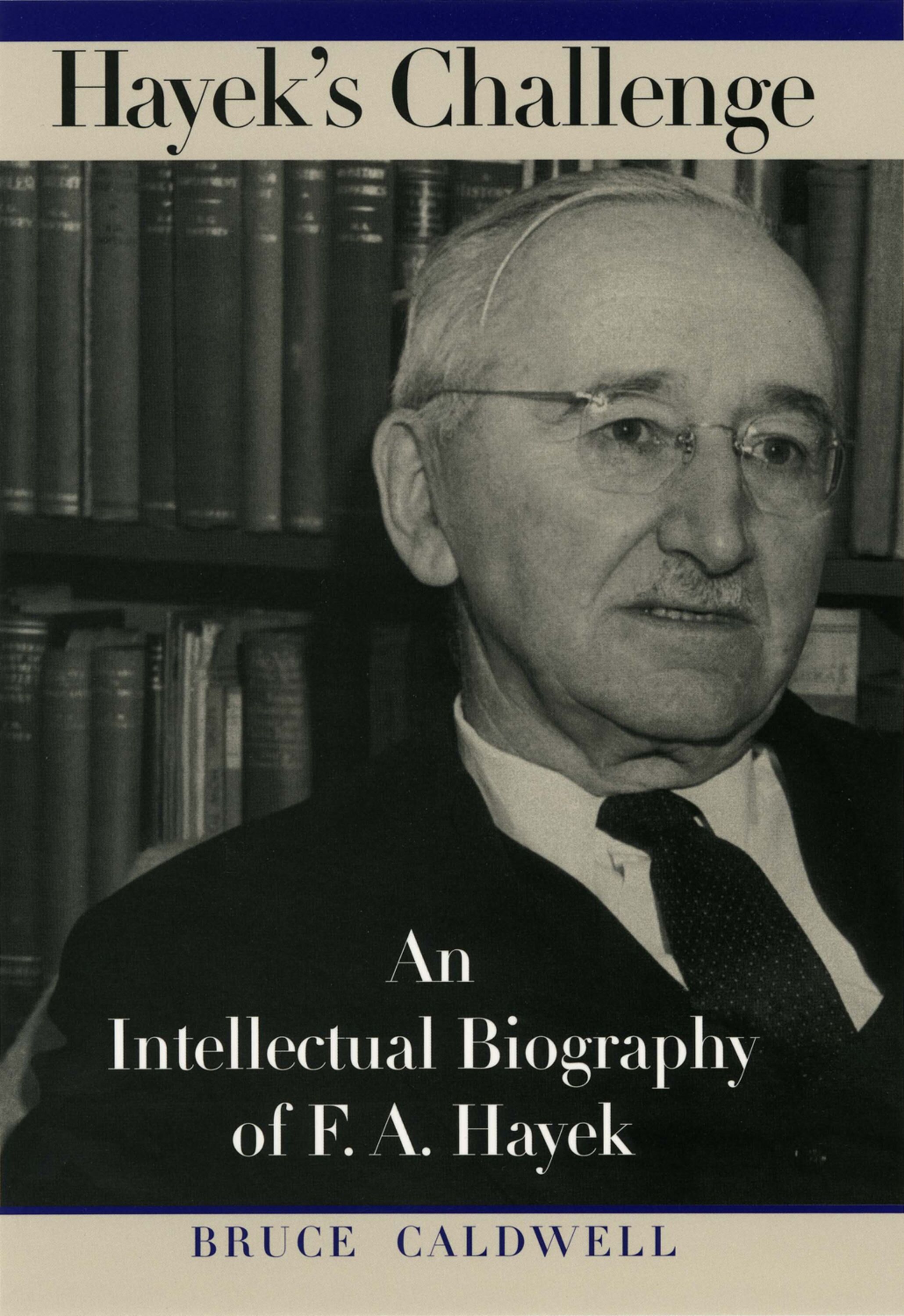
Hayek's challenge
Friedrich A. Hayek is regarded as one of the preeminent economic theorists of the twentieth century, as much for his work outside of economics as for his work within it. During a career spanning several decades, he made contributions in fields as diverse as psychology, political philosophy, the history of ideas, and the methodology of the social sciences. Bruce Caldwell—editor of The Collected Works of F. A. Hayek—understands Hayek's thought like few others, and with this book he offers us the first full intellectual biography of this pivotal social theorist. Caldwell begins by providing the necessary background for understanding Hayek's thought, tracing the emergence, in fin-de-siècle Vienna, of the Austrian school of economics—a distinctive analysis forged in the midst of contending schools of thought. In the second part of the book, Caldwell follows the path by which Hayek, beginning from the standard Austrian assumptions, gradually developed his unique perspective on not only economics but a broad range of social phenomena. In the third part, Caldwell offers both an assessment of Hayek's arguments and, in an epilogue, an insightful estimation of how Hayek's insights can help us to clarify and reexamine changes in the field of economics during the twentieth century. As Hayek's ideas matured, he became increasingly critical of developments within mainstream economics: his works grew increasingly contrarian and evolved in striking—and sometimes seemingly contradictory—ways. Caldwell is ideally suited to explain the complex evolution of Hayek's thought, and his analysis here is nothing short of brilliant, impressively situating Hayek in a broader intellectual context, unpacking the often difficult turns in his thinking, and showing how his economic ideas came to inform his ideas on the other social sciences. Hayek's Challenge will be received as one of the most important works published on this thinker in recent decades.
eBook


Everglades providence
No one did more than Marjory Stoneman Douglas to transform the Everglades from the country's most maligned swamp into its most beloved wetland. By the late twentieth century, her name and her classic The Everglades: River of Grass had become synonymous with Everglades protection. The crusading resolve and boundless energy of this implacable elder won the hearts of an admiring public while confounding her opponents—growth merchants intent on having their way with the Everglades. Douglas's efforts ultimately earned her a place among a mere handful of individuals honored as a namesake of a national wilderness area.
In the first comprehensive biography of Douglas, Jack E. Davis explores the 108-year life of this compelling woman. Douglas was more than an environmental activist. She was a suffragist, a lifetime feminist and supporter of the ERA, a champion of social justice, and an author of diverse literary talent. She came of age literally and professionally during the American environmental century, the century in which Americans mobilized an unprecedented popular movement to counter the equally unprecedented liberties they had taken in exploiting, polluting, and destroying the natural world.
The Everglades were a living barometer of America's often tentative shift toward greater environmental responsibility. Reconstructing this larger picture, Davis recounts the shifts in Douglas's own life and her instrumental role in four important developments that contributed to Everglades protection: the making of a positive wetland image, the creation of a national park, the expanding influence of ecological science, and the rise of the modern environmental movement. In the grand but beleaguered Everglades, which Douglas came to understand is a vast natural system that supports human life, she saw nature's providence.
eBook

One step sideways, three steps forward : one woman's path to becoming a biologist
Scientist Rosemary Grant's journey in life has involved detours and sidesteps - not the shortest or the straightest of paths, but one that has led her to the top of evolutionary biology. In this engaging and moving book, Grant tells the story of her life and career - from her childhood love of nature in England's Lake District to an undergraduate education at the University of Edinburgh through a swerve to Canada and teaching, followed by marriage, children, a PhD at age forty-nine, and her life's work with Darwin's finches in the Galápagos Islands. Grant's unorthodox career is one woman's solution to the problem of combining professional life as a field biologist with raising a family.
BOOK

From Taxonomy to Phylogenetics Life and Work of Willi Hennig
Willi Hennig (1913-1976), laid the fundaments of a 'scientific revolution' in Biological Systematics by his method called \"Phylogenetic Systematics\". The book describes the historical development of this 'scientific revolution', and highlights the life and the work of a 'cautious revolutioniser' in a Germany of dictatorship, war, and separation.
eBook