
Catalogue Search | MBRL


Are you sure you want to remove the book from the shelf?

{{itemTitle}}
139,924
result(s) for
"Biology Classification."
Sort by:

Next generation systematics
\"We live in an age of ubiquitous genomics. Next generation sequencing (NGS) technology, both widely adopted today and advancing at pace, has transformed today's data landscape, opening up an enormous source of heritable characters to the comparative biologist. Its impact on systematics, like many other fields of biology, has been felt throughout its breadth: from defining species boundaries to estimating their evolutionary histories. This volume examines the broad range of ways in which NGS data are being used in systematics and in the fields that it underpins, from biodiversity prospecting to evo-devo. The authors draw on contemporary case studies to demonstrate state-of-the-art applications of NGS data. These, along with novel analyses, comprehensive reviews and lively perspectives are combined to produce an authoritative account of contemporary issues in systematics that have been advanced and impacted by the recent adoption of NGS\"-- Provided by publisher.
Book
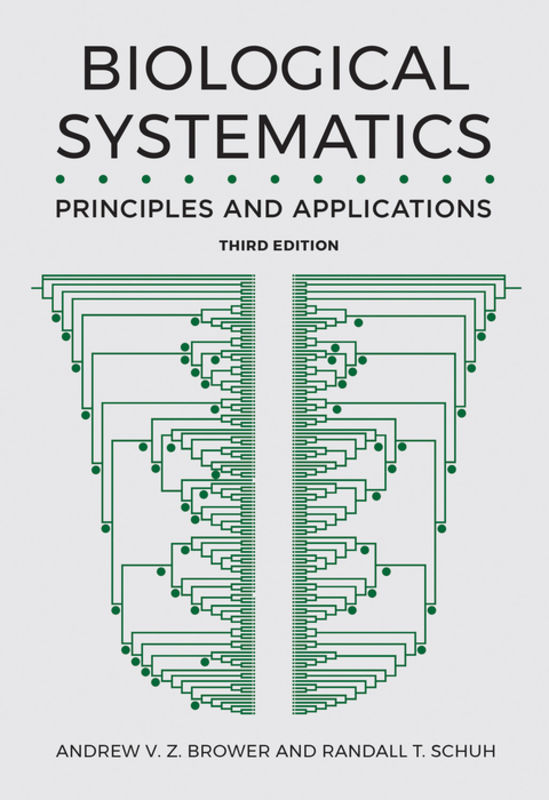
Biological Systematics
Understanding the history and philosophy of biological
systematics (phylogenetics, taxonomy and classification of living
things) is key to successful practice of the discipline.
In this thoroughly revised Third Edition of the classic
Biological Systematics , Andrew V. Z. Brower and Randall T.
Schuh provide an updated account of cladistic principles and
techniques, emphasizing their empirical and epistemological
clarity. Brower and Schuh cover:
-the history and philosophy of systematics -the mechanics and
methods of character analysis, phylogenetic inference, and
evaluation of results -the practical application of systematic
results to: -biological classification -adaptation and coevolution
-biodiversity,and conservation -new chapters on species and
molecular clocks
Biological Systematics is both a textbook for students
studying systematic biology and a desk reference for practicing
systematists. Part explication of concepts and methods, part
exploration of the underlying epistemology of systematics, This
third edition addresses why some methods are more empirically sound
than others.
eBook

Your guide to life on Earth
\"What exactly is a living thing? What is it made of? Your Guide to Life on Earth starts with the very basics of life and provides bite-sized chunks of information to explain in an easy-to-understand way the science behind the mystery of life on Earth\"-- Provided by publisher.
Book

From Taxonomy to Phylogenetics Life and Work of Willi Hennig
Willi Hennig (1913-1976), laid the fundaments of a 'scientific revolution' in Biological Systematics by his method called \"Phylogenetic Systematics\". The book describes the historical development of this 'scientific revolution', and highlights the life and the work of a 'cautious revolutioniser' in a Germany of dictatorship, war, and separation.
eBook


Taxonomic Tapestries
This volume explores the complexity, diversity and interwoven nature of taxonomic pursuits within the context of explorations of humans and related species. It also pays tribute to Professor Colin Groves, whose work has had an enormous impact on this field. Recent research into that somewhat unique species we call humankind, through the theoretical and conceptual approaches afforded by the discipline of biological anthropology, is showcased. The focus is on the evolution of the human species, the behaviour of primates and other species, and how humans affect the distribution and abundance of other species through anthropogenic impact. Weaving together these three key themes, through the considerable influence of Colin Groves, provides glimpses of how changes in taxonomic theory and methodology, including our fluctuating understanding of speciation, have recrafted the way in which we view animal behaviour, human evolution and conservation studies.
eBook


Biogeography of Australasia
Over the last decade, molecular studies carried out on the Australasian biota have revealed a new world of organic structure that exists from submicroscopic to continental scale. Furthermore, in studies of global biogeography and evolution, DNA sequencing has shown that many large groups, such as flowering plants, passerine birds and squamates, have their basal components in this area. Using examples ranging from kangaroos and platypuses to kiwis and birds of paradise, the book examines the patterns of distribution and evolution of Australasian biodiversity and explains them with reference to tectonic and climatic change in the region. The surprising results from molecular biogeography demonstrate that an understanding of evolution in Australasia is essential for understanding the development of modern life on Earth. A milestone in the literature on this subject, this book will be a valuable source of reference for students and researchers in biogeography, biodiversity, ecology and conservation.
eBook