
Catalogue Search | MBRL


Are you sure you want to remove the book from the shelf?

{{itemTitle}}
1,433
result(s) for
"Biotechnology Law and legislation."
Sort by:

Bioethics, medicine, and the criminal law. Volume 1, The criminal law and bioethical conflict : walking the tightrope
\"Who should define what constitutes ethical and lawful medical practice? Judges? Doctors? Scientists? Or someone else entirely? This volume analyses how effectively criminal law operates as a forum for resolving ethical conflict in the delivery of health care. It addresses key questions such as: how does criminal law regulate controversial bioethical areas? What effect, positive or negative, does the use of criminal law have when regulating bioethical conflict? And can the law accommodate moral controversy? By exploring criminal law in theory and in practice and examining the broad field of bioethics as opposed to the narrower terrain of medical ethics, it offers balanced arguments that will help readers form reasoned views on the ethical legitimacy of the invocation and use of criminal law to regulate medical and scientific practice and bioethical issues\"-- Provided by publisher.
Book

Corporate crops : biotechnology, agriculture, and the struggle for control
Biotechnology crop production area increased from 1.7 million hectares to 148 million hectares worldwide between 1996 to 2010. While genetically modified food is a contentious issue, the debates are usually limited to health and environmental concerns, ignoring the broader questions of social control that arise when food production methods become corporate-owned intellectual property. Drawing on legal documents and dozens of interviews with farmers and other stakeholders, Corporate Crops covers four case studies based around litigation between biotechnology corporations and farmers. Pechlaner investigates the extent to which the proprietary aspects of biotechnologies—from patents on seeds to a plethora of new rules and contractual obligations associated with the technologies—are reorganizing crop production. The lawsuits include patent infringement litigation launched by Monsanto against a Saskatchewan canola farmer who, in turn, claimed his crops had been involuntarily contaminated by the company’s GM technology; a class action application by two Saskatchewan organic canola farmers launched against Monsanto and Aventis (later Bayer) for the loss of their organic market due to contamination with GMOs; and two cases in Mississippi in which Monsanto sued farmers for saving seeds containing its patented GM technology. Pechlaner argues that well-funded corporate lawyers have a decided advantage over independent farmers in the courts and in creating new forms of power and control in agricultural production. Corporate Crops demonstrates the effects of this intersection between the courts and the fields where profits, not just a food supply, are reaped.
eBook


Genetic Data and the Law
Research using genetic data raises various concerns relating to privacy protection. Many of these concerns can also apply to research that uses other personal data, but not with the same implications for failure. The norms of exclusivity associated with a private life go beyond the current legal concept of personal data to include genetic data that relates to multiple identifiable individuals simultaneously and anonymous data that could be associated with any number of individuals in different, but reasonably foreseeable, contexts. It is the possibilities and implications of association that are significant, and these possibilities can only be assessed if one considers the interpretive potential of data. They are missed if one fixates upon its interpretive pedigree or misunderstands the meaning and significance of identification. This book demonstrates how the public interest in research using genetic data might be reconciled with the public interest in proper privacy protection.
eBook

Genetic data and the law : a critical perspective on privacy protection
\"Research using genetic data raises various concerns relating to privacy protection. Many of these concerns can also apply to research that uses other personal data, but not with the same implications for failure. The norms of exclusivity associated with a private life go beyond the current legal concept of personal data to include genetic data that relates to multiple identifiable individuals simultaneously and anonymous data that could be associated with any number of individuals in different, but reasonably foreseeable, contexts. It is the possibilities and implications of association that are significant, and these possibilities can only be assessed if one considers the interpretive potential of data. They are missed if one fixates upon its interpretive pedigree or misunderstands the meaning and significance of identification. This book demonstrates how the public interest in research using genetic data might be reconciled with the public interest in proper privacy protection\"-- Provided by publisher.
Book
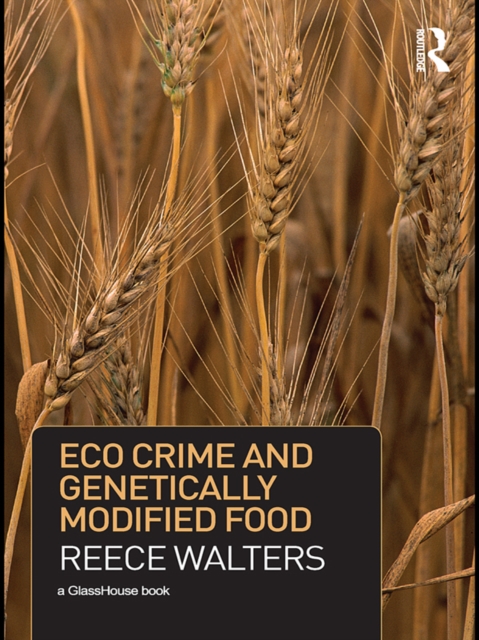
Eco Crime and Genetically Modified Food
The GM debate has been ongoing for over a decade, yet it has been contained in the scientific world and presented in technical terms. Eco Crime and Genetically Modified Food brings the debates about GM food into the social and criminological arena.
This book highlights the criminal and harmful actions of state and corporate officials. It concludes that corporate and political corruption, uncertain science, bitter public opposition, growing farmer concern and bankruptcy, irreversible damage to biodervisty, corporate monopolies and exploitation, disregard for social and cultural practices, devastation of small scale and local agricultural economies, imminent threats to organics, weak regulation, and widespread political and biotech mistrust – do not provide the bases for advancing and progressing GM foods into the next decade. Yet, with the backing of the WTO, the US and UK Governments march on – but at what cost to future generations?
Reece Walters is Professor in Criminology, and Head of the Social Policy and Criminology Department at The Open University. He has published widely on the politics and governance of criminological knowledge, including Deviant Knowledge - Criminology, Politics and Policy and Critical Thinking about the Uses of Research (with Tim Hope).
1. Introduction: Planting the Seed 2. The Politicisation of GM: Terrain, Terms and Concepts 3. The Perils, Prospects and Controversies of GM Food 4. Risk, Public Opinion and Consumer Resistance 5. Biotech, Papal and Trade ‘Wars’: Third World Hunger, Exploitation and the Politics of GM Food 6. Regulatory Regimes: Ensuring Safety or Enhancing Profits? 7. Green Criminology: Power, Harm and (In) Justice 8. Reflections and Conclusions
eBook


Intellectual property rights in agricultural biotechnology
During the past twenty-five years, biotechnology has revolutionized agricultural research. The enormous potential, together with a landmark decision by the US Supreme Court to allow the patenting of genetically-engineered organisms has encouraged private sector companies to invest in agricultural biotechnology research programmes. This has contributed to a rapid growth in interest in intellectual property rights as applied to this subject.The first edition of this book was published in 1998. Now fully revised and updated it presents definitive information on intellectual property law in a simplified form (with a minimum of legal jargon). New chapters have been added which cover plant variety protection and farmers rights, and additional case studies.
eBook

Wireless computing in medicine : from nano to cloud with ethical and legal implications
\"Provides a comprehensive overview of wireless computing in medicine, with technological, medical, and legal advances This book brings together the latest work of leading scientists in the disciplines of Computing, Medicine, and Law, in the field of Wireless Health. The book is organized into three main sections. The first section discusses the use of distributed computing in medicine. It concentrates on methods for treating chronic diseases and cognitive disabilities like Alzheimer’s, Autism, etc. آ It also discusses how to improve portability and accuracy of monitoring instruments and reduce the redundancy of data. It emphasizes the privacy and security of using such devices. The role of mobile sensing, wireless power and Markov decision process in distributed computing is also examined. The second section covers nanomedicine and discusses how the drug delivery strategies for chronic diseases can be efficiently improved by Nanotechnology enabled materials and devices such as MENs and Nanorobots. The authors will also explain how to use DNA computation in medicine, model brain disorders and detect bio-markers using nanotechnology. The third section will focus on the legal and privacy issues, and how to implement these technologies in a way that is a safe and ethical. Defines the technologies of distributed wireless health, from software that runs cloud computing data centers, to the technologies that allow new sensors to work Explains the applications of nanotechnologies to prevent, diagnose and cure disease Includes case studies on how the technologies covered in the book are being implemented in the medical field, through both the creation of new medical applications and their integration into current systems Discusses pervasive computing’s organizational benefits to hospitals and health care organizations, and their ethical and legal challenges Wireless Computing in Medicine: From Nano to Cloud with Its Ethical and Legal Implications is written as a reference for computer engineers working in wireless computing, as well as medical and legal professionals. The book will also serve students in the fields of advanced computing, nanomedicine, health informatics, and technology law\"-- Provided by publisher.
Book
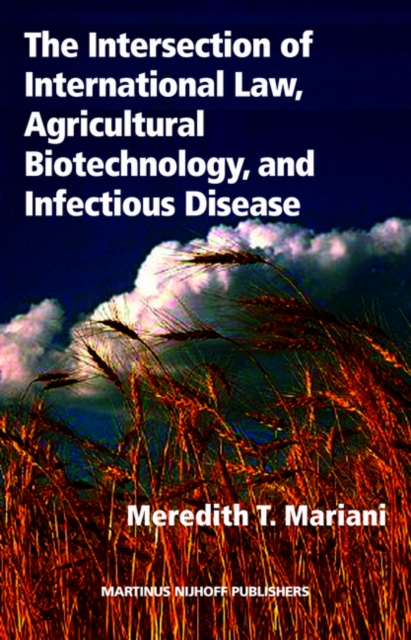
The Intersection of International Law, Agricultural Biotechnology, and Infectious Disease
The Intersection of International Law, Agricultural Biotechnology, and Infectious Disease examines legal frameworks and perspectives for infectious disease and GMOs and argues for a more connective approach for future regulation.
eBook