
Catalogue Search | MBRL


Are you sure you want to remove the book from the shelf?

{{itemTitle}}
12
result(s) for
"Biotic communities Alaska."
Sort by:

Serendipity : an ecologist's quest to understand nature
\"To newly minted biologist James Estes, the sea otters he was studying in the leafy kelp forests off the coast of Alaska appeared to have an unbalanced relationship with their larger environment. Gorging themselves on the sea urchins that grazed among the kelp, these small charismatic mammals seemed to give little back in return. But as Estes dug deeper, he unearthed a far more complex relationship between the otter and its underwater environment, discovering that otters played a critical role in driving positive ecosystem dynamics. While teasing out the connective threads, he began to question our assumptions about ecological relationships. These questions would ultimately inspire a lifelong quest to better understand the surprising complexity of our natural world and the unexpected ways we discover it. Serendipity tells the story of James Estes's life as a naturalist and the concepts that drive his interest in researching the ecological role of large predators. Using the relationship between sea otters, kelp, and sea urchins as a touchstone, Estes retraces his investigations of numerous other species, ecosystems, and ecological processes in an attempt to discover why ecologists can learn so many details about the systems within which they work and yet understand so little about the broader processes that influence those systems. Part memoir, part natural history, and deeply inquisitive, Serendipity will entertain and inform readers as it raises thoughtful questions about our relationship with the natural world.\"--Provided by publisher.
Book

Limited stand expansion by a long-lived conifer at a leading northern range edge, despite available habitat
1. In an era of rapid climate change, understanding the natural capacity of species' ranges to track shifting climatic niches is a critical research and conservation need. Because species do not move across the landscape through empty space, but instead have to migrate through existing biotic communities, basic dispersal ecology and biotic interactions are important considerations beyond simple climate niche tracking. 2. Yellow-cedar (Callitropsis nootkatensis), a long-lived conifer of the North Pacific coastal temperate rainforest region, is thought to be undergoing a continued natural range expansion in southeast Alaska. At the same time, yellow-cedar's trailing edge is approaching its leading edge in the region, due to climate-induced root injury leading to widespread mortality over the past century. To examine the current dispersal capacity of yellow-cedar at its leading range edge, and potential for the species' leading edge to stay ahead of its trailing edge, we characterized recent yellow-cedar stand development near Juneau, Alaska, and surveyed the spread of yellow-cedar seedlings just beyond existing stand boundaries. 3. Despite suitable habitat beyond stand edges, stand expansion appears limited in recent decades to centuries. Large quantities of seed are germinating within stands and just beyond boundaries, but seedlings are not developing to maturity. Furthermore, c. 100-200-year-old yellow-cedar trees are located abruptly at stand boundaries, indicating stand expansion is in a period of stasis with a last pulse at the end of the Little Ice Age climate period. 4. Vegetative regeneration is common across stands and may be an adaptive strategy for this long-lived tree to persist on the landscape until conditions are favourable for successful seedling recruitment, leading to an overall punctuated migration and colonization of new landscapes. 5. Synthesis. Species ranges do not always respond linearly to shifting climatic conditions. Instead, successful colonization of new habitat may be tied to episodic, threshold-related landscape phenomena, dispersal ability, and competition with existing plant communities.
Journal Article

A ‘Knowledge Ecologies’ Analysis of Co-designing Water and Sanitation Services in Alaska
Willingness to collaborate across disciplinary boundaries is necessary but not sufficient for project success. This is a case study of a transdisciplinary project whose success was constrained by contextual factors that ultimately favoured technical and scientific forms of knowledge over the cultural intelligence that might ensure technical solutions were socially feasible. In response to Alaskan Water and Sewer Challenge (AWSC), an international team with expertise in engineering, consultative design and public health formed in 2013 to collaborate on a two-year project to design remote area water and sanitation systems in consultation with two native Alaskan communities. Team members were later interviewed about their experiences. Project processes are discussed using a ‘Knowledge Ecology’ framework, which applies principles of ecosystems analysis to knowledge ecologies, identifying the knowledge equivalents of ‘biotic’ and ‘abiotic’ factors and looking at their various interactions. In a positivist ‘knowledge integration’ perspective, different knowledges are like Lego blocks that combine with other ‘data sets’ to create a unified structure. The knowledge ecology framework highlights how interactions between different knowledges and knowledge practitioners (‘biotic factors’) are shaped by contextual (‘abiotic’) factors: the conditions of knowledge production, the research policy and funding climate, the distribution of research resources, and differential access to enabling infrastructures (networks, facilities). This case study highlights the importance of efforts to negotiate between different knowledge frameworks, including by strategic use of language and precepts that help translate social research into technical design outcomes that are grounded in social reality.
Journal Article

Oil and Wilderness in Alaska
Colliding environmental and development interests have shaped national policy reforms supporting both oil development and environmental protection in Alaska.Oil and Wilderness in Alaskaexamines three significant national policy reform efforts that came out of these conflicts: the development of the Trans-Alaska pipeline, the establishment of a vast system of protected natural areas through the Alaska National Interest Lands Conservation Act, and the reform of the environmental management of the marine oil trade in Alaska to reduce the risk of oil pollution after theExxon Valdezdisaster. Illuminating the delicate balance and give-and-take between environmental and commercial interests, as well as larger issues shaping policy reforms, Busenberg applies a theoretical framework to examine the processes and consequences of these reforms at the state, national, and international levels. The author examines the enduring institutional legacies and policy consequences of each reform period, their consequences for environmental protection, and the national and international repercussions of reform efforts. The author concludes by describing the continuing policy conflicts concerning oil development and nature conservation in Alaska left unresolved by these reforms. Rich case descriptions illustrate the author's points and make this book an essential resource for professors and students interested in policies concerning Alaska, the Arctic, oil development, nature conservation, marine oil spills, the policy process, and policy theory.
eBook

Plant Community Composition as a Predictor of Regional Soil Carbon Storage in Alaskan Boreal Black Spruce Ecosystems
The boreal forest is the largest terrestrial biome in North America and holds a large portion of the world's reactive soil carbon. Therefore, understanding soil carbon accumulation on a landscape or regional scale across the boreal forest is useful for predicting future soil carbon storage. Here, we examined the relationship between floristic composition and ecosystem parameters, such as soil carbon pools, the carbon-to-nitrogen (C/N) ratio of live black spruce needles, and normalized basal area increment (NBAI) of trees in black spruce communities, the most widespread forest type in the boreal forest of Alaska. Variability in ecosystem properties among black spruce stands was as large as that which had previously been documented among all forest types in the central interior of Alaska; we found an eightfold range in NBAI and fivefold range in mineral soil carbon and nitrogen pools. Acidic black spruce communities had significantly more carbon in the organic soil horizon than did nonacidic black spruce communities, but did not differ in any other measured ecosystem parameter. We explained 48% of the variation in total soil carbon with a combination of plant community indices and abiotic and biotic factors. Plant community composition was at least as effective as any single environmental factor or stand characteristic in predicting soil C pools in Alaskan black spruce ecosystems. We conclude that among the community properties analyzed, the presence of key groups of species, overall species composition, and diversity of certain functional types, especially Sphagnum moss species, are important predictors of soil carbon sequestration in the black spruce forest type.
Journal Article

Causes and ecosystem consequences of multiple pathways of primary succession at Glacier Bay, Alaska
The classic account of primary succession inferred from a 220-yr glacial retreat chronosequence at Glacier Bay National Park, Alaska was compared to reconstructions of stand development based on tree-ring records from 850 trees at 10 sites of different age. The three oldest sites (deglaciated prior to 1840) differ from all younger sites in the early recruitment of Sitka spruce (Picea sitchensis), the presence of western hemlock (Tsuga heterophylla), and the inferred importance of early shrub thickets. The nitrogen-fixing shrub Sitka alder (Alnus sinuata) has been an important and long-lived species only at sites deglaciated since 1840. Black cottonwood (Populus trichocarpa) has been an overstory dominant only at sites deglaciated since 1900. These single-species additions or replacements distinguish three pathways of vegetation compositional change which are segregated spatially and temporally. The communities of different age at Glacier Bay do not constitute a single chronosequence and should not be used uncritically to infer long-term successional trends. Among-site differences in texture and lithology of soil parent material cannot account for the multiple pathways. However, distance from each study site to the closest seed source of Sitka spruce at the time of deglaciation explains up to 58% of the among-site variance in early spruce recruitment. Multiple pathways of compositional change at Glacier Bay appear to be a function of landscape context, which, in conjuction with species life history traits (dispersal capability and generation time), affects seed rain to newly deglaciated surfaces and thereby alters the arrival sequence of species. Differences among the pathways probably include long-term differences in ecosystem function resulting from substantial accumulation of nitrogen at sites where nitrogen-fixing shrubs are important.
Journal Article
Eddy Covariance Measurements of CO2 and Energy Fluxes of an Alaskan Tussock Tundra Ecosystem
Eddy covariance was used to measure the net CO2 exchange and energy balance of a moist-tussock tundra ecosystem at Happy Valley, Alaska (69 degrees 08.54′ N 148 degrees 50.47′ W), during the 1994-1995 growing seasons (June-August). The system operated for 75-95% of the time, and energy balance closure was within 5%, indicating good system performance. Daily rates of evapotranspiration (ET) were on average 1.5 mm/d, while seasonal ET ranged between 100 and 150 mm. Daily ET was strongly correlated with daily fluctuations in net radiation. However, the \"omega factor\" (an index of the relative importance of meteorological and physiological limitations to evapotranspiration) was generally <0.5 throughout June and early July, indicating that biological limitations to ET were relatively more important than meteorological limitations during the first half of the growing season. The biological limitation to ET was presumably due to bryophyte desiccation and subsequent reductions in canopy water-vapor conductance, especially under conditions of high evaporative demand. The moist-tussock tundra ecosystem was a net sink for atmospheric CO2 of -3.3 and -4.6 mol/m2 during the 1994 and 1995 growing seasons, respectively (negative flux depicts net CO2 accumulation). Over diel (24-h) periods, 60-90% of the variation in net CO2 exchange was explained as a hyperbolic function of photosynthetic photon flux density (PPFD), while over seasonal time scales, model estimates of the estimated quantum yield and maximum gross assimilation indicate that daily variations in net CO2 uptake were driven more by the seasonal trend in ecosystem phenology than by meteorology. Approximately 70% of the variation in nighttime net CO2 exchange, an estimate of the whole-ecosystem respiration rate, was explained by variations in water-table depth and temperature. Although other environmental factors may be important, interannual differences in observed net CO2 exchange were almost completely explained by the interannual differences in estimated whole-ecosystem respiration.
Journal Article
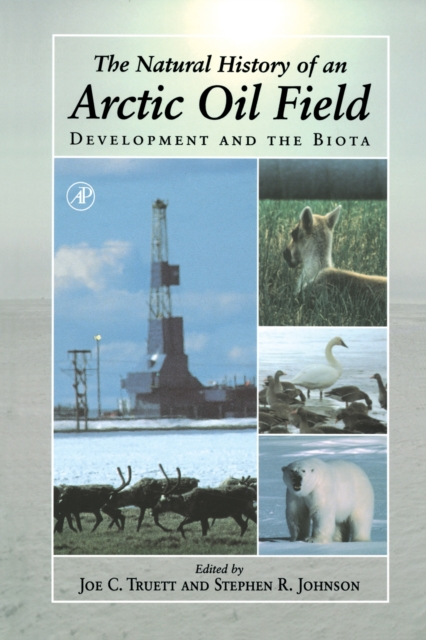
The natural history of an arctic oil field : development and the biota
In spite of the harsh conditions that characterize the Arctic, it is a surprisingly fragile ecosystem.The exploration for oil in the Arctic over the past 30 years has had profound effects on the plants and animals that inhabit this frozen clime.The Natural History of an Arctic Oil Field synthesizes decades of research on these myriad impacts.
eBook
A Century of Ecosystem Science
This report provides guidance to the Gulf Ecosystem Monitoring (GEM) program to help ensure that it is based on a a science plan that is robust, far-reaching, and scientifically sound. The report commends the Trustee Council for its foresight in setting aside funds to create a trust fund to provide long-term research support; it notes that the GEM program offers an unparalleled opportunity to increase understanding of how large marine ecosystems function and change over time. The report outlines elements of a sound long-term science plan, including conceptual foundation, scope and geographic focus, organizational structure, community involvement, data and information management, and synthesis, modeling, and evaluation.
eBook
