
Catalogue Search | MBRL


Are you sure you want to remove the book from the shelf?

{{itemTitle}}
3,176
result(s) for
"Bird refuges"
Sort by:

Seeking refuge
Each fall and spring, millions of birds travel the Pacific Flyway, the westernmost of the four major North American bird migration routes. The landscapes they cross vary from wetlands to farmland to concrete, inhabited not only by wildlife but also by farmers, suburban families, and major cities. In the twentieth century, farmers used the wetlands to irrigate their crops, transforming the landscape and putting migratory birds at risk. The U.S. Fish and Wildlife Service responded by establishing a series of refuges that stretched from northern Washington to southern California.
What emerged from these efforts was a hybrid environment, where the distinctions between irrigated farms and wildlife refuges blurred. Management of the refuges was fraught with conflicting priorities and practices. Farmers and refuge managers harassed birds with shotguns and flares to keep them off private lands, and government pilots took to the air, dropping hand grenades among flocks of geese and herding the startled birds into nearby refuges. Such actions masked the growing connections between refuges and the land around them.
Seeking Refuge examines the development and management of refuges in the wintering range of migratory birds along the Pacific Flyway. Although this is a history of efforts to conserve migratory birds, the story Robert Wilson tells has considerable salience today. Many of the key places migratory birds use the Klamath Basin, California s Central Valley, the Salton Sea are sites of recent contentious debates over water use. Migratory birds connect and depend on these landscapes, and farmers face pressure as water is reallocated from irrigation to other purposes. In a time when global warming promises to compound the stresses on water and migratory species, Seeking Refuge demonstrates the need to foster landscapes where both wildlife and people can thrive.
eBook

Evaluating the impacts of season, timing, and age on the energetic condition of Catharus thrushes at a northern stopover site/Evaluación del impacto de la estacionalidad, temporalidad y edad en la condición energética de zorzales Catharus en su sitio de parada migratoria más norteño
Most passerines use fat to fuel migration and pause at stopover sites to rest or refuel. Moreover, during spring migration, en route to breeding grounds, passerines may deposit \"excess\" fat as either insurance against unpredictable environmental conditions or in anticipation of breeding. We analyzed the energetic condition of Hermit Thrush (Catharus guttatus), Swainson's Thrush (C. ustulatus), and Veery (C. fuscescens) during spring and autumn migration at the Braddock Bay Bird Observatory (Rochester, New York, USA). We used path analysis to determine if the \"spring fatter\" or insurance hypotheses could help explain some of the variation in energetic condition in Catharus thrushes by designing and analyzing biologically plausible models of the potential effects of season, capture date, hour captured, and age on energetic condition during stopover. While path models differed among species and seasons, capture (or arrival) date was the strongest predictor of energetic condition; contrary to the insurance hypothesis condition increased with date during both seasons for all species. Hour of capture predicted much less variation in condition but was consistently positive (when significant). In long-distance migrants (i.e., Swainson's Thrush and Veery), less experienced or young migrants exhibited better condition than adults regardless of arriving later, which was revealed by including a direct path between age and condition and an indirect path mediated via capture date to control for potential differences in arrival timing related to age. Despite being closely related, we found only a few patterns in common among Swainson's Thrush, Hermit Thrush, and Veery. We suspect differences in phenology, flight, morphology, and migratory strategy may play a significant role in the differences among these species.
Journal Article
Egg morphometrics and egg shape coefficients for White-faced Ibis /Morfometria y cocficiente de forma de los huevos del ibis Plegadis chihi
Egg size is a useful metric for maternal investment, offspring quality, and contaminant studies. Yet these values and the egg shape coefficients required to estimate egg size are not available for many species, including White-faced-lbis (Plegadis chihi). We provide egg morphometries derived from 319 White-faced Ibis eggs sampled at Bear River Migratory Bird Refuge, Great Salt Lake. Utah, from 2010 to 2012. Measured egg length (mean [+ or -] SD) was 51.20 [+ or -] 1.99 mm, egg width was 36.08 [+ or -]1.15 mm, and whole egg mass was 34.1 [+ or -] 3.3 g. Estimated whole egg volume was 34.63 [+ or -] 3.73 [cm.sup.3] and estimated egg shape coefficients were 0.507 for [K.sub.v] (whole egg and egg contents), 0.547 for [K.sub.w] (whole egg), and 0.524 for [K.sub.w] (egg contents only). In addition, we documented expected declines in egg mass over time due to incubation (-0.22 g/d) and desiccation during storage (-0.03 g/d). that should be accounted for prior to analyses that use egg mass of freshly laid eggs. Received 18 May 2021. Accepted 9 June 2021.
Journal Article

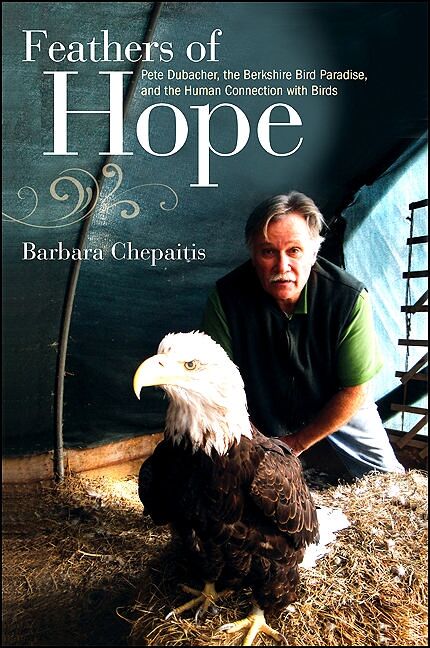
Feathers of Hope
Feathers of Hope takes the reader on a joyful journey
through the Berkshire Bird Paradise in Grafton, New York. Founded
and maintained by Pete Dubacher, the Berkshire Bird Paradise is a
magical place that provides sanctuary to over twelve hundred
injured or otherwise unreleasable birds, from emus, pigeons, and
tropical birds to eagles, owls, hawks, and more. New York City
residents regularly drive four hours to hand-deliver injured
pigeons to Pete, and wildlife officials across the country have
sent injured birds for his care, from an eagle mauled by a bear in
Alaska to cranes left over from a breeding program in Maryland. In
April 1999, two baby golden eagles were hatched from two disabled
birds, and the surviving eaglet, Dotty, was successfully released
into the wild, and in 2003 two bald eagles were, for the first time
ever, hatched in captivity, raised, and released. Following Pete
for a \"typical\" day at the sanctuary, which includes tossing dead
rats to eagles and stoking woodstoves at one in the morning, author
Barbara Chepaitis provides an intimate view of what it takes to
maintain a dream of this proportion, and what makes Pete Dubacher
the kind of man who can do so. Along the way, she also tells the
stories of other people in many different walks of life who have
found solace in and taken inspiration from their interactions with
birds, including a college student who takes an injured baby bird
to her critical theory class, avid birdwatchers who keep careful
lists of all the birds they've seen, and a man who found meaning by
rescuing injured pigeons in New York City. Together with Pete's
story and the story of the Berkshire Bird Paradise, their stories
offer an engaging look at how forging a stronger connection to
birds, and to nature in general, can teach us to be more fully
human. Birds of Paradise is for anyone who ever rescued a baby bird
or wondered how to make a dream come true.
eBook
Patterns in the physiological condition of three species of thrushes during autumn stopover near the south shore of Lake Ontario/Patrones en la condicion fisiologica de tres especies de zorzales durante la parada migratoria de otono cercana a la ribera del lago Ontario
Annual migrations are energetically challenging for migratory passerines and represent a potentially stressful period of the annual cycle, particularly during brief refueling periods at stopover sites. Shoreline habitats near the Great Lakes in eastern North America support many landbird migrants; however, environmental factors–including food availability and unpredictable weather–may impact the health and physiological condition of these birds during refueling periods. The aim of this study at the Braddock Bay Bird Observatory was to use key blood metrics (plasma metabolite profiling and leukocyte counts) to assess annual and within-season variation in nutrient utilization and physiological condition of 3 species of Catharus thrushes with known variation in migration strategy and passage timing. We observed similar plasma triglyceride concentrations across species; however, glucose and uric acid were elevated in a short-distance migrant, the Hermit Thrush (Catharus guttatus). Furthermore, Hermit Thrush showed higher heterophil/lymphocyte ratios than Gray-cheeked Thrush (C. minimus) or Swainson's Thrush (C. ustulatus). Year was an important factor in all analyses exploring variables that may influence nutrient utilization or chronic stress. Our results suggest that thrushes with diverse migration strategies do not significantly differ in fat deposition patterns at the site, but end-of-season migrants may consume different resources and display increased chronic stress levels as they experience reduced food availability with the progression of autumn migration. We additionally propose that annual variation detected in this multi-year study underscores the importance of physiological condition metrics as tools for assessing yearly patterns in refueling performance at stopover sites, which is especially relevant in light of the continuing pressures of invasive species and environmental change.
Journal Article

Do mice matter? Impacts of house mice alone on invertebrates, seedlings and fungi at Sanctuary Mountain Maungatautari
Reports the findings of a 5-year examination of the impacts of house mice (Mus musculus) alone on biodiversity at Sanctuary Mountain Maungatautari by a comparison of forest blocks with relatively high and low numbers of mice. Source: National Library of New Zealand Te Puna Matauranga o Aotearoa, licensed by the Department of Internal Affairs for re-use under the Creative Commons Attribution 3.0 New Zealand Licence.
Journal Article

Visual surveys provide baseline data on small vessel traffic and waterbirds in a coastal protected area
The coastal waters of southern British Columbia, Canada, encompass habitat of international conservation significance to coastal and marine birds, including sizeable areas designated in the early 1900s as Migratory Bird Sanctuaries (MBS) to protect overwintering waterfowl from hunting near urban centres. Two of these, Shoal Harbour (SHMBS) and Victoria Harbour (VHMBS), have seen significant marine infrastructure development in recent decades and experience considerable vessel traffic. Vessel-related stressors are known to affect waterbirds, but traffic characteristics in coastal urban areas are poorly understood for the smaller vessels not tracked by Automatic Identification Systems (AIS). We conducted a pilot study using shore-based observers to develop small-vessel baselines for the winter months, when regional waterbird numbers are highest. During our surveys we recorded considerable inter-site variability in vessel traffic characteristics, with one site (SHMBS) a source of nearly twice as many vessel transits as the other (VHMBS). Most recorded vessels were small watercraft (mean length 26 ± 17′, mode 18′), and vessels at the high-traffic site were both shorter and faster on average. One in six vessels were classified as ‘noisy’, of interest given that noise is an important component of vessel disturbance of waterbirds and other marine animals. Few vessels (7% of all recorded) were of the type required to carry AIS transponders, which highlights the monitoring gap created by using AIS-based approaches alone in nearshore waters, and allows for correction of AIS-derived vessel counts. Waterbird community composition also varied by locality, with one site dominated by gulls (Laridae), cormorants (Phalacrocoracidae), and seaducks (Tribe Mergini), and the other by gulls, cormorants, and alcids (Alcidae). Our results demonstrate that fine-scale local variability must be taken into account when managing for vessel traffic disturbance of waterbirds, particularly at sites of high human population density and increasing coastal development.
Journal Article
Flight call response is lower at dusk than during daytime in two parulid species/La respuesta a los llamados en vuelo es nienos al anocheeer que durante el dia en dos espeeies de pariilidos
Many passerines regularly use flight calls to communicate during migration. However, flight-calling is inconsistent throughout the day. with a markedly lower degree of calling by free-flying individuals during the early evening hours and with peaks in calling typically around dawn. Based on these observations, we hypothesized that individual flight call response would vary by time of day, and the likelihood to respond would be lower at dusk than during the daytime. We tested daytime and dusk flight call responsiveness of captive American Redstarts (Setophaga ruticilla) and Magnolia Warblers (S. magnolia) during spring migration at the Braddock Bay Bird Observatory (near Rochester, New York, USA). We played a conspecific flight call sound stimulus for individual birds placed inside a soundproof recording studio and recorded their acoustic responses. In our experiment. American Redstarts and Magnolia Warblers were significantly less likely to give flight call responses at dusk than the individuals tested during the daytime. The almost absent responsiveness to flight calls at dusk suggests that these species either minimally communicate with one another during take-off or do not use llight calls as a source of communication at this time. These results have important implications for detection and quantitative bioacoustics migration monitoring. They also demonstrate the need for additional studies in temporal flight-calling behavior.
Journal Article