
Catalogue Search | MBRL


Are you sure you want to remove the book from the shelf?

{{itemTitle}}
31,810
result(s) for
"Bird watching."
Sort by:

A history of birdwatching in 100 objects
This book looks at 100 items that have profoundly shaped how people watched, studied and engaged with the avian world. Each item contains around 500 words on a double-page spread and include an illustration of the object in question.
Book
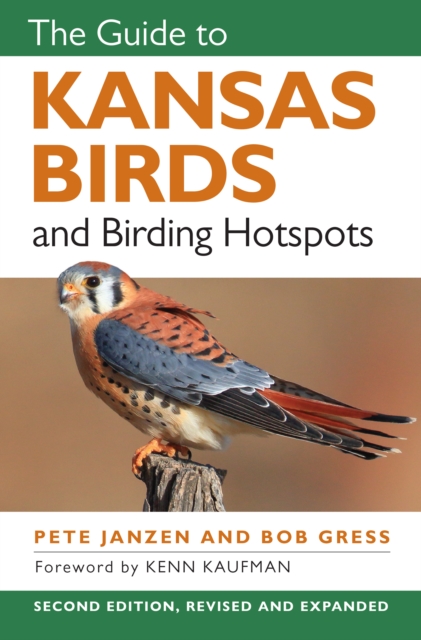
The Guide to Kansas Birds and Birding Hotspots
This definitive guide is an essential resource for Kansas
birders of all kinds!
Kansas is a bird-watcher’s paradise, boasting
exceptional habitat diversity and a key location at the hub of
the hemisphere’s migration corridors. An astounding 486
avian species have been documented in the state. In this greatly
expanded edition of their award-winning guide, renowned experts
Pete Janzen and Bob Gress have gathered a wealth of information
on 321 species and 100 birding hotspots in Kansas.
Janzen and
Gress offer beautiful photographs, useful identification
information, and field notes on habitat, seasonal occurrence, and
more. The guides to birding hotspots throughout the state
highlight the unique species and seasonal features of the most
diverse and exciting places Kansas has to offer and will help you
plan your next adventure. Additionally, Janzen and Gress have
included essays on topics like birding basics and the geography
and ecosystems of Kansas, along with a calendar of bird activity
in Kansas and a complete species checklist of Kansas birds.
This new edition is a must-have guide for every backyard
enthusiast and day-tripping birder.
eBook

Birdology : 30 activities and observations for exploring the world of birds
Encourages young nature enthusiasts to explore the world of birds.
Book

When Birds Are Near
In this dazzling literary collection, writers explore and
celebrate their lives with and love for birds-detailing experiences
from Alaska to Bermuda, South Dakota to Panama. In When Birds
Are Near , fresh new voices as well as seasoned authors offer
tales of adventure, perseverance, and fun, whether taking us on a
journey down Highway 1 to see a rare California Condor, fighting
the destruction of our grasslands, or simply watching the feeder
from a kitchen window.
But these essays are more than just field notes. The authors
reflect on love, loss, and family, engaging a broad array of
emotions, from wonder to amusement. As Rob Nixon writes, \"Sometimes
the best bird experiences are defined less by a rare sighting than
by a quality of presence, some sense of overall occasion that sets
in motion memories of a particular landscape, a particular light, a
particular choral effect, a particular hiking partner.\" Or, as the
poet Elizabeth Bradfield remarks, \"We resonate with certain
animals, I believe, because they are a physical embodiment of an
answer we are seeking. A sense of ourselves in the world that is
nearly inexpressible.\"
When Birds Are Near gives us the chance to walk
alongside these avid appreciators of birds and reflect on our own
interactions with our winged companions.
Contributors: Christina Baal, Thomas Bancroft, K. Bannerman, R.
A. Behrstock, Richard Bohannon, Elizabeth Bradfield, Christine Byl,
Susan Cerulean, Sara Crosby, Jenn Dean, Rachel Dickinson, Katie
Fallon, Jonathan Franzen, Andrew Furman, Tim Gallagher, David
Gessner, Renata Golden, Ursula Murray Husted, Eli J. Knapp, Donald
Kroodsma, J. Drew Lanham, John R. Nelson, Rob Nixon, Jonathan
Rosen, Alison Townsend, Alison Világ
eBook


Bird-watching and eco-crafting bird feeders as nature-based experiential learning activities for students in urban areas
The global urbanization surge, with the majority of the global population expected to reside in urbanized places, raises concerns about children’s limited exposure to nature, which could lead to a lack of environmental knowledge, gradually causing a decline in pro-environmental behaviors. Here, a bird-watching activity aims to introduce 10–18 year old students to urban biodiversity, enhance their knowledge of the ecological significance of local bird species, and help them explore their roles in conserving bird diversity. In the lesson, students observe and document bird species in their urban localities, followed by collaboratively designing and constructing bird feeders using waste and reuse of materials. We observed that students displayed excitement during the outdoor bird-walk, and identifying birds by name generated enthusiasm and increased engagement. With little assistance, they generated creative ideas for making bird feeders and could rationalize their choice of materials. This holistic learning experience fosters students’ interpersonal and intrapersonal skills, promotes awareness of and responsibility towards their environmental surroundings, and empowers them to enjoy nature and act as environmental stewards. More broadly, students benefit through improved observational skills, creativity, scientific inquiry, teamwork and interdisciplinary learning. This lesson emphasizes the significance of providing more nature-based experiential learning activities in the curricula by encouraging educators to leverage school campuses and urban green spaces as valuable resources for learning about urban nature.
Journal Article


Birds of Aruba, Bonaire, and Curacao
Birds of Aruba, Bonaire, and Curaçaois the essential guide for anyone traveling to those islands. It showcases the more than 280 species seen on Aruba, Bonaire, and Curaçao and provides descriptions of and directions to the best places to bird, from the famous white sand beaches to hidden watering holes to the majestic national parks.
Aruba, Bonaire, and Curaçao-the \"ABCs\"-located in the southwestern Caribbean, not far from Venezuela, share fascinating ecological features with the West Indies as well as the South American mainland, making birding on the islands unique. The identification portion of the book features endemic subspecies such as the Brown-throated Parakeet; a wide variety of wintering North American migrants; spectacular restricted-range northern South American species such as the Yellow-shouldered Parrot, Bare-eyed Pigeon, Troupial, Ruby-topaz Hummingbird, and Yellow Oriole; and West Indian species including the Pearly-eyed Thrasher and Caribbean Elaenia.
Colorful introductory sections provide readers with a brief natural history of the islands, detailing the geography, geology, and general ecology of each. In the site guide that follows, Jeffrey V. Wells and Allison Childs Wells share their more than two decades of experience in the region, providing directions to the best birding spots. Clear, easy-to-read maps accompany each site description, along with notes about the species that birders are likely to find.
The identification section is arranged in classic field guide format and offers vivid descriptions of each bird, along with tips on how to identify them by sight and sound. The accounts also include current status and seasonality, if relevant, and common names in English, Dutch, and Papiamento, often inspired by the unique voices of the birds, such as the \"chibichibi\" (Bananaquit) and \"choco\" (Burrowing Owl). The accompanying color plates feature the beautiful work of illustrator Robert Dean.
The final section, on conservation, raises awareness about threats facing the birds and the habitats on which they rely and summarizes conservation initiatives and needs, offering recommendations for each island.
eBook

A bird watcher's guide to sparrows
Learn how to start a bird watching hobby including the habitats and life cycle of sparrows.
Book

In the Field, Among the Feathered
America is a nation of ardent, knowledgeable birdwatchers. But how did it become so? And what role did the field guide play in our passion for spotting, watching, and describing birds? This book tells the history of field guides to birds in America from the Victorian era to the present, relating changes in the guides to shifts in science, the craft of field identification, and new technologies for the mass reproduction of images. Drawing on experience and a wealth of archival research, this book shows how the twin pursuits of recreation and conservation have inspired birders and how field guides have served as the preferred method of informal education about nature for well over a century. The book begins with the first generation of late nineteenth-century birdwatchers who built the hobby when opera glasses were often the best available optics and bird identification was sketchy at best. As America became increasingly urban, birding became more attractive, and with Roger Tory Peterson's first field guide in 1934, birding grew in both popularity and accuracy. By the 1960s recreational birders were attaining new levels of expertise, even as the environmental movement made birding's other pole, conservation, a matter of human health and planetary survival. The book concludes by showing how recreation and conservation have reached a new balance in the last forty years, as scientists have increasingly turned to amateurs, whose expertise had been honed by the new guides, to gather the data they need to support habitat preservation.
eBook