
Catalogue Search | MBRL


Are you sure you want to remove the book from the shelf?

{{itemTitle}}
6,743
result(s) for
"Birds, Extinction"
Sort by:

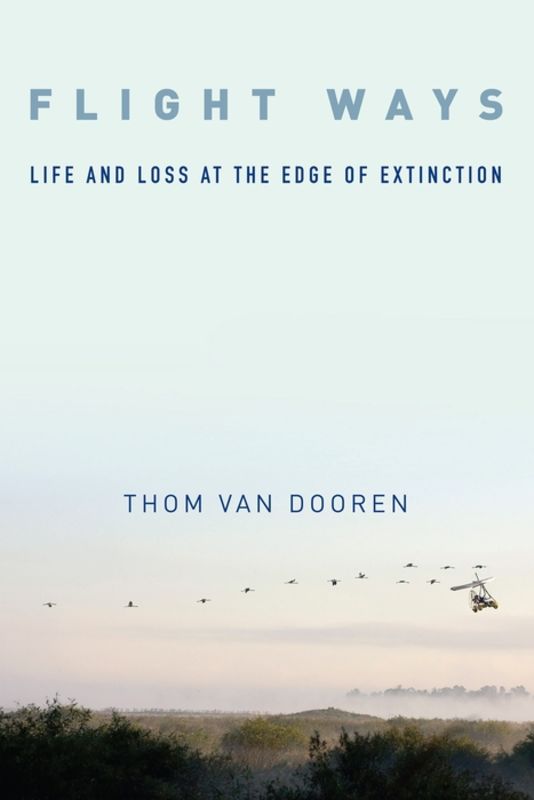
Flight ways
A leading figure in the emerging field of extinction studies, Thom van Dooren puts philosophy into conversation with the natural sciences and his own ethnographic encounters to vivify the cultural and ethical significance of modern-day extinctions. Unlike other meditations on the subject,Flight Waysincorporates the particularities of real animals and their worlds, drawing philosophers, natural scientists, and general readers into the experience of living among and losing biodiversity.
Each chapter ofFlight Waysfocuses on a different species or group of birds: North Pacific albatrosses, Indian vultures, an endangered colony of penguins in Australia, Hawaiian crows, and the iconic whooping cranes of North America. Written in eloquent and moving prose, the book takes stock of what is lost when a life form disappears from the world -- the wide-ranging ramifications that ripple out to implicate a number of human and more-than-human others. Van Dooren intimately explores what life is like for those who must live on the edge of extinction, balanced between life and oblivion, taking care of their young and grieving their dead. He bolsters his studies with real-life accounts from scientists and local communities at the forefront of these developments. No longer abstract entities with Latin names, these species become fully realized characters enmeshed in complex and precarious ways of life, sparking our sense of curiosity, concern, and accountability toward others in a rapidly changing world.
eBook

Flight ways : life and loss at the edge of extinction
\"A leading figure in the emerging field of extinction studies, Thom van Dooren puts philosophy into conversation with the natural sciences and his own ethnographic encounters to vivify the cultural and ethical significance of modern-day extinctions. Unlike other meditations on the subject, Flight Ways incorporates the particularities of real animals and their worlds, drawing philosophers, natural scientists, and general readers into the experience of living among and losing biodiversity. Each chapter of Flight Ways focuses on a different species or group of birds: North Pacific albatrosses, Indian vultures, an endangered colony of penguins in Australia, Hawaiian crows, and the iconic whooping cranes of North America. Written in eloquent and moving prose, the book takes stock of what is lost when a life form disappears from the world -- the wide-ranging ramifications that ripple out to implicate a number of human and more-than-human others. Van Dooren intimately explores what life is like for those who must live on the edge of extinction, balanced between life and oblivion, taking care of their young and grieving their dead. He bolsters his studies with real-life accounts from scientists and local communities at the forefront of these developments. No longer abstract entities with Latin names, these species become fully realized characters enmeshed in complex and precarious ways of life, sparking our sense of curiosity, concern, and accountability toward others in a rapidly changing world\"-- Publisher's description.
Book


Belonging on an island : birds, extinction, and evolution in Hawai°i
This natural history takes readers on a thousand-year journey as it explores the Hawaiian Islands' beautiful birds and a variety of topics including extinction, survival, conservationists and their work, and, most significantly, the concept of belonging. Author Daniel Lewis, an award-winning historian and globe-traveling amateur birder, builds this lively text around the stories of four species - the stumbling moa-nalo, the Kaua'i 'o'هo, the palila, and the Japanese white-eye. Lewis offers innovative ways to think about what it means to be native and proposes new definitions that apply to people as well as to birds. Being native, he argues, is a relative state influenced by factors including the passage of time, charisma, scarcity, utility to others, short-term evolutionary processes, and changing relationships with other organisms. This book also describes how bird conservation started in Hawai`i and the naturalists and environmentalists who did extraordinary work.-- Source other than Library of Congress.
Book
Discover what caused the extinction of the dodo bird in 1681
Title: Dodo. Once native to the Island of Mauritius in the Indian Ocean, the dodo is one of the most famous examples of human induced extinction.
Streaming Video
The Last Slender-Billed Curlew
\"The slender-billed curlew once flew far. It went to Asia, Europe, and Africa. The bird had long legs and a slim bill. It had heart-shaped spots. And the shorebird sang a sweet call. The slender-billed curlew was a beautiful bird. And now it is gone. Someone saw a slender-billed curlew on February 25, 1995. That was in Merja Zerga, Morocco. No one has seen one since. On October 10, 2025, the IUCN called it extinct.\" (News-O-Matic) Learn why the slender-billed curlew went extinct.
Web Resource
Lost Birds: Join the Search!
\"Scientists wrote a list of birds that have not been seen in at least 10 years. And they want your help to find them! There are about 12,000 species of birds. And 126 have not been documented since 2014. That means no one has taken a picture for a decade. The bird may have gone extinct. But no one knows. That’s why scientists hope people will join the search.\" (News-O-Matic) Read why scientists want people to join the search for lost birds.
Web Resource

Rabbits Killing Birds: Modelling the Hyperpredation Process
1. Introduced rabbits are known to have catastrophic effects on oceanic islands, either by direct destruction of the vegetative cover, or by the resulting disturbance of indigenous vertebrates. 2. Another dramatic effect, less well known, but potentially of major importance, is the hyperpredation process. This process, related to apparent competition, predicts that an introduced prey species, well adapted to high predation pressure, could induce the extinction of an indigenous prey, through the sudden increased population size of an introduced predator. In many island ecosystems, the simultaneous presence of introduced feral cats and rabbits is thus potentially a further threat for small vertebrates endemic of these islands. 3. Through a mathematical model, we tested this hypothesis, using a tri-trophic system comprising an indigenous prey (birds), an introduced prey (rabbits) and an introduced predator (cats), and we demonstrated the theoretical existence of the hyperpredation process. 4. In addition, the numerical analysis of the model allowed a quantification of this process. It shows that the conditions required for an indigenous species to cope with the hyperpredation process imply very high intrinsic growth rates and/or carrying capacity, as well as behavioural anti-predator response to the introduced predator. Since these conditions are unlikely to be met, this process is a further potential threat to most indigenous vertebrate prey. 5. Finally, our model shows that, although it can be induced by both types of adaptation together or alone, behavioural adaptations alone are more powerful in generating the hyperpredation process, than are life history traits adaptations.
Journal Article