
Catalogue Search | MBRL


Are you sure you want to remove the book from the shelf?

{{itemTitle}}
44,675
result(s) for
"Birds Behavior"
Sort by:


Boom and Bust
In Boom and Bust, the authors draw on the natural history of Australia's charismatic birds to explore the relations between fauna, people and environment in a continent where variability is 'normal' and rainfall patterns not always seasonal. They consider changing ideas about deserts and how these have helped us understand birds and their behaviour in this driest of continents. The book describes the responses of animals and plants to environmental variability and stress. It is also a cultural concept, when it is used to capture the patterns of change wrought by humans in Australia, where landscapes began to become cultural about 55,000 years ago as ecosystems responded to Aboriginal management. In 1788, the British settlement brought, almost simultaneously, both agricultural and industrial revolutions to a land previously managed by fire for hunting. How have birds responded to this second dramatic invasion? Boom and Bust is also a tool for understanding global change. How can Australians in the 21st century better understand how to continue to live in this land as its conditions are still dynamically unfolding in response to the major anthropogenic changes to the whole Earth system?This interdisciplinary collection is written in a straightforward and accessible style. Many of the writers are practising field specialists, and have woven their personal field work into the stories they tell about the birds.
eBook
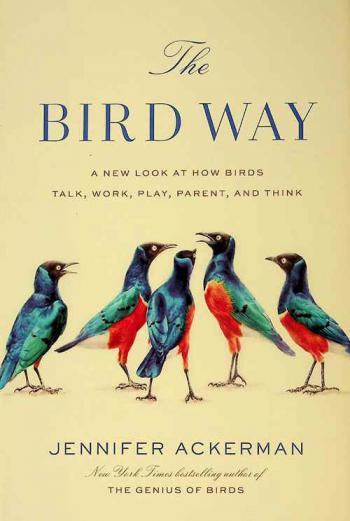
The bird way : a new look at how birds talk, work, play, parent, and think
\"\"There is the mammal way and there is the bird way.\" This is one scientist's pithy distinction between mammal brains and bird brains: two ways to make a highly intelligent mind. But the bird way is much more than a unique pattern of brain wiring, and lately, scientists have taken a new look at bird behaviors they have, for years, dismissed as anomalies or mysteries. What they are finding is upending the traditional view of how birds conduct their lives, how they communicate, forage, court, breed, survive. They're also revealing the remarkable intelligence underlying these activities, abilities we once considered uniquely our own--deception, manipulation, cheating, kidnapping, infanticide, but also, ingenious communication between species, cooperation, collaboration, altruism, culture, and play. Some of these extraordinary behaviors are biological conundrums that seem to push the edges of--well--birdness: A mother bird that kills her own infant sons, and another that selflessly tends to the young of other birds as if they were her own. Young birds that devote themselves to feeding their siblings and others so competitive they'll stab their nestmates to death. Birds that give gifts and birds that steal, birds that dance or drum, that paint their creations or paint themselves, birds that build walls of sound to keep out intruders and birds that summon playmates with a special call--and may hold the secret to our own penchant for playfulness and the evolution of laughter. Drawing on personal observations, the latest science, and her bird-related travel around the world, from the tropical rainforests of eastern Australia and the remote woodlands of northern Japan, to the rolling hills of lower Austria and the islands of Alaska's Kachemak Bay, Ackerman shows there is clearly no single bird way of being. In every respect, in plumage, form, song, flight, lifestyle, niche, and behavior, birds vary. It's what we love about them. As E.O Wilson once said, when you have seen one bird, you have not seen them all\"-- Provided by publisher.

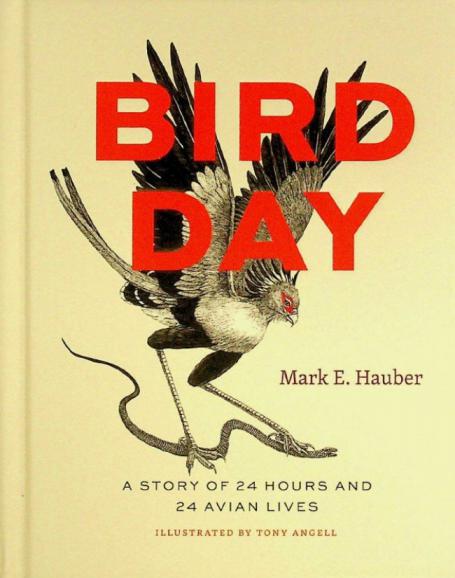
Bird day : a story of 24 hours and 24 avian lives
\"From morning to night and from the Antarctic to the equator, birds have busy days. In this short book, ornithologist Mark E. Hauber shows readers exactly how birds spend their time. Each of the book's twenty-four brief chapters covers a single bird and a single hour. At 1:00 in the night, we meet a nearly-blind kiwi, hunting with smell for earthworm prey. Later that morning, at 11:00, we float alongside a common pochard, a duck that can sleep with one eye open to avoid predators and bumping into other birds. At 8:00 that evening, we spot a hawk able to swallow bats whole in mid-flight, gorging on up to fifteen in rapid succession before retreating into the darkness. For each chapter, award-winning artist Tony Angell has depicted these scenes with his signature linocut-style illustrations-which grow increasingly light and then dark as our bird day passes\"-- Provided by publisher.
Book

The crossley ID guide
This stunningly illustrated book from acclaimed birder and photographer Richard Crossley revolutionizes field guide design by providing the first real-life approach to identification. Whether you are a beginner, expert, or anywhere in between,The Crossley ID Guidewill vastly improve your ability to identify birds.
Unlike other guides, which provide isolated individual photographs or illustrations, this is the first book to feature large, lifelike scenes for each species. These scenes--640 in all--are composed from more than 10,000 of the author's images showing birds in a wide range of views--near and far, from different angles, in various plumages and behaviors, including flight, and in the habitat in which they live. These beautiful compositions show how a bird's appearance changes with distance, and give equal emphasis to characteristics experts use to identify birds: size, structure and shape, behavior, probability, and color. This is the first book to convey all of these features visually--in a single image--and to reinforce them with accurate, concise text. Each scene provides a wealth of detailed visual information that invites and rewards careful study, but the most important identification features can be grasped instantly by anyone.
By making identification easier, more accurate, and more fun than ever before,The Crossley ID Guidewill completely redefine how its users look at birds. Essential for all birders, it also promises to make new birders of many people who have despaired of using traditional guides.
Revolutionary. This book changes field guide design to make you a better birderA picture says a thousand words. The most comprehensive guide: 640 stunning scenes created from 10,000 of the author's photographsReality birding. Lifelike in-focus scenes show birds in their habitats, from near and far, and in all plumages and behaviorsTeaching and reference. The first book to accurately portray all the key identification characteristics: size, shape, behavior, probability, and colorPractice makes perfect. An interactive learning experience to sharpen and test field identification skillsBird like the experts. The first book to simplify birding and help you understand how to bird like the bestAn interactive website--www.crossleybirds.com--includes expanded captions for the plates and species updates
eBook

Just like us! Birds
\"Gives young readers an up-close and personal look at how birds do things that are remarkably similar to the way humans do\"-- Provided by publisher.
Book

Stray Feathers
Stray Feathers showcases some of the remarkable adaptations of Australian birds. A brief introduction describes how evolution shapes form and function, followed by a series of vignettes illustrating the wondrous variety of forms and functions shaped by evolution. For example, did you know that Barn Owls can hunt in absolute darkness and that cuckoos commence incubation before their egg is laid?
Sections include anatomy and physiology; the senses; giving voice; tongues talking; plumage; getting around; finding and handling food; optimising foraging and feeding; reducing competition; using 'tools'; communicating; quality vs quantity; courtship; nests; parental care; chicks; and living together.
The book is superbly illustrated with black and white drawings of a range of birds, making it a worthy addition to the bookshelves of bird lovers everywhere.
eBook