
Catalogue Search | MBRL


Are you sure you want to remove the book from the shelf?

{{itemTitle}}
11,728
result(s) for
"Birds Reproduction."
Sort by:


Physiological Adaptations for Breeding in Birds
Physiological Adaptations for Breeding in Birdsis the most current and comprehensive account of research on avian reproduction. It develops two unique themes: the consideration of female avian reproductive physiology and ecology, and an emphasis on individual variation in life-history traits. Tony Williams investigates the physiological, metabolic, energetic, and hormonal mechanisms that underpin individual variation in the key female-specific reproductive traits and the trade-offs between these traits that determine variation in fitness.
The core of the book deals with the avian reproductive cycle, from seasonal gonadal development, through egg laying and incubation, to chick rearing. Reproduction is considered in the context of the annual cycle and through an individual's entire life history. The book focuses on timing of breeding, clutch size, egg size and egg quality, and parental care. It also provides a primer on female reproductive physiology and considers trade-offs and carryover effects between reproduction and other life-history stages. In each chapter, Williams describes individual variation in the trait of interest and the evolutionary context for trait variation. He argues that there is only a rudimentary, and in some cases nonexistent, understanding of the physiological mechanisms that underpin individual variation in the major reproductive life-history traits, and that research efforts should refocus on these key unresolved problems by incorporating detailed physiological studies into existing long-term population studies, generating a new synthesis of physiology, ecology, and evolutionary biology.
eBook

Reproductive Biology and Phylogeny of Birds, Part B
The second part of volume 6 discusses sexual selection of ultraviolet and structural signals; melanins and carotenoids as feather colorants and signals; sexual selection and auditory signaling; odors and chemical signaling; sexual dimorphism; sexual selection, signal selection and the handicap principle; courtship and copulation; sexual conflict and its implications for fitness; intra- and extra-pair paternity; parental care (including cooperative breeding); brood parasitism in birds; applications of reproductive biology to bird conservation and population management; embryogenesis and development; molecular genetics of avian sex determination and gonadal development. Many new illustrations are provided throughout the volume.
eBook

Reproductive Biology and Phylogeny of Birds, Part A
Aspects of reproduction covered in this volume include classification and phylogeny as revealed by molecular biology; anatomy of the male reproductive tract and organs; anatomy and evolution of copulatory structures; development and anatomy of the female reproductive tract; endocrinology of reproduction; ovarian dynamics and follicle development; s
eBook
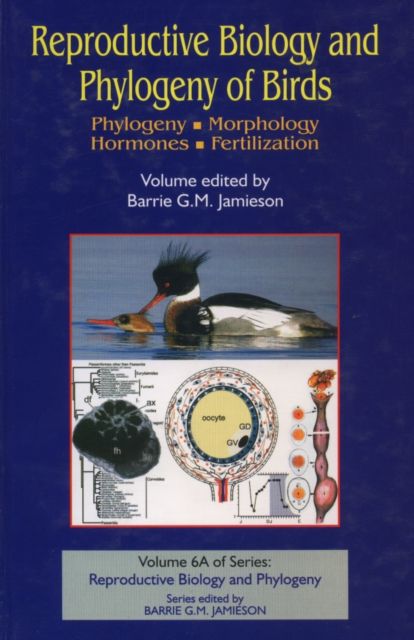
Reproductive biology and phylogeny of birds
Aspects of reproduction covered in this volume include classification and phylogeny as revealed by molecular biology; anatomy of the male reproductive tract and organs; anatomy and evolution of copulatory structures; development and anatomy of the female reproductive tract; endocrinology of reproduction; ovarian dynamics and follicle development; spermatogenesis and testicular cycles; avian spermatozoa: structure and phylogeny; testis size, sperm size and sperm competition and lastly, fertilization.
eBook

Winged Sentinels
'The ability of the birds to show us the consequences of our own actions is among their most important and least appreciated attributes. Despite the free advice of the birds, we do not pay attention', said Marjory Stoneman Douglas in 1947. From ice-dependent penguins of Antarctica to songbirds that migrate across the Sahara, birds' responses provide early warning signs of the impact of climate change. Winged Sentinels: Birds and Climate Change uses colourful examples to show how particular groups of birds face heightened threats from climate change and to explore how we can help birds adapt in a warming world. Generously illustrated with colour photographs, the book is a fascinating insight into what climate change means for birds, and the potential consequences of ignoring these warning signs.
eBook

Assisted Reproduction Techniques to Improve Reproduction in a Non-Model Species: The Case of the Arabian Bustard (Ardeotis arabs) Conservation Breeding Program
Artificial reproductive technologies are highly valuable for ex situ conservation. While Arabian bustard populations are declining and extinct in some parts of the range, the International Fund for Houbara Conservation in the United Arab Emirates implemented a conservation breeding program. Since 2012, a total of 1253 eggs were laid through natural reproduction, 1090 were incubated and 379 of these were fertile (fertility rate of 34.8%), leading to the production of 251 chicks. To improve fertility and acquire crucial knowledge for other endangered large birds, artificial reproduction was implemented in 2018 using fresh, refrigerated, and frozen sperm. A total of 720 ejaculates were collected from 12 birds. We analysed these samples for concentration, volume, motility score (0 to 5), viability (eosin/nigrosine), length, and morphology. The first age at collection was 35.7 ± 18.8 months, mean volume was 89.2 ± 65.3 µL, mean concentration was 928 ± 731 sptz/mL and mean motility score was 2.61 ± 0.95. Morphology analyses revealed a bimodal distribution of sperm length. Five hundred and thirty-five ejaculates were cryopreserved and the initial motility score was 3.4 ± 0.7 and 2.0 ± 0.6 after thawing, while the percentage of normal and intact membrane sperm cells decreased from 88.8 ± 7.5% to 52.9 ± 1%. Sixty-five artificial inseminations were performed, leading to a global fertility rate of 84.3%—more precisely, 85.2% and 83.3%, respectively, for fresh and cryopreserved semen. All methods successfully produced fertile eggs, indicating that artificial insemination is an efficient tool for the conservation and genetic management of the species.
Journal Article
Changes in Sperm Morphology, Morphometry, and Motility from the Epididymis to the Vas Deferens in Rheas (Rhea americana, Linnaeus, 1758)
The objective was to characterize morphological, morphometric, and ultrastructural changes in rhea spermatozoa between the epididymis and the vas deferens. Sperm samples were collected from the reproductive tracts of seven adult individuals and evaluated for sperm characteristics using brightfield microscopy as well as ultrastructural features using scanning electron microscopy (SM). Mean sperm count tended to increase in the vas deferens (378.0 ± 135.0 × 10⁶) compared to the epididymis (201.0 ± 77.4 × 10⁶). Percentages of motile sperm grew from 37.0 ± 4.9% in the epididymis to 58.5 ± 7.7% in the vas deferens. The proportion of normal spermatozoa was 75.6 ± 1.8% and most common defects were bent tails (9.7 ± 0.9%). However, these proportions were not different between epididymis and vas deferens. SM analysis revealed further features of rhea spermatozoa. Normal rhea spermatozoa were threadlike with an acrosome (0.95 ± 0.0 µm), head (7.53 ± 0.01 µm), midpiece (2.08 ± 0.01 µm), and tail (30.7 ± 0.06 µm). Lengths of sperm acrosome, head, midpiece, and tail were longer in the vas deferens compared to the epididymis. Our findings suggest that rhea spermatozoa undergo a maturation process during the passage from the epididymis to the vas deferens.
Journal Article

Morphological aspects of epididymal microscopy and rete testis in greater Rhea Americana
The purpose of this research was to study the histology and describe the microscopy findings of the epididymis epithelium of greater Rhea americana at three time periods: November 2005 (n=14), December 2006 (n= 20), and May 2007 (n= 20), to observe and compare the differences that occurred. We studied the epididymis from 54 rheas, bred in Santa Maria, Rio Grande do Sul, Brazil. The epididymis were collected during commercial slaughter and fixed in bouin. Optical microscopy was used to measure the cellular structure, types of cells, tubules, and stereological values like the epididymis epithelium diameters, lumen, thickness, and relative volume of the tissue structure. Additionally, electron microscopy was studied. In December 2006 and May 2007, the means of the epididymis tubular diameter were: 79.1 and 58.1 µm, epithelium thickness: 24.0 and 52.2 µm, and lumen diameter: 55.0 and 5.8 µm, respectively. Regarding the volumetric proportion, we reported the following values: epithelium volume 36.2 and 80.4%, lumen without spermatozoon 19.6 and 3.0%, lumen with spermatozoon 5.4 and 0.0%, interstitium 35.4 and 12.0%, blood vessels 3.5 and 4.6%, structures in cellular superficies 1.4 and 0%, lamina 1.4 and 3.2%, and artifacts 0.3 and 1.3%, respectively. The epididymis ducts had a circular form in transverse sections with spermatozoon only in November 2005 and December 2006. The Rhea’s epididymis morphology was found to be similar to ostriches, roosters, and Japanese quail. Here, we present data from stereological microscopy (tubular diameter, epithelium thickness, and lumen diameter), volumetric proportion (epithelium, lumen without spermatozoon, lumen with spermatozoon, interstitium, blood vessels, structures in cellular superficies; cilium, estereocilium, and lamina) in this species during the repose and sexual activity period (reproductive season). RESUMO: O objetivo desta pesquisa foi estudar a histologia e descrever os achados microscópicos do epitélio epidídimo de ema em três períodos: novembro/2005 (n = 14), dezembro/2006 (n = 20) e maio/2007 (n = 20), para observação e comparação das diferenças que ocorreram nesses tempos distintos. Estudamos o epidídimo de 54 animais, criados em Santa Maria, RS. Durante o abate comercial, os epidídimos foram coletados e fixados em Bouin. A microscopia óptica mede a estrutura celular, tipos de células, túbulos e valores estereológicos, como os diâmetros do epitélio do epidídimo, lúmen, espessura, volume relativo da estrutura do tecido. Em dezembro/2006 e maio/2007, as médias do diâmetro tubular do epidídimo foram: 79,1 e 58,1µm, espessura do epitélio: 24,0 e 52,2µm, diâmetro do lúmen: 55,0 e 5,8µm, respectivamente. Em relação à proporção volumétrica, encontramos os seguintes valores: volume epitelial 36,2 e 80,4%, lúmen sem espermatozoide 19,6 e 3,0%, lúmen com espermatozoide 5,4 e 0,0%, intestínio 35,4 e 12,0%, vasos sanguíneos 3,5 e 4,6%, estruturas celulares superfícies 1,4 e 0%, lâmina 1,4 e 3,2%, artefatos 0,3 e 1,3%, respectivamente. Os ductos do epidídimo apresentaram forma circular em cortes transversais com espermatozoide apenas em novembro/2005 e dezembro/2006. A morfologia do epidídimo de Rhea foi semelhante ao avestruz, galo e codornas japonesas. Apresentamos dados de microscopia estereológica (diâmetro tubular, espessura do epitélio, diâmetro do lúmen), proporção volumétrica, em porcentagem (epitélio, lúmen sem espermatozóide, lúmen com espermatozoide, intestório, vasos sanguíneos, estruturas em superfícies celulares - cílio - estereocílio, lâmina e artefatos) nesta espécie nos períodos de repouso e atividade sexual (estação reprodutiva).
Journal Article

Living fences decrease the edge effect on nest predation in a tropical dry forest landscape: evidence from an experiment using artificial nests
Agricultural expansion has contributed to the loss and fragmentation of natural habitats and, as a consequence, the edge effect in these habitats has increased, leading to nest predation rates higher at the edge of fragments than in the interior. Living fences in abandoned croplands, however, add a structural component to the landscape which can help to mitigate the effects of disturbance. We used artificial nests to assess whether a living fence at the edge of a fragment of tropical dry forest, immersed in an agricultural landscape, can assuage the edge effect by decreasing predation rates. We identified the predators that attacked nests at several distances from the living fence and related the frequency of predator attacks with plant height, leaf height diversity, and tree and herb coverage. Vegetation structure of the living fence was vertically more complex than that found inside the fragment. 52% of nests were predated and we did not find a significant relationship between predation rates and the proximity of nests to the living fence, suggesting a null edge effect on predation. Birds were the most frequent predators, followed by rodents and carnivorous mammals, with the composition of predators varying among transects. The composition of predators and vegetation structure of the living fence were the factors that explained the null edge effect on nests predation. Our results indicate that the presence of a living fence at the edge of a fragment in agroforestry systems could mitigate the edge effects on nest predation.
Journal Article