
Catalogue Search | MBRL


Are you sure you want to remove the book from the shelf?

{{itemTitle}}
1,023
result(s) for
"Blanchot, Maurice"
Sort by:

Clandestine encounters : philosophy in the narratives of Maurice Blanchot
\"Blanchot's narratives are here read with the care, patience, and thoroughness they deserve. The collection sustains a remarkable intensity of engagement throughout in so doing opening these narratives out to their necessary context--philosophical, of course; but also literary, political, theological, and biographical--with welcome dedication and integrity.\"--Martin Crowley, Queens' College, University of Cambridge\" \"\"This outstanding collection--lucid, engaging, generous--illuminates Blanchot and the very notion of t̀he philosophical.\"--Gerald Prince, University of Pennsylvania\" \"\"This collection contains some very important pieces on a major figure of twentieth-century modernism. Blanchot now has a much wider audience in North American than he did even a few years ago, when it was mostly experimental fiction writers like Paul Auster, Lydia Davis, R. M. Berry, and Steve Tomasula--not literary critics--who took an interest in Blanchot's literary writings. The focus on the ǹarratives' (or, better, f̀ictions') sets this volume apart from, and makes it a good deal more stimulating than, other recent collections of essays on Blanchot.\"--Gerald Bruns, University of Notre Dame\"--BOOK JACKET.
BOOK

WOUNDED THINKING OF THE WOUNDED WORLD NIHILISM AND GLOBAL WARMING
According to Copernicus Climate Change Service, June 2024 is the 12th consecutive month where global temperatures have reached 1.5 °C above pre-industrial averages. For us, the problem is much bigger, not the exhaustion of sense, but the concrete tendency of exhaustion of both human and nonhuman life. [...]the sense of human life is now a lesser problem, while the greater problem resides in the relation of human life to the totality of nonhuman life, upon which it depends. Disaster Is the deterioration of the conditions of all life a nihilistic event? The hypothesis I develop here (and in a forthcoming book) is that, instead of explaining it in habitual terms of catastrophe, it needs to be rethought as an unprecedented disaster, of which we have an equally unprecedented impersonal experience.
Journal Article


Radical Indecision
In his newest book, Radical Indecision , esteemed
scholar Leslie Hill poses the following question: If the task of a
literary critic is to make decisions about the value of a literary
work or the values embodied in it, decisions in turn based on some
inherited or established values, what happens when that piece of
literature fails to subscribe to the established values? Put
another way, how should literary criticism respond to the paradox
that in order to make critical judgments of literary works, it is
first necessary to suspend judgment and to consider the
impossibility of making a final decision? Hill pursues these ideas
in the works of leading French critics Roland Barthes, Maurice
Blanchot, and Jacques Derrida, discussing writers such as Sade,
Mallarmé, Proust, Artaud, Genet, Celan, and Duras.
Hill concludes that, despite their differences, Barthes,
Blanchot, and Derrida share a conviction that criticism cannot take
place without exposure to that resistance to decision that is
inseparable from reading and that they address diversely as the
\"neuter\" or the \"undecidable.\" Radical Indecision offers
the first sustained exploration of the \"undecidable.\" This
comprehensive book breathes new life into the discipline of
literary theory and will be essential reading for students and
scholars alike.
eBook


The Imperative to Write: Destitutions of the Sublime in Kafka, Blanchot and Beckett
Is writing haunted by a categorical imperative? Does the Kantian sublime continue to shape the writer's vocation, even for twentieth-century authors? What precise shape, form, or figure does this residue of sublimity take in the fictions that follow from itand that leave it in ruins? This book explores these questions through readings of three authors who bear witness to an ambiguous exigency: writing as a demanding and exclusive task, at odds with life, but also a mere compulsion, a drive without end or reason, even a kind of torture. If Kafka, Blanchot, and Beckett mimic a sublime vocation in their extreme devotion to writing, they do so in full awareness that the trajectory it dictates leads not to metaphysical redemption but rather downward, into the uncanny element of fiction. As this book argues, the sublime has always been a deeply melancholy affair, even in its classical Kantian form, but it is in the attenuated speech of narrative voices progressively stripped of their resources and rewards that the true nature of this melancholy is revealed.
eBook


A.I. Artificial Intelligence (2001) as the Spiritual Swan Song of Stanley Kubrick
This article proposes a reading of A.I. Artificial Intelligence (2001) as the spiritual swan song of Stanley Kubrick, even though it was completed posthumously by Steven Spielberg. Conceived and developed by Kubrick from the 1970s until the late 1990s, the film emerges as a profound meditation on life, death, and the persistence of memory—one that continues to resonate through another author’s hand. It stands as a singular case of authorial transmission, where Spielberg’s intervention operates less as completion than as curatorship: the act of listening to, translating, and preserving a vision projected beyond its creator’s lifetime. Beyond its production history, which includes Kubrick’s long collaboration with writer Ian Watson, the early story treatments, and Spielberg’s eventual reinterpretation of Kubrick’s design materials and narrative architecture, this essay advances a philosophical reflection on A.I. as a mediated testamentary work. Drawing on the thoughts of Paul Ricoeur, Jacques Derrida, and Maurice Blanchot, it examines how questions of authorship, memory, and narrative closure intersect with the film’s ontological and affective dimensions. Through these lenses, A.I. reveals itself as both an allegory of survival and a reflection on artistic legacy—suggesting that a swan song may endure beyond its maker, preserved through the curatorship and imagination of another.
Journal Article
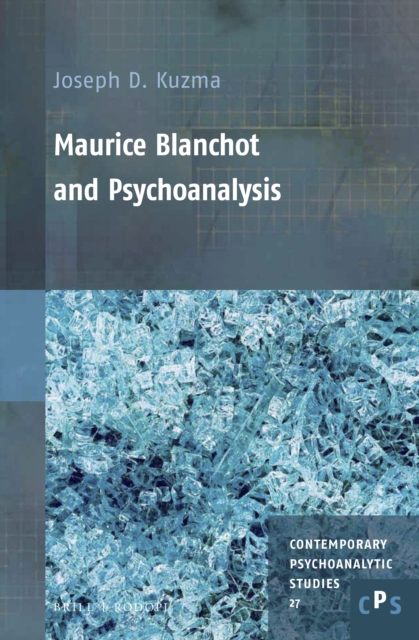
Maurice Blanchot and Psychoanalysis
This work explores the status of psychoanalysis in Blanchot's texts, from the early 1950s onward, elucidating the political and philosophical dimensions of Blanchot's writings on madness, narcissism, and trauma.
eBook

The Eye and the Flesh: Céline, Bataille, and the Fascination with Death
This paper argues that Louis-Ferdinand Céline and Georges Bataille use voyeurism as a transgressive mechanism to confront death through the female body, a paradoxical site of life and decay. Though Céline’s clinical, disenchanted gaze contrasts with Bataille’s erotic, metaphysical quest, both employ the act of seeing to reveal death’s presence within vitality. In Céline’s works, voyeurism shifts from erotic curiosity to cold observation, framing the female body as a sterile emblem of mortality. In Bataille’s, it becomes participatory, merging ecstasy with dissolution in a sacred yet destructive form. Drawing on Freud and Sodom motifs, this study shows how their gazes transform the female body into a lens for existential finitude, challenging life–death boundaries in 20th-century French literature.
Journal Article