
Catalogue Search | MBRL


Are you sure you want to remove the book from the shelf?

{{itemTitle}}
39
result(s) for
"Blanchot, Maurice -- Criticism and interpretation"
Sort by:

Clandestine encounters : philosophy in the narratives of Maurice Blanchot
\"Blanchot's narratives are here read with the care, patience, and thoroughness they deserve. The collection sustains a remarkable intensity of engagement throughout in so doing opening these narratives out to their necessary context--philosophical, of course; but also literary, political, theological, and biographical--with welcome dedication and integrity.\"--Martin Crowley, Queens' College, University of Cambridge\" \"\"This outstanding collection--lucid, engaging, generous--illuminates Blanchot and the very notion of t̀he philosophical.\"--Gerald Prince, University of Pennsylvania\" \"\"This collection contains some very important pieces on a major figure of twentieth-century modernism. Blanchot now has a much wider audience in North American than he did even a few years ago, when it was mostly experimental fiction writers like Paul Auster, Lydia Davis, R. M. Berry, and Steve Tomasula--not literary critics--who took an interest in Blanchot's literary writings. The focus on the ǹarratives' (or, better, f̀ictions') sets this volume apart from, and makes it a good deal more stimulating than, other recent collections of essays on Blanchot.\"--Gerald Bruns, University of Notre Dame\"--BOOK JACKET.
BOOK

Radical Indecision
In his newest book, Radical Indecision , esteemed
scholar Leslie Hill poses the following question: If the task of a
literary critic is to make decisions about the value of a literary
work or the values embodied in it, decisions in turn based on some
inherited or established values, what happens when that piece of
literature fails to subscribe to the established values? Put
another way, how should literary criticism respond to the paradox
that in order to make critical judgments of literary works, it is
first necessary to suspend judgment and to consider the
impossibility of making a final decision? Hill pursues these ideas
in the works of leading French critics Roland Barthes, Maurice
Blanchot, and Jacques Derrida, discussing writers such as Sade,
Mallarmé, Proust, Artaud, Genet, Celan, and Duras.
Hill concludes that, despite their differences, Barthes,
Blanchot, and Derrida share a conviction that criticism cannot take
place without exposure to that resistance to decision that is
inseparable from reading and that they address diversely as the
\"neuter\" or the \"undecidable.\" Radical Indecision offers
the first sustained exploration of the \"undecidable.\" This
comprehensive book breathes new life into the discipline of
literary theory and will be essential reading for students and
scholars alike.
eBook


The Imperative to Write: Destitutions of the Sublime in Kafka, Blanchot and Beckett
Is writing haunted by a categorical imperative? Does the Kantian sublime continue to shape the writer's vocation, even for twentieth-century authors? What precise shape, form, or figure does this residue of sublimity take in the fictions that follow from itand that leave it in ruins? This book explores these questions through readings of three authors who bear witness to an ambiguous exigency: writing as a demanding and exclusive task, at odds with life, but also a mere compulsion, a drive without end or reason, even a kind of torture. If Kafka, Blanchot, and Beckett mimic a sublime vocation in their extreme devotion to writing, they do so in full awareness that the trajectory it dictates leads not to metaphysical redemption but rather downward, into the uncanny element of fiction. As this book argues, the sublime has always been a deeply melancholy affair, even in its classical Kantian form, but it is in the attenuated speech of narrative voices progressively stripped of their resources and rewards that the true nature of this melancholy is revealed.
eBook


Ending and Unending Agony: On Maurice Blanchot
Published posthumously, Ending and Unending Agony is Philippe Lacoue-Labarthe's only book entirely devoted to the French writer and essayist Maurice Blanchot (1907-2003). The place of Blanchot in Lacoue-Labarthe's thought was both discreet and profound, involving difficult, agonizing questions about the status of literature, with vast political and ethical stakes. Together with Plato, Holderlin, Nietzsche, Benjamin, and Heidegger, Blanchot represents a decisive crossroads for Lacoue-Labarthe's central concerns. In this book, they converge on the question of literature, and in particular of literature as the question of myth--in this instance, the myth of the writer born of the autobiographical experience of death. However, the issues at stake in this encounter are not merely autobiographical; they entail a relentless struggle with processes of figuration and mythicization inherited from the age-old concept of mimesis that permeates Western literature and culture. As this volume demonstrates, the originality of Blanchot's thought lies in its problematic but obstinate deconstruction of precisely such processes. In addition to offering unique, challenging readings of Blanchot's writings, setting them among those of Montaigne, Rousseau, Freud, Winnicott, Artaud, Bataille, Lacan, Malraux, Leclaire, Derrida, and others, this book offers fresh insights into two crucial twentieth-century thinkers and a new perspective on contemporary debates in European thought, criticism, and aesthetics.
eBook

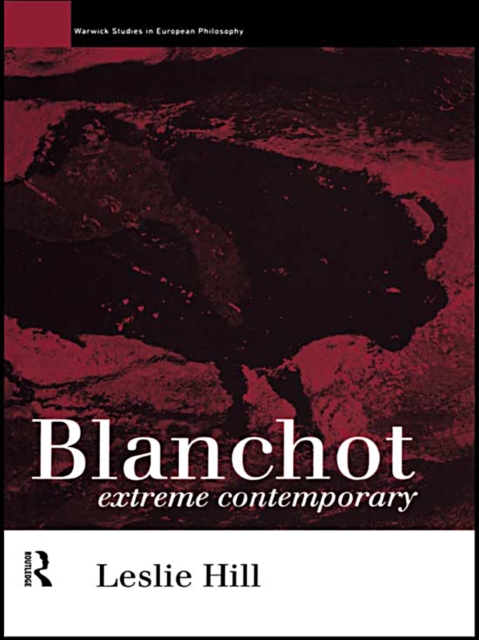
Blanchot
Blanchot provides a compelling insight into one of the key figures in the development of postmodern thought. Although Blanchot's work is characterised by a fragmentary and complex style, Leslie Hill introduces clearly and accessibly the key themes in his work. He shows how Blanchot questions the very existence of philosophy and literature and how we may distinguish between them, stresses the importance of his political writings and the relationship between writing and history that characterised Blanchot's later work; and considers the relationship between Blanchot and key figures such as Emmanuel Levinas and Georges Bataille and how this impacted on his work. Placing Blanchot at the centre stage of writing in the twentieth century, Blanchot also sheds new light on Blanchot's political activities before and after the Second World War. This accessible introduction to Blanchot's thought also includes one of the most comprehensive bibliographies of his writings of the last twenty years.
eBook

Maurice Blanchot and the Literature of Transgression
In this book, the first in English devoted exclusively to Maurice Blanchot, John Gregg examines the problematic interaction between the two forms of discourse, critical and fictional, that comprise this writer's hybrid oeuvre. The result is a lucid introduction to the thought of one of the most important figures on the French intellectual scene of the past half-century.
Gregg organizes his discussion around the notion of transgression, which Blanchot himself took over from Georges Bataille--most palpably in his interpretation of the myth of Orpheus--as a paradigm capable of accounting for the relationships that exist in the textual economies formed by author, work, and reader. Chapters on the critical work address such issues as Blanchot's ambivalent attitude toward the speculative dialectic of Hegelianism, his thematization of literature's involvement with death, and the mythical and Biblical figures he uses to portray the acts of reading and writing. Gregg also performs extended close readings of two representative works of fiction,Le Très-HautandL'Attente l'oubli,in an effort to trace Blanchot's evolution as a creator of narratives and to ascertain how his fiction can be seen as constitutinga mise en oeuvreof the concerns he treats in his criticism. The book concludes with an assessment of Blanchot's place in the recent history of French critical theory.
eBook
The Imperative to Write
Is writing haunted by a categorical imperative? Does the Kantian sublime continue to shape the writer's vocation, even for twentieth-century authors? What precise shape, form, or figure does this residue of sublimity take in the fictions that follow from it-and that leave it in ruins? This book explores these questions through readings of three authors who bear witness to an ambiguous exigency: writing as a demanding and exclusive task, at odds with life, but also a mere compulsion, a drive without end or reason, even a kind of torture. If Kafka, Blanchot, and Beckett mimic a sublime vocation in their extreme devotion to writing, they do so in full awareness that the trajectory it dictates leads not to metaphysical redemption but rather downward, into the uncanny element of fiction. As this book argues, the sublime has always been a deeply melancholy affair, even in its classical Kantian form, but it is in the attenuated speech of narrative voices progressively stripped of their resources and rewards that the true nature of this melancholy is revealed.
eBook