
Catalogue Search | MBRL


Are you sure you want to remove the book from the shelf?

{{itemTitle}}
366
result(s) for
"Blank verse"
Sort by:
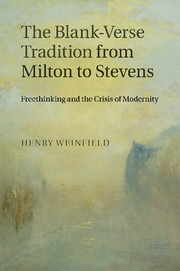
The Blank-Verse Tradition from Milton to Stevens
Blank verse, unrhymed iambic pentameter, has been central to English poetry since the Renaissance. It is the basic vehicle of Shakespeare's plays and the form in which Milton chose to write Paradise Lost. Milton associated it with freedom, and the Romantics, connecting it in turn with freethinking, used it to explore change and confront modernity, sometimes in unexpectedly radical ways. Henry Weinfield's detailed readings of the masterpieces of English blank verse focus on Milton, Wordsworth, Shelley, Keats, Tennyson and Stevens. He traces the philosophical and psychological struggles underlying these poets' choice of form and genre, and the extent to which their work is marked, consciously or not, by the influence of other poets. Unusually attuned to echoes between poems, this study sheds new light on how important poetic texts, most of which are central to the literary canon, unfold as works of art.
eBook

Freiheit in Maßen
Der Blankvers als ›ungebundener‹ Vers ist seit seiner Entstehung in der Renaissance Objekt lebhafter Diskussionen um die Freiheit der Dichtung. Grundlage dieser Diskussionen ist der Reim, dessen Fehlen neue Möglichkeiten der Darstellung eröffnet. Gegen die Fesseln des Reims wird der Blankvers im 18. Jahrhundert zunehmend zu einer Freiheitsform stilisiert, so die These des Artikels. Der Beitrag stellt die europaweiten Diskurse um den tragischen Blankvers bis 1800 ins Zentrum seiner Betrachtung. Er untersucht, welche poetologischen Potenziale der Form zugeschrieben und welche historischen und politischen Vorstellungen mit dem reimlosen Vers verknüpft werden.
Journal Article

DOWN IN POMPEII: A SEXUAL GRAFFITO IN VERSE (CIL 4.9123)
This article revisits a famous graffiti poem from Pompeii (CIL 4.9123). It argues that the poem is both more erotically charged and more cleverly metaliterary than previously recognized; and that this reading of the poem offers new evidence for the literary richness of Pompeii's graffiti culture.
Journal Article


Fascinating Rhythm
This essay focuses on one of the lesser blank-verse meditations in the Lyrical Ballads, “Lines Left Upon a Seat in a Yew-Tree,” to argue that the poem’s thematization of barrenness allegorizes blank verse as the supreme—because barely-there—poetic form. The achievement of blank verse is its conversion of meter into a “virtual” property, a point elaborated with reference to contemporary media theory as well as eighteenth-century poetics. In readings of Coleridge’s “Frost at Midnight” and Wordsworth’s “Boy of Winander,” the essay concludes that blank verse is “heard,” paradoxically, in the pauses of deep silence that momentarily interrupt what Eve Kosofsky Sedgwick calls the “hammering iteration of rhythm.”
Journal Article

Claudel—Dante 1921
This paper deals with Claudel’s Jubilee Ode, which he wrote on the occasion of the six-hundredth anniversary of Dante’s death. The Ode first appeared in a booklet published by the Roman Catholic Committee, Bulletin du Jubilé, as mentioned in Revue de littérature comparée, 1921. The poem, written in blank verse and full of Dante’s reminiscences, is reflected in an explanatory prose text—thus not unlike Vita Nova. It mainly consists of a twofold prosopopoeia, Dante’s first, followed by Beatrice’s, about exile, love, and joy, suggesting a parallel with The Satin Slipper. As a matter of fact, we now understand (thanks to the recent publication of Lettres à Ysé) how deeply autobiographical this Ode is. Substitution rather than celebration and comparison?
Journal Article

Preserving Meaning or Form: The Dilemma of Translating Blank Verse in Hamlet Into Indonesian
The research aims to analyze the structure of the lines of verse in \"Hamlet\", examines the translation techniques employed, and understands their impact. This study adopts a descriptive qualitative approach with case studies on translation products. It used purposive sampling to select documents, specifically the original verses from \"Hamlet\" and their Indonesian translations. It gathered insights from informants, including a literary expert, a translation expert, and raters. The research involved two types of data: linguistic data, which consists of the lines of verse in \"Hamlet,\" and translation data, which included the translation techniques and the shifts observed in the translated text. Data collection methods included document analysis and focus group discussions, analyzed through an ethnographic model using domain, taxonomy, and component analysis to identify cultural themes. The findings show that \"Hamlet's\" verse contains both regular lines with five metrical foot and irregular lines that deviate from this pattern. Seventeen translation techniques are identified: paraphrase, established equivalent, transposition, modulation, reduction, variation, explicitation, compensation, implication, pure borrowing, particularization, addition, generalization, discursive creation, adaptation, literal translation, and linguistic amplification. These techniques result in translation shifts at both micro and macro levels. The study underscores the complexities of translating literary works, especially in preserving the original poetic form and meaning. Future research could compare the translation of the same literary work into various target languages, offering insights into how different translators handle similar challenges across diverse linguistic and cultural contexts and the techniques they use to achieve equivalence.
Journal Article


Conveying the symbols of Lyuba Yakimchuk’s poetry, ‘Apricots of Donbas’, in English translation
Background. Although the translation of modern Ukrainian poetry has been widely studied, the specific challenge of conveying symbols in Lyuba Yakimchuk’s expressionistic poems has yet to be explored.Contribution to the research field. The present study raises intriguing questions about the possibility of translating symbols in poetry, especially those deeply culturally rooted.Purpose. To analyse how the author uses various symbols in her poetry, decipher their meaning and compare them with how they have been conveyed in English with some conclusions about the equivalency of the chosen options.Methods. This research applies descriptive-analytical and comparative methods, with original Ukrainian poems selected using a sampling technique.Results. The poems in Lyuba Yakimchuk’s collection “Apricots of Donbas” are written in blank verse. However, this fact does not solve the problem of conveying the form and meaning in the English translation since symbolism in her works is sometimes expressed through graphic means, such as split words and lines or phonological means (e.g., alliteration). The main peculiarity is the contextual nature of symbols, as some are related to a particular place (the author’s hometown, Pervomaisk of Luhansk Oblast) or the tragic historical events that began in the east of Ukraine in 2014. All these peculiarities make conveying such symbols in English quite challenging and allow us to conclude about partial untranslatability in some cases.Discussion. This research has shown that poems in the collection “Apricots of Donbas” by Lyuba Yakimchuk are full of vivid and memorable symbols representing her hometown Pervomaisk and her native Luhansk Oblast (apricots, coal mines, earth, water, terricones, ashtray), war (caterpillar, Yum), family and relations with them (blood, phone, cup), and symbolic colours (black, red, white). Though many symbols used in the poems are deeply related to a specific cultural and historical context, the translators mostly managed to convey their meaning in English by using such translation strategies as domestication and foreignization. Symbols tied to the phonological and morphological features of the Ukrainian language presented significant challenges, resulting in a partial loss of semantic load.Future research will explore how symbols in contemporary Ukrainian poetry written after February 24, 2022, reflect the current events in Ukraine.
Journal Article

A Plethora of Bashvilles: Shaw's “Masterpiece” and the Musicals It Spawned
Shaw's 1901 play The Admirable Bashville, itself an adaptation of his novel Cashel Byron's Profession, has twice been adapted for the professional musical stage. In the first of these adaptations, the 1983 Bashville, Shaw's play was left largely untouched in favor of an outwardly reverential adaptation that inserted songs at various points in the original text and expanded its nonspeaking cast to allow for large-scale musical ensembles. In contrast, the 1995 Bashville in Love was a much smaller-scale work that took considerable liberties with its source material. This article analyzes the textual changes and musical treatments in both works and concludes that the latter adaptation, in spite of its numerous departures from Shaw's play, is in fact the more Shavian of the two musicals.
Journal Article