
Catalogue Search | MBRL


Are you sure you want to remove the book from the shelf?

{{itemTitle}}
39
result(s) for
"Boccaccio, Giovanni, 1313-1375 -- Criticism and interpretation"
Sort by:


Boccaccio's Fabliaux
Short works known for their humor and ribaldry, the fabliaux were comic or satirical tales told by wandering minstrels in medieval France. Although the fabliaux are widely acknowledged as inspiring Giovanni Boccaccio's masterpiece, theDecameron, this theory has never been substantiated beyond perceived commonalities in length and theme. This new and provocative interpretation examines the formal similarities between theDecameron's tales of wit, wisdom, and practical jokes and the popular thirteenth-century fabliaux.
Katherine Brown examines these works through a prism of reversal and chiasmus to show that Boccaccio was not only inspired by the content of the fabliaux but also by their fundamental design--where a passage of truth could be read as a lie or a tale of life as a tale of death. Brown reveals close resemblances in rhetoric, literary models, and narrative structure to demonstrate how the Old French manuscripts of the fabliaux were adapted in the organization of theDecameron.
Identifying specific examples of fabliaux transformed by Boccaccio for his classicDecameron, Brown shows how Boccaccio refashioned borrowed literary themes and devices, playing with endless possibilities of literary creation through manipulations of his model texts.
eBook


Building a Monument to Dante
Building a Monument to Danteemploys literary analysis coupled with philological and historical evidence to argue that Boccaccio's multifaceted work as Dante's editor, biographer, apologist, and commentator created a literary figure that could support Boccaccio's poetic and political ideologies.
eBook

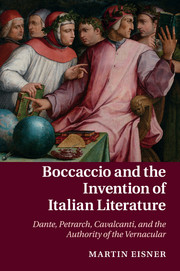
Boccaccio and the Invention of Italian Literature
Giovanni Boccaccio played a pivotal role in the extraordinary emergence of the Italian literary tradition in the fourteenth century, not only as author of the Decameron, but also as scribe of Dante, Petrarch and Cavalcanti. Using a single codex written entirely in Boccaccio's hand, Martin Eisner brings together material philology and literary history to reveal the multiple ways Boccaccio authorizes this vernacular literary tradition. Each chapter offers a novel interpretation of Boccaccio as a biographer, storyteller, editor and scribe, who constructs arguments, composes narratives, compiles texts and manipulates material forms to legitimize and advance a vernacular literary canon. Situating these philological activities in the context of Boccaccio's broader reflections on poetry in the Decameron and the Genealogy of the Gentile Gods, the book produces a new portrait of Boccaccio that integrates his vernacular and Latin works, while also providing a new context for understanding his fictions.
eBook


Boccaccio's Naked Muse
Venturing outside the Decameron to the Latin works, and outside the usual textual and intertextual readings of Boccaccio to more broadly cultural and anthropological material,Boccaccio's Naked Museoffers fresh insights on this hugely significant literary figure.
eBook

The Cambridge Companion to Boccaccio
\"Incorporating the most recent research by scholars in Italy, the UK and North America, this collection of essays foregrounds Boccaccio's significance as a pre-eminent scholar and mediator of the classical and vernacular traditions, whose innovative textual practices confirm him as a figure of equal standing to Petrarch and Dante. Situating Boccaccio and his works in their cultural contexts, the Companion introduces a wide range of his texts, paying close attention to his formal innovations, elaborate voicing strategies, and the tensions deriving from his position as a medieval author who places women at the centre of his work. Four chapters are dedicated to different aspects of his masterpiece, the Decameron, while particular attention is paid to the material forms of his works: from his own textual strategies as the shaper of (his own and others') literary legacies, to his subsequent editorial history, and translation into other languages and media\"-- Provided by publisher.
BOOK

The Decameron Sixth Day in Perspective
The Sixth Day of Giovanni Boccaccio’s Decameron marks a new beginning. Its first story is the structural centre of the one hundred tales and signals the start of the day’s reflection on the power of the word as the fundamental building block of human communication. This collection gathers together readings of each of the ten stories in Day Six of the Decameron – the shortest of the entire work. Featuring a diverse group of literary scholars whose expertise is not limited to Boccaccio studies, the collection offers both comprehensive accounts of the tales and new interpretations of their significance. A major contribution to the study of the Decameron , it will also serve as an excellent starting point for new readers of Boccaccio’s masterpiece.
The readings demonstrate how Boccaccio engaged in rethinking or elaborating on the heritage of Western literature and thought, including the Bible; the works of Dante; the Roman literary, rhetorical, and legal tradition; the writings of the Church Fathers; and the ideas of scholastic theologians. These lecturae employ a range of methodologies that account for both historical and theoretical issues in their engagement with Boccaccio's poetic and ethical project in the Decameron .
eBook