
Catalogue Search | MBRL


Are you sure you want to remove the book from the shelf?

{{itemTitle}}
227
result(s) for
"Bomber Command"
Sort by:

Four who dared : inspiring stories of Canadian airmen in the Second World War
\"The sacrifice of Canadian soldiers in the Second World War was staggering. Over the course of the conflict, more than one million Canadians served in the Canadian Army, the Royal Canadian Navy, the Royal Canadian Airforce, and in forces across the British Commonwealth, including the Royal Airforce. More than 44,000 Canadians were killed in the war, and more than 54,000 were left wounded. In Four Who Dared, author and historian Ken Cothliff lifts four Canadian volunteer pilots out of obscurity, highlighting their personal stories and acts of heroism. The four pilots in this book were unknown to each other, but they are forever united in their quest to serve their country and its allies in an unprecedented hour of need. Reg Lane joined British Bomber Command relatively early in the War, rising from NCO pilot to become a Master Bomber with the elite Pathfinder Force. Jim Moffat ended his flying combat career after twelve operations, becoming a Resistance fighter on the European mainland. Steve Puskas's comprehensive diaries and unpublished writings provide extraordinary insight into his training as part of the British Commonwealth Air Training Plan, an experience familiar to many Commonwealth and British aircrew. Bill Gracie, a Scot who had immigrated to Canada as a boy, was keen to take up the fight when the war began, with the sole aim of becoming aircrew. Sadly, he was one of the over ten thousand Canadian Bomber Command aircrew who never returned home. Equal parts riveting and humbling, Four Who Dared is a must-read for anyone interested in delving into the lives and sacrifices of our unsung Canadian heroes.\"-- Provided by publisher.
Book

Crossing the Red Line?
On 21/22 January 1944, RAF Bomber Command conducted an area-bombing attack on the city of Magdeburg. The outcome was hardly pleasing, marked by high losses and inaccurate bombing. However, most notable was the rancorous aftermath, in which a full-blown row would erupt between the Air Ministry and Bomber Command Headquarters. This stemmed from the Air Staff perceiving that Sir Arthur Harris had 'crossed a red line' in his non-cooperation with their bombing policy. But the truth was much less clear-cut, as this article will show. Nonetheless, the Magdeburg operation led to a new Directive on 28 January 1944, which would force Harris's cooperation in a combined Anglo-American assault against the German aircraft industry.
Journal Article


Strategy in the Missile Age
Strategy in the Missile Age first reviews the development of modern military strategy to World War II, giving the reader a reference point for the radical rethinking that follows, as Dr. Brodie considers the problems of the Strategic Air Command, of civil defense, of limited war, of counterforce or pre-emptive strategies, of city-busting, of missile bases in Europe, and so on. The book, unlike so many on modern military affairs, does not present a program or defend a policy, nor is it a brief for any one of the armed services. It is a balanced analysis of the requirements of strength for the 1960's, including especially the military posture necessary to prevent war. A unique feature is the discussion of the problem of the cost of preparedness in relation to the requirements of the national economy, so often neglected by other military thinkers. Originally published in 1959. The Princeton Legacy Library uses the latest print-on-demand technology to again make available previously out-of-print books from the distinguished backlist of Princeton University Press. These editions preserve the original texts of these important books while presenting them in durable paperback and hardcover editions. The goal of the Princeton Legacy Library is to vastly increase access to the rich scholarly heritage found in the thousands of books published by Princeton University Press since its founding in 1905.
eBook

Bomber Command
Bomber Commands air offensive against the cities of Nazi Germany was one of the most epic campaigns of World War II. More than 56,000 British and Commonwealth aircrew and 600,000 Germans died in the course of the RAFs attempt to win the war by bombing. The struggle in the air began meekly in 1939 with only a few Whitleys, Hampdens, and Wellingtons flying blindly through the night on their ill-conceived bombing runs. It ended six years later with 1,600 Lancasters, Halifaxes, and Mosquitoes, equipped with the best of British wartime technology, blazing whole German cities in a single night. Bomber Command, through its fits and starts, grew into an effective fighting force. In Bomber Command, originally published to critical acclaim in the U.K., famed British military historian Sir Max Hastings offers a captivating analysis of the strategy and decision-making behind one of World War II's most violent episodes. With firsthand descriptions of the experiences of aircrew from 1939 to 1945 - based on one hundred interviews with veterans - and a harrowing narrative of the experiences of Germans on the ground during the September 1944 bombing of Darmstadt, Bomber Command is widely recognized as a classic account of one of the bloodiest campaigns in World War II history. Now back in print in the U.S., this book is an essential addition to any history readers bookshelf.
eBook
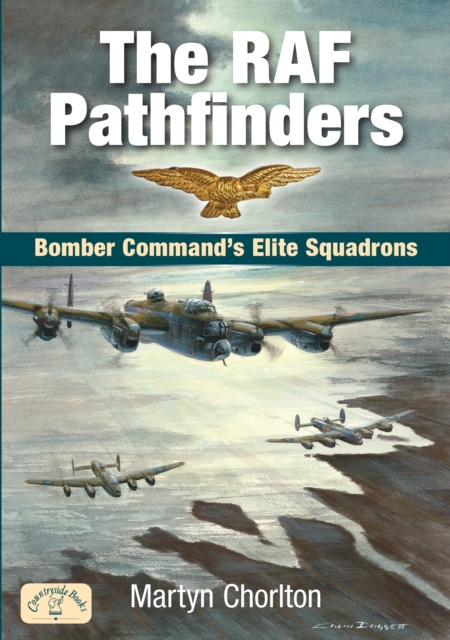
The RAF Pathfinders
The formation of the Pathfinder Force in August 1942 produced a steady but certain change in the fortunes of Bomber Command. During the early years of the war, aerial photographs showed that less than one third of the aircraft were successfully placing their bombs with accuracy. There was a basic lack of navigational skills, as well as what came to be known in the RAF as the will to 'Press On'. These shortcoming were addressed, and the special force of elite aircrew, the Pathfinder squadrons, whose purpose was to locate targets and mark them, proved indispensible to the success of the RAF's overall bombing campaign. Led by the inspirational and imaginative Don Bennett, Pathfinders were equipped with the best available aircraft, which included the famous Lancaster bomber and later, increasingly, the Mosquito. To join a Pathfinder squadron (all crewmen were volunteers) was a rare privilege but with it went a huge leap in the likelihood of being shot down. Pathfinder aircraft led the way for their following bomber force in hazardous raid after raid. They were highly vulnerable to the wall of flak thrown up by German city defenders, as well as to attacks by night-fighters; and it took a full 25 minutes to run the gauntlet of the Berlin defences from end to end at full stretch. By the end of the war, some 56,000 crewmen of Bomber Command had lost their lives. Martyn Chorlton has written a gripping account of the RAF's Pathfinder squadrons, recalling the often reckless heroism of the young aircrew and the challenges they faced in the smoke-filled skies over occupied Europe. His book also contains a moving foreword by Michael Wadsworth, chaplain to the Pathfinders Association.
eBook
The termination of the long immunity from air raids
Arthur Harris infamously pursued the Battle of Berlin in winter 1943/1944 in the face of an increasingly sceptical Air Staff and a disinterested prime minister. The irony was that originally the C-in-C Bomber Command was lukewarm about bombing Berlin. Instead, it was Churchill who continually pressed for attacking the German Capital under Operation Tannenberg, which went ahead in mid-January 1943, for wider political considerations, especially Anglo-Soviet relations. For the Air Staff and Harris, they endeavoured to use Churchill’s enthusiasm for bombing Berlin to further an agenda of increasing the qualitative and quantitative capabilities of Bomber Command.
Journal Article

Rhetoric and Reality in Air Warfare
A major revision of our understanding of long-range bombing, this book examines how Anglo-American ideas about \"strategic\" bombing were formed and implemented. It argues that ideas about bombing civilian targets rested on--and gained validity from--widespread but substantially erroneous assumptions about the nature of modern industrial societies and their vulnerability to aerial bombardment. These assumptions were derived from the social and political context of the day and were maintained largely through cognitive error and bias. Tami Davis Biddle explains how air theorists, and those influenced by them, came to believe that strategic bombing would be an especially effective coercive tool and how they responded when their assumptions were challenged. Biddle analyzes how a particular interpretation of the World War I experience, together with airmen's organizational interests, shaped interwar debates about strategic bombing and preserved conceptions of its potentially revolutionary character. This flawed interpretation as well as a failure to anticipate implementation problems were revealed as World War II commenced. By then, the British and Americans had invested heavily in strategic bombing. They saw little choice but to try to solve the problems in real time and make long-range bombing as effective as possible. Combining narrative with analysis, this book presents the first-ever comparative history of British and American strategic bombing from its origins through 1945. In examining the ideas and rhetoric on which strategic bombing depended, it offers critical insights into the validity and robustness of those ideas--not only as they applied to World War II but as they apply to contemporary warfare.
eBook
Operational Research and the British Bombing Offensive against Germany, 1941–1945
Operational research is a scientific discipline that appeared in Great Britain on the eve of the Second World War. Bomber Command's Operational research section began its studies in September 1941, using civilian scientists to analyse the bombing operations. Two potentially conflicting goals were pursued, one intended to maximize the offensive power against Germany, the other striving to minimize bomber losses. This article uses the Operational research performed during the conflict to illustrate the choices made by Bomber Command between those two possibilities, concluding on a clear priority in favour of the offensive.
Journal Article

The excavation of WWII RAF bomber, Halifax LV881-ZA-V
This article outlines the preliminary results of archaeological fieldwork at the crash site of RAF Halifax bomber LV881-ZA-V and explores some of the challenges presented by the excavation of this military wartime crash site. The aircraft and her crew were shot down by a German night fighter in the early hours of 31 March 1944 during the infamous Nuremberg Raid. Four of her crew were killed and the remaining three were taken prisoner and later took part in the 'Long March'. All three survived the war. An international team comprised of staff and students from Germany, the Netherlands, Finland and the UK explored what remained of the crash site, located on a hill outside the village of Steinheim, north east of Frankfurt in the German Federal State of Hesse.
Journal Article