
Catalogue Search | MBRL


Are you sure you want to remove the book from the shelf?

{{itemTitle}}
1,578
result(s) for
"Book burning."
Sort by:

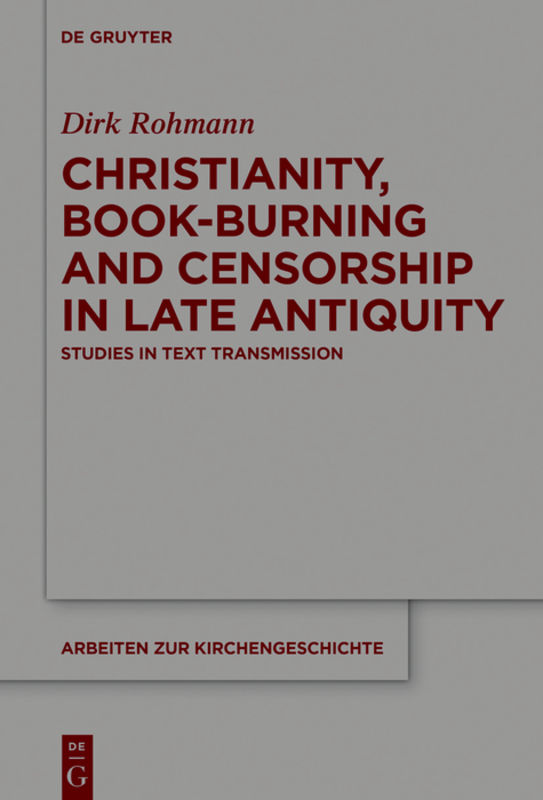
Christianity, Book-Burning and Censorship in Late Antiquity
It is estimated that only a small fraction, less than 1 per cent, of ancient literature has survived to the present day. The role of Christian authorities in the active suppression and destruction of books in Late Antiquity has received surprisingly little sustained consideration by academics. In an approach that presents evidence for the role played by Christian institutions, writers and saints, this book analyses a broad range of literary and legal sources, some of which have hitherto been little studied. Paying special attention to the problem of which genres and book types were likely to be targeted, the author argues that in addition to heretical, magical, astrological and anti-Christian books, other less obviously subversive categories of literature were also vulnerable to destruction, censorship or suppression through prohibition of the copying of manuscripts. These include texts from materialistic philosophical traditions, texts which were to become the basis for modern philosophy and science. This book examines how Christian authorities, theologians and ideologues suppressed ancient texts and associated ideas at a time of fundamental transformation in the late classical world.
eBook

Ray Bradbury's Fahrenheit 451 : the authorized adaptation
A retelling--in graphic novel format--of Bradbury's story about the dangers of censorship.
Book

Book-Burning and the Uses of Writing in Ancient Rome: Destructive Practice between Literature and Document
This article examines the burning of written material at Rome from the Republican period until the rise of Christianity, using the lens of book history. It considers why and how Romans burned written material, gathering for the first time all testimony of burning any kind of writing, and examines responses to these burnings in ancient discourse. A capacious, book-historical approach to Roman book-burning shows that differences in practice and uses — of books as opposed to documents, for example — account for the different consequences Romans saw for burning different written media.
Journal Article

Fahrenheit 451
In a society in which books are outlawed, Montag, a regimented fireman in charge of burning the forbidden volumes, meets a revolutionary school teacher who dares to read. Suddenly he finds himself a hunted fugitive, forced to choose not only between two women, but between personal safety and intellectual freedom.
Book


Fahrenheit 451
In a future totalitarian state where books are banned and destroyed by the government, Guy Montag, a fireman in charge of burning books, meets a revolutionary schoolteacher who dares to read and a girl who tells him of a past when people did not live in fear ... This sixtieth-anniversary edition commenmorates Ray Bradbury's masterpiece with a new introduction by Neil Gaiman ; personal essays on the genesis of the novel by the author; a weath of critical essays and reveiws by Nelson Algren, Harold Bloom, Margaret Atwood, and others; rare manuscript pages and sketches from Ray Bradbury's personal archive; and much more ... --- From back cover.
BOOK

Christianity, Book-Burning and Censorship in Late Antiquity. Studies in Text Transmission
The role of Christian institutions, writers and saints in the active suppression and destruction of books in Late Antiquity has received surprisingly little consideration. The author argues that texts and ideas from materialistic philosophical traditions were vulnerable to destruction, censorship or suppression through prohibition of the copying of manuscripts. This includes texts which were to become the basis for modern philosophy and science.
eBook


Why Did the Nazis Burn the Hebrew Bible? Nazi Germany, Representations of the Past, and the Holocaust
The Nazis did burn the Hebrew Bible, on Nov 9 and 10, 1938--not one copy, but thousands; not in one place, but in hundreds of communities across the Reich; and not only in metropolises such as Berlin, Stettin, Vienna, Dresden, Stuttgart, and Cologne, but also in small communities such as Sulzburg, a Protestant village in Baden with 1,070 inhabitants, 120 among them Jewish, where the stone tablets of the Ten Commandments were thrown from the roof and the Nazis marched mockingly up and down the main Street with the Torah scrolls before destroying them. By fire and other means, the destruction of the Book of Books was at the center of Kristallnacht, when 1,400 synagogues were set on fire. Destroying the Hebrew Bible in small communities was an open event that no one could ignore. Key players were often children, whose action is a sensitive barometer of adult perceptions. Confino discusses why the Nazis burnt the Hebrew Bible and looks at the Nazi Germany, representations of the past and the Holocaust.
Journal Article